How Shu Pu-erh Is Made: A Complete Guide to the Production Process
Shu Pu-erh is one of China's most distinctive teas, known for its deep color, smooth texture, and earthy character. But what makes it different from other teas is not simply the tea plant or the region where it grows. The defining feature of Shu Pu-erh is the production process used after the tea leaves are harvested.
How Shu Pu-erh is made is a question that leads into one of the most fascinating areas of Chinese tea production. Unlike green tea, which is usually made to preserve a fresh, vegetal character, Shu Pu-erh undergoes a carefully managed process that encourages microbial fermentation and transforms the tea over time.
In this guide, we will explain what Shu Pu-erh is, why its production method is important, and how the tea is made from fresh leaves into the dark, mellow tea many people enjoy today. We will also cover how production affects quality and what to look for when choosing authentic Shu Pu-erh.
What Is Shu Pu-erh?
Shu Pu-erh, also called ripe Pu-erh or shou Pu-erh, is a fermented tea traditionally associated with Yunnan Province in southwestern China.
Like other Pu-erh teas, Shu Pu-erh is made from the leaves of the Camellia sinensis tea plant. What sets it apart is the post-processing method known as wo dui, often translated as wet piling or pile fermentation.
During wo dui, tea leaves are gathered into carefully managed piles, moistened, and monitored as natural microbial activity changes the tea. This controlled process encourages the leaves to darken and develop a smoother, deeper flavor profile.
The word “fermented” can sometimes cause confusion. Shu Pu-erh is not produced in exactly the same way as beverages made through alcoholic fermentation. Instead, its production involves a complex interaction of moisture, heat, microorganisms, and time. In tea discussions, the term post-fermented tea is commonly used to describe this process.
The result is a tea that may offer flavors such as:
- Earth
- Wood
- Cocoa
- Dried fruit
- Nuts
- Dark sweetness
The exact character depends on the tea material, production conditions, age, storage, and brewing method.
Why Is the Production of Shu Pu-erh Important?
The production process is important because it fundamentally changes the character of the tea.
Fresh tea leaves naturally contain compounds that contribute to their aroma, color, bitterness, and astringency. During Shu Pu-erh production, controlled microbial activity and oxidation alter many of these compounds. As a result, the finished tea becomes darker and often more rounded and mellow.
- A response to the demand for aged Pu-erh
Traditionally, Sheng Pu-erh, or raw Pu-erh, was aged naturally over many years. Over time, changes in the tea could gradually soften its character and create more complex flavors.
However, natural aging takes time and depends heavily on storage conditions. The development of Shu Pu-erh in the 20th century offered a way to produce a tea with a darker, more mature style in a much shorter period than traditional aging alone.
This does not mean Shu Pu-erh is simply “artificially aged.” The production method is a distinct tea-making process in its own right. A well-made Shu Pu-erh has its own characteristics and should be evaluated as Shu Pu-erh rather than only as a substitute for aged Sheng Pu-erh.
- Production affects the final cup
The way Shu Pu-erh is made influences everything from its appearance to its aroma and mouthfeel.
A carefully produced tea may have a clean, smooth character. Poorly handled or poorly stored tea can have unpleasant odors, excessive dampness, or a harsh flavor.
For this reason, understanding the production process can help tea drinkers make more informed choices.
How Shu Pu-erh Is Made: Step by Step
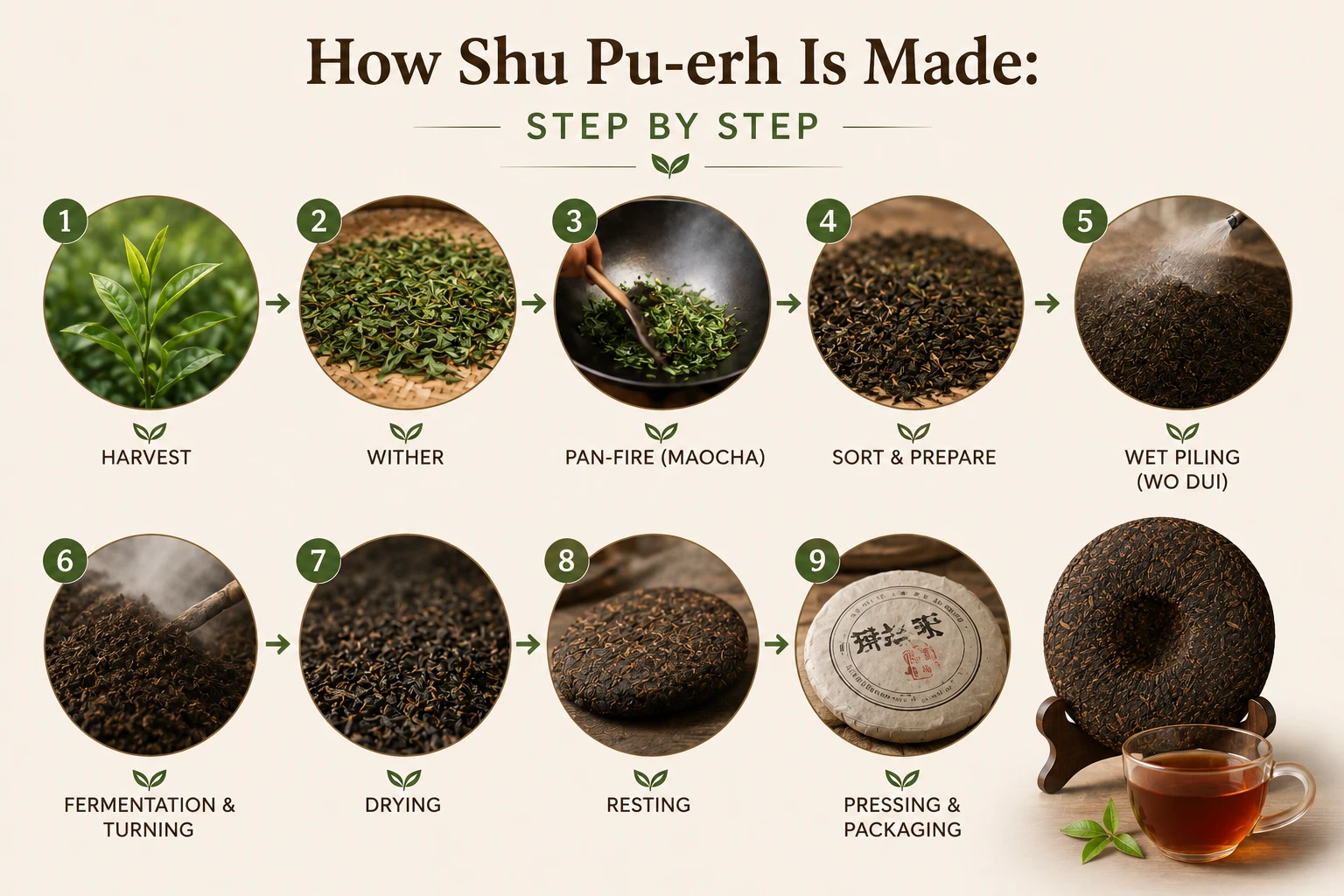
The production of Shu Pu-erh begins with fresh tea leaves. However, the fermentation process is only one stage in a longer sequence of tea-making steps.
1. Tea Leaves Are Harvested
The process begins in tea gardens, primarily in Yunnan.
Tea leaves are harvested from the tea plant, often using a combination of a young bud and several leaves. The exact picking standard can vary depending on the tea and the producer.
The quality of the raw material matters. Tea made from healthy, well-grown leaves can offer more depth and complexity than tea made from poor-quality material.
Although Shu Pu-erh is often associated with fermentation, the quality of the tea leaves before fermentation remains important. The process cannot completely compensate for weak or unsuitable tea material.
2. The Leaves Are Withered
After harvesting, the fresh leaves are spread out and allowed to wither.
Withering reduces some of the moisture in the leaves and begins a series of natural chemical changes. This step also makes the leaves more flexible and easier to process.
Withering is not the same as drying the tea completely. The leaves still retain significant moisture and remain part of the active production process.
The length and conditions of withering can vary according to the producer and the tea material.
3. The Leaves Are Pan-Fired to Make Maocha
The withered leaves are heated in a process known as sha qing, or “kill-green.”
This step is traditionally carried out in a large heated wok or similar equipment. The purpose is to reduce the activity of certain natural enzymes in the leaves.
Once this stage is complete, the tea is known as maocha, or rough tea.
Maocha is the basic tea material used to make Pu-erh. At this stage, it is not yet Shu Pu-erh.
This distinction is important. Many people assume that Shu Pu-erh begins with a fully finished dark tea. In reality, the tea first becomes maocha before undergoing the defining fermentation process.
4. The Maocha Is Sorted and Prepared
Before wet piling, the maocha may be sorted, graded, and prepared for fermentation.
Producers may remove unwanted material or organize the tea according to leaf size and quality. Different producers use different approaches, and the preparation process can influence how evenly the tea ferments.
The maocha is then ready for the most distinctive stage in the production of Shu Pu-erh.
5. Wet Piling: The Key Stage in How Shu Pu-erh Is Made
The central step in how Shu Pu-erh is made is called wo dui.
During wet piling, the maocha is placed into large piles. The leaves are then moistened with water and covered or managed in a way that helps maintain a warm, humid environment.
The pile is not simply left alone.
- Moisture is carefully managed
Water provides the moisture needed for the fermentation environment. Too little moisture can prevent the process from developing properly. Too much moisture can create problems with excessive heat, poor airflow, or undesirable microbial activity.
The goal is to create stable conditions that encourage the desired transformation of the tea.
- Heat naturally develops
As microbial activity takes place, the pile generates heat.
This is one reason producers must monitor the tea carefully. The temperature of the pile can rise, and the heat needs to be managed.
- The tea is turned regularly
The piles are periodically turned, or fan dui.
Turning helps distribute moisture and heat more evenly throughout the tea. It also prevents certain areas of the pile from becoming excessively hot or overly damp.
The timing and frequency of turning are important parts of the producer's skill.
This is one of the reasons Shu Pu-erh production should not be understood as a simple recipe. The general process may be familiar, but the details of production require experience and careful observation.
6. Microbial Activity Transforms the Tea
During wo dui, naturally occurring microorganisms play an important role in changing the tea.
The exact microbial environment can vary according to the tea material and production conditions. Microbial activity contributes to the transformation of the leaves, influencing their color, aroma, flavor, and texture.
The tea gradually becomes darker.
Its original greenish or brownish appearance changes, and the finished tea may eventually develop a rich dark brown or nearly black appearance.
This transformation is one of the defining characteristics of Shu Pu-erh.
Is this process controlled?
Yes, but “controlled” does not mean completely artificial or chemically manufactured.
Producers control the environment by managing factors such as:
- Moisture
- Temperature
- Pile size
- Airflow
- Turning
- Fermentation time
At the same time, natural microbial activity is part of the process.
The producer's role is to create and maintain conditions that allow the desired transformation to take place.
7. The Tea Is Dried
Once the wet-piling process is complete, the tea must be dried.
Drying reduces excess moisture and helps stabilize the tea.
The tea is not necessarily ready to be sold immediately. Many producers allow the tea to rest after fermentation and drying so that strong production aromas can gradually soften.
This resting period is particularly important because freshly produced Shu Pu-erh can sometimes have what tea drinkers describe as a “wo dui” aroma.
Some people describe this as earthy, damp, or slightly pungent. With proper resting and storage, these aromas may become less noticeable over time.
8. The Tea May Be Compressed
Shu Pu-erh can be sold as loose-leaf tea or compressed into various shapes.
The most familiar form is the tea cake, but Pu-erh may also be pressed into:
- Tuocha
- Bricks
- Small rounded forms
Compression is traditionally associated with the history of Pu-erh tea and made the tea easier to transport and store.
However, compression is not the same as fermentation. The tea is already Shu Pu-erh before it is pressed.
The finished tea may then be packaged and stored.
How Long Does It Take to Make Shu Pu-erh?
The answer depends on the producer and the style of tea.
The active wet-piling stage can take several weeks. The exact length varies according to the production method, tea material, pile conditions, and the producer's goals.
After fermentation, the tea may be dried and allowed to rest.
This is why it is useful to separate production time from aging time.
Production
Production includes the steps that turn maocha into Shu Pu-erh, including wet piling.
Aging and resting
After production, the tea can continue to change during storage.
Shu Pu-erh does not require decades of aging to be drinkable. However, storage and time may influence its aroma and overall character.
This is an important distinction for beginners. Shu Pu-erh is made through the wet-piling process; it is not simply raw Pu-erh that has been left to age.
What Does the Production Process Do to Shu Pu-erh?
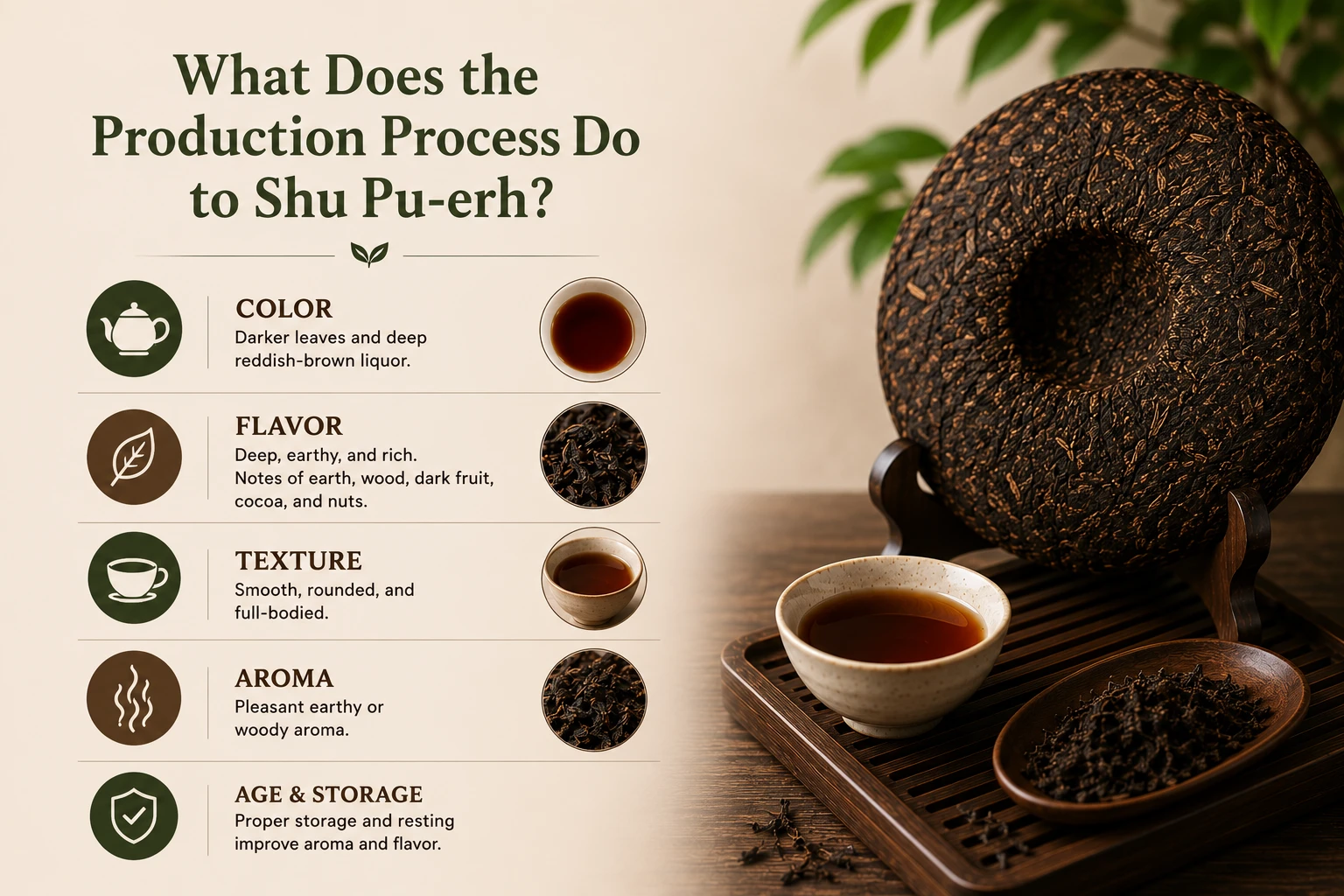
The production process changes the tea in several noticeable ways.
- Color
Shu Pu-erh is usually much darker than green tea or young Sheng Pu-erh.
The brewed liquor may range from deep reddish-brown to dark brown, depending on the tea.
- Flavor
The flavors are often deeper and less fresh than those found in young green teas.
Common flavor descriptions include earth, wood, dark fruit, cocoa, and nuts. However, not every Shu Pu-erh tastes the same.
- Texture
Many drinkers appreciate Shu Pu-erh for its smooth, rounded mouthfeel.
The tea can feel fuller and softer than many lightly processed teas.
- Aroma
A clean Shu Pu-erh may have a pleasant earthy or woody aroma.
Young Shu Pu-erh may sometimes have stronger production-related aromas. This is one reason resting and proper storage are important.
How Can You Use This Information When Choosing Shu Pu-erh?
Understanding how Shu Pu-erh is made gives you practical tools for choosing tea.
- Look beyond the dark color
A very dark tea is not automatically a high-quality tea.
Color alone cannot tell you whether the tea was well produced. Pay attention to aroma, flavor, texture, and how the tea develops across multiple infusions.
- Consider the producer and source
Reliable sourcing matters.
Authentic Chinese tea should have a clear origin and be handled with care. A knowledgeable tea seller should be able to provide useful information about the tea rather than relying only on vague descriptions.
- Do not confuse strong flavor with quality
A tea that tastes extremely powerful or intensely earthy is not necessarily better.
Quality Shu Pu-erh can be remarkably smooth and balanced. If a tea has a harsh, unpleasant, or persistently musty character, the issue may relate to production or storage.
- Brew with short infusions
Shu Pu-erh is often well suited to gongfu-style brewing.
Use a relatively small amount of tea and begin with short infusions. This allows you to observe how the tea changes.
A quick rinse is also commonly used with compressed Pu-erh to help loosen the leaves and prepare them for brewing.
Most importantly, avoid judging the tea from a single cup. Shu Pu-erh can develop noticeably across several infusions.
- Store it correctly
Keep Shu Pu-erh in a clean, dry environment with some airflow.
Avoid storing it next to strong-smelling items, as tea can absorb surrounding odors.
Extreme humidity can create problems, while excessively dry conditions may affect how the tea develops. The goal is a stable, clean storage environment.
Common Misunderstandings About How Shu Pu-erh Is Made
“Shu Pu-erh is just old tea.”
Not exactly.
Shu Pu-erh is produced through the wet-piling process. Aging and storage may further influence the tea, but they are not what makes the tea Shu Pu-erh.
“All Shu Pu-erh tastes the same.”
No.
Tea material, region, producer, fermentation conditions, age, and storage all influence the final cup.
“The darker the tea, the better it is.”
Color is only one characteristic.
A well-made Shu Pu-erh should be evaluated as a complete tea, considering its aroma, flavor, texture, and overall balance.
“Fermentation means the tea contains alcohol.”
No.
The production of Shu Pu-erh is not alcoholic fermentation. The term refers to the microbial and chemical transformation that takes place during the wet-piling process.
Final Thoughts: How Shu Pu-erh Is Made
So, how is Shu Pu-erh made?
The process begins with harvested tea leaves that are withered, heated, and processed into maocha. The maocha then undergoes wo dui, or wet piling, where carefully managed moisture, heat, airflow, and microbial activity transform the tea. After fermentation, the tea is dried, rested, and sometimes compressed into cakes or other traditional forms.
This production method is what gives Shu Pu-erh its distinctive dark appearance, mellow character, and deep flavor profile.
For tea drinkers, understanding the process makes it easier to appreciate what is in the cup and to make more informed choices when purchasing Chinese tea. Rather than judging Shu Pu-erh by color or intensity alone, look for clean flavor, balanced texture, trustworthy sourcing, and careful production.
If you'd like to experience authentic Shu Pu-erh prepared in the traditional Chinese tea tradition, explore Stepman's Tea carefully selected collection of Chinese teas and discover the distinctive character that thoughtful production brings to every cup.
FAQs
1. Is Shu Pu-erh naturally fermented?
Yes. Shu Pu-erh is produced through a controlled fermentation process that relies on naturally occurring microorganisms. Tea makers carefully manage moisture, temperature, and airflow during the wo dui (wet piling) stage, allowing the tea leaves to develop their characteristic dark color, smooth texture, and mellow flavor.
2. What is the difference between Shu Pu-erh and Sheng Pu-erh?
Both Shu (ripe) and Sheng (raw) Pu-erh are made from tea leaves grown primarily in Yunnan Province, China. The key difference lies in how they are processed.
Sheng Pu-erh is traditionally aged over many years, allowing it to mature naturally. Shu Pu-erh, on the other hand, undergoes a controlled fermentation process called wo dui, which produces a rich, mellow tea in a much shorter time.
3. What is wo dui?
Wo dui, meaning "wet piling," is the defining stage in how Shu Pu-erh is made. During this process, prepared tea leaves are stacked into large piles, lightly moistened, and carefully monitored. Heat and naturally occurring microbial activity gradually transform the leaves, creating the smooth character and deep color associated with Shu Pu-erh.
4. How long does it take to make Shu Pu-erh?
The complete production process varies by producer, but the active wet-piling stage generally takes several weeks. After fermentation, the tea is dried and often allowed to rest for a period so that its flavors and aromas can settle before being sold.
5. Does Shu Pu-erh continue to age after it is made?
Yes. Although Shu Pu-erh is ready to drink once production is complete, it can continue to develop during proper storage. Over time, subtle changes in aroma, texture, and flavor may occur, although these changes are generally less dramatic than those seen in naturally aged Sheng Pu-erh.
6. Why is Shu Pu-erh so dark?
The tea's dark color is a direct result of the fermentation process. During wo dui, natural microbial activity changes the chemical composition of the tea leaves, producing the deep reddish-brown to nearly black liquor that Shu Pu-erh is known for.
7. Is Shu Pu-erh made from old tea leaves?
No. Shu Pu-erh is typically made from freshly harvested tea leaves that are first processed into maocha (rough tea). The tea then undergoes controlled fermentation. It is the production method—not the age of the leaves—that defines Shu Pu-erh.
8. Can Shu Pu-erh be enjoyed immediately after production?
Yes. Unlike Sheng Pu-erh, which is often appreciated after years of natural aging, Shu Pu-erh is designed to be enjoyable soon after production and resting. Many tea drinkers appreciate its smooth, approachable flavor even when it is relatively young.
9. Does higher fermentation mean better quality?
Not necessarily. Quality depends on several factors, including the quality of the harvested leaves, careful fermentation, proper drying, clean storage, and overall craftsmanship. A well-made Shu Pu-erh should taste balanced, clean, and smooth rather than excessively earthy or musty.
10. How can I tell if Shu Pu-erh is high quality?
Look for tea with a clean aroma, smooth mouthfeel, and balanced flavor. High-quality Shu Pu-erh should not smell moldy or unpleasantly damp. Purchasing from a knowledgeable tea specialist who can provide information about the tea's origin and production is one of the best ways to ensure authenticity.
11. Does compressing Shu Pu-erh into cakes affect fermentation?
No. Fermentation is completed before the tea is compressed. Pressing the tea into cakes, bricks, or other traditional shapes is primarily done for storage, transportation, and aging rather than to continue the fermentation process.
12. What is the best way to experience the flavors of Shu Pu-erh?
Many tea enthusiasts recommend brewing Shu Pu-erh using the traditional gongfu method. Short, repeated infusions allow you to experience how the tea's aroma, texture, and flavor evolve from one steep to the next, revealing its complexity over multiple cups.