What Is Oolong Tea?
Oolong tea is a traditional Chinese tea known for its wide range of aromas, flavors, colors, and levels of oxidation. It occupies a unique position between green tea and black tea, although describing it simply as a middle ground can be misleading. Oolong encompasses an exceptionally broad category of teas, from lightly oxidized, floral teas from Fujian and Taiwan to deeply roasted, mineral-rich teas from the Wuyi Mountains and southern Fujian.
What makes oolong distinctive is not one particular flavor or appearance, but the way the tea leaves are processed. Through controlled withering, bruising or shaking, oxidation, heating, rolling, and sometimes roasting, tea makers can shape the character of the finished tea.
Understanding what oolong tea is begins with understanding this production process. It also helps explain why two oolong teas can look and taste remarkably different despite belonging to the same broad category.
What Is Oolong Tea?
Oolong tea is a partially oxidized tea made primarily from the leaves of the Camellia sinensis plant, the same species used to produce green, white, black, and pu-erh teas.
The defining characteristic of oolong is its degree and style of oxidation.
After tea leaves are picked, natural enzymes within the leaves begin reacting with oxygen. Tea producers carefully manage this process rather than allowing it to proceed completely. The leaves are eventually heated to slow or stop enzymatic oxidation, followed by shaping and drying.
Green tea is generally processed to minimize oxidation, while black tea is produced with substantial oxidation. Oolong occupies the broad territory between these categories, but there is no single oxidation level that defines every oolong.
Some oolongs are lightly oxidized and retain fresh, floral, and vegetal characteristics. Others undergo considerably more oxidation and roasting, producing flavors that can be reminiscent of dried fruit, toasted grain, nuts, wood, spices, or caramelized sugar.
This diversity is one of the most important things to understand about oolong tea: oolong is a category of tea, not a single flavor profile.
Where Does Oolong Tea Come From?
Oolong tea has deep roots in China, particularly in the southeastern provinces of Fujian and Guangdong. Taiwan later developed its own important oolong traditions, influenced in part by tea-making techniques and cultivars brought from Fujian.
Among the most significant oolong-producing regions are:
- Fujian Province: Known for teas such as Tieguanyin and Wuyi yancha.
- Wuyi Mountains: Famous for traditional rock oolongs, often called yancha.
- Anxi County: An important center for Tieguanyin production.
- Guangdong: Known for Phoenix Dancong oolongs.
- Taiwan: Known for high-mountain oolongs, Baozhong, Dong Ding, and other distinctive styles.
The environment in which tea is grown can influence the final character of the tea. Elevation, soil, climate, rainfall, cultivar, farming practices, and processing techniques all contribute to the finished product.
This is why the name of an oolong often tells the drinker something important about its identity. A Wuyi oolong and a Taiwanese high-mountain oolong may share the same broad category while offering entirely different drinking experiences.
Why Are There So Many Types of Oolong Tea?
Oolong is one of the most diverse categories of Chinese tea because producers can vary several important factors.
These include:
- Tea cultivar
- Growing region
- Elevation
- Harvest season
- Leaf maturity
- Withering conditions
- Degree of leaf bruising
- Oxidation level
- Rolling and shaping techniques
- Drying methods
- Roasting level
- Roasting frequency
- Storage and subsequent refinement
Even teas with the same name can vary depending on the producer and harvest year.
For example, Tieguanyin can be produced in different styles. A modern, lightly oxidized version may be intensely floral and fresh, while a traditionally roasted version can have deeper roasted and mineral characteristics.
This variation is part of what makes oolong worth exploring. Instead of expecting one standardized flavor, it is more useful to think of oolong as a large family of related tea-making traditions.
Common Types of Oolong Tea
Tieguanyin
Tieguanyin, sometimes written as Tie Guan Yin, is associated with Anxi County in Fujian Province.
Modern versions are often lightly oxidized and tightly rolled, with floral aromas and a fresh, lively character. Traditional styles may receive more roasting and offer deeper, warmer flavors.
The name refers to Guanyin, a revered Buddhist figure, and is often translated as "Iron Goddess."
Wuyi Rock Tea
Wuyi yancha, or Wuyi rock tea, comes from the Wuyi Mountains of Fujian.
These teas are traditionally associated with rocky mountain terrain and are often characterized by mineral, roasted, floral, fruity, or woody notes.
Examples include Da Hong Pao, Rougui, and Shuixian.
The term "rock tea" refers to the traditional growing environment and style rather than meaning that the tea literally contains minerals from rocks.
Phoenix Dancong
Phoenix Dancong comes from the Phoenix Mountain area of Guangdong Province.
These teas are particularly known for their aromatic complexity. Depending on the cultivar and production style, a Dancong may display floral, fruity, honeyed, spicy, or herbal aromas.
The category includes numerous traditional aroma profiles and cultivars, making Phoenix Dancong another example of the diversity found within oolong.
Taiwanese Oolong
Taiwan has developed a significant oolong tradition, with styles ranging from lightly oxidized Baozhong to more traditionally processed teas such as Dong Ding.
Taiwanese high-mountain oolongs are often grown at relatively high elevations and are valued for their aromatic clarity, smooth texture, and distinctive floral or creamy qualities.
As with Chinese oolongs, Taiwanese teas vary considerably according to region, cultivar, harvest, and production method.
What Does Oolong Tea Taste Like?
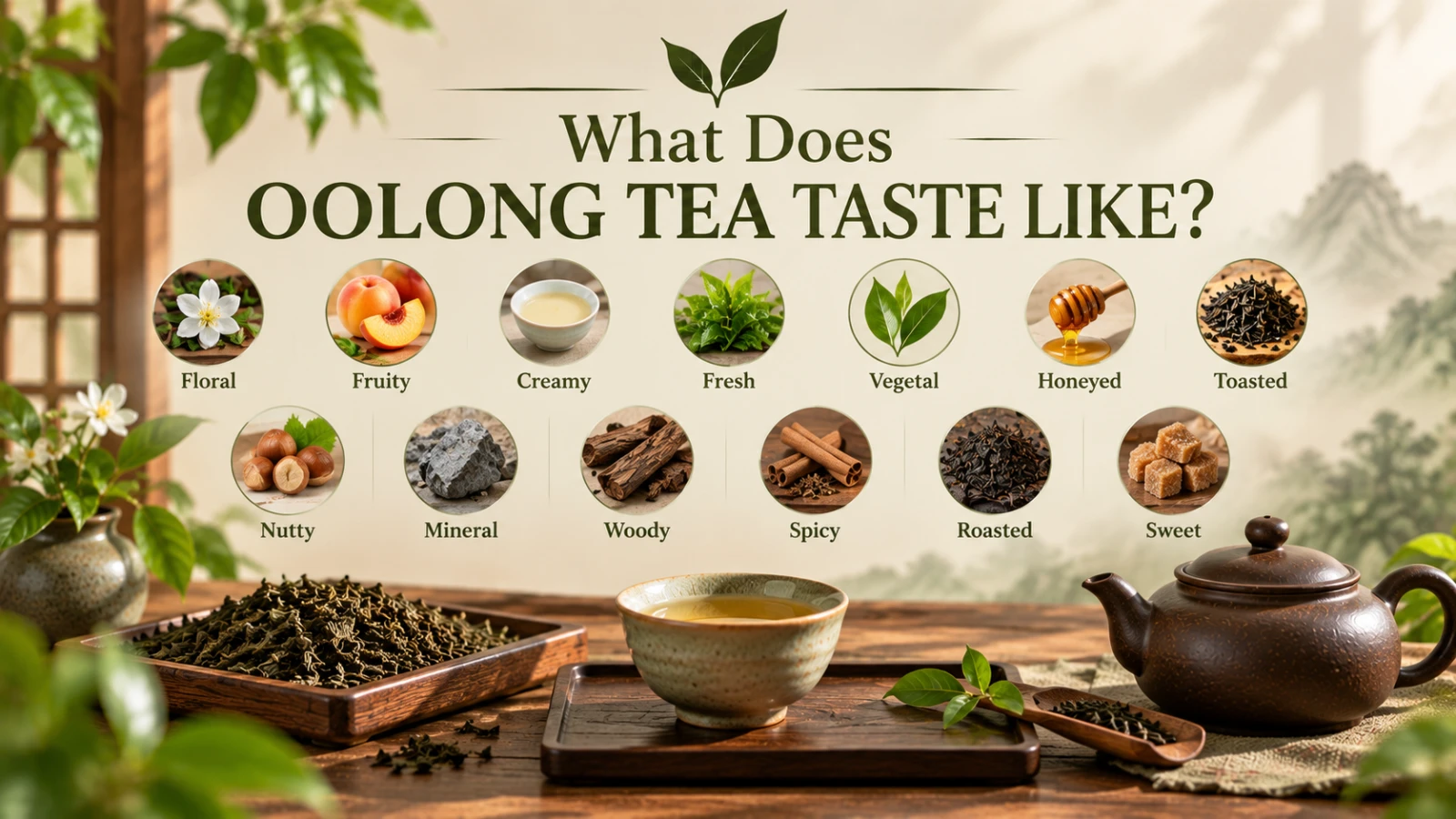
There is no single flavor that defines oolong tea.
Depending on the style, oolong can taste:
- Floral
- Fruity
- Creamy
- Fresh
- Vegetal
- Honeyed
- Toasted
- Nutty
- Mineral
- Woody
- Spicy
- Roasted
- Sweet
Lightly processed oolongs often emphasize floral, fresh, or green characteristics. More heavily oxidized or roasted teas tend to develop deeper flavors.
The brewing method also affects perception. A lightly brewed oolong may appear delicate, while a concentrated infusion can reveal stronger aromatics, texture, and aftertaste.
For this reason, tasting oolong is more useful than relying solely on descriptions. Tea terminology provides a framework, but the actual experience depends on the tea, preparation, water, and individual palate.
Oolong Tea vs. Green and Black Tea
The primary difference between oolong, green, and black tea is the way the leaves are processed.
| Tea Type | General Oxidation | Typical Characteristics |
|---|---|---|
| Green Tea | Minimal oxidation; leaves are heated early in processing | Fresh, vegetal, grassy, nutty |
| Oolong Tea | Partial oxidation; degree varies by style | Floral, fruity, mineral, roasted, complex |
| Black Tea | Substantial oxidation before drying | Rich, malty, fruity, robust |
| Shu Pu-Erh Tea | Microbially fermented through a controlled wet-piling process (wo dui); not defined by oxidation level alone | Earthy, smooth, mellow, woody, sometimes sweet or reminiscent of dark chocolate |
These categories should be understood as broad processing classifications rather than strict flavor rules.
Some green teas can be sweet and floral, while some black teas can be delicate and fruity. Likewise, oolong can range from exceptionally fresh to deeply roasted.
Does Oolong Tea Contain Caffeine?
Yes. Oolong tea naturally contains caffeine because it is produced from Camellia sinensis.
The actual amount can vary according to several factors, including:
- Tea cultivar
- Leaf maturity
- Amount of leaf used
- Brewing temperature
- Steeping duration
- Number of infusions
- Production style
Consequently, it is difficult to assign one universal caffeine level to all oolong tea.
If caffeine sensitivity is a concern, consider the quantity of tea used and how strongly it is brewed rather than assuming that one tea category always contains a specific amount.
Oolong should not automatically be considered "low caffeine" simply because it is partially oxidized. Oxidation level does not provide a reliable measure of caffeine content.
How Do You Brew Oolong Tea?
Oolong tea can be brewed using Western-style methods, a teapot, a gaiwan, or traditional Chinese gongfu brewing.
A simple starting method is:
- Place approximately 3–5 grams of oolong tea in a small teapot or gaiwan.
- Add hot water appropriate to the particular tea.
- Steep for roughly 30 seconds to 2 minutes, depending on the tea and desired strength.
- Taste the infusion.
- Adjust the next infusion by changing the steeping time, water temperature, or amount of tea.
- Re-steep the leaves when appropriate.
There is no single "correct" brewing formula for every oolong.
Lighter oolongs can respond well to moderately hot water, while many traditionally processed or roasted oolongs can tolerate very hot water. The goal is to extract the tea without overwhelming its aromatic balance.
Gongfu Brewing
Gongfu brewing uses a relatively high quantity of leaves with a small amount of water and multiple short infusions.
This method is particularly useful for oolong because the leaves often change considerably from infusion to infusion.
A tightly rolled tea may initially produce a concentrated infusion and gradually open as it is steeped. Later infusions can reveal different aromatic and textural qualities.
Gongfu brewing also encourages attention to the tea rather than treating brewing as a fixed recipe.
How Should Oolong Tea Be Stored?
Proper storage helps preserve the tea's aroma and quality.
Oolong should generally be protected from:
- Excessive moisture
- Strong odors
- Direct sunlight
- Excessive heat
- Air exposure
For everyday storage, keep tea in a clean, airtight or appropriately sealed container in a cool, dry, odor-free environment.
Different oolongs may have different storage considerations. Lightly oxidized, highly aromatic teas can be particularly sensitive to moisture, heat, and strong odors. Traditionally roasted oolongs may be more tolerant of storage and may also undergo changes over time under appropriate conditions.
The most important principle is consistency: avoid environments with large fluctuations in temperature or humidity and keep tea away from foods or substances with strong aromas.
How to Choose a Quality Oolong Tea
When purchasing oolong, the name alone does not guarantee quality.
Consider the following factors.
Know the Origin
A reputable seller should provide meaningful information about where the tea was produced.
For regional teas, information about the growing area can help establish context and distinguish a specific tea tradition from a generic product description.
Look at the Cultivar and Style
When available, cultivar information can be valuable. Different cultivars have distinct characteristics and are traditionally associated with particular tea styles.
Understanding whether a tea is lightly oxidized, traditionally roasted, or heavily roasted can also help set realistic expectations.
Examine the Leaves
Dry leaves can provide useful visual clues.
Look for leaves that appear reasonably consistent with the tea's stated style. Tightly rolled oolong should generally open during brewing, while strip-style oolong should display recognizable leaf structure after infusion.
Appearance alone, however, should not be treated as proof of quality. Aroma, taste, processing information, and provenance are equally important.
Evaluate the Information Provided
A quality-focused tea seller should be able to explain what the tea is, where it comes from, and how it was produced.
Clear information about origin and processing is often more useful than vague claims about exceptional quality or extraordinary effects.
Common Mistakes When Brewing Oolong Tea
Even a good oolong can taste disappointing if it is prepared poorly.
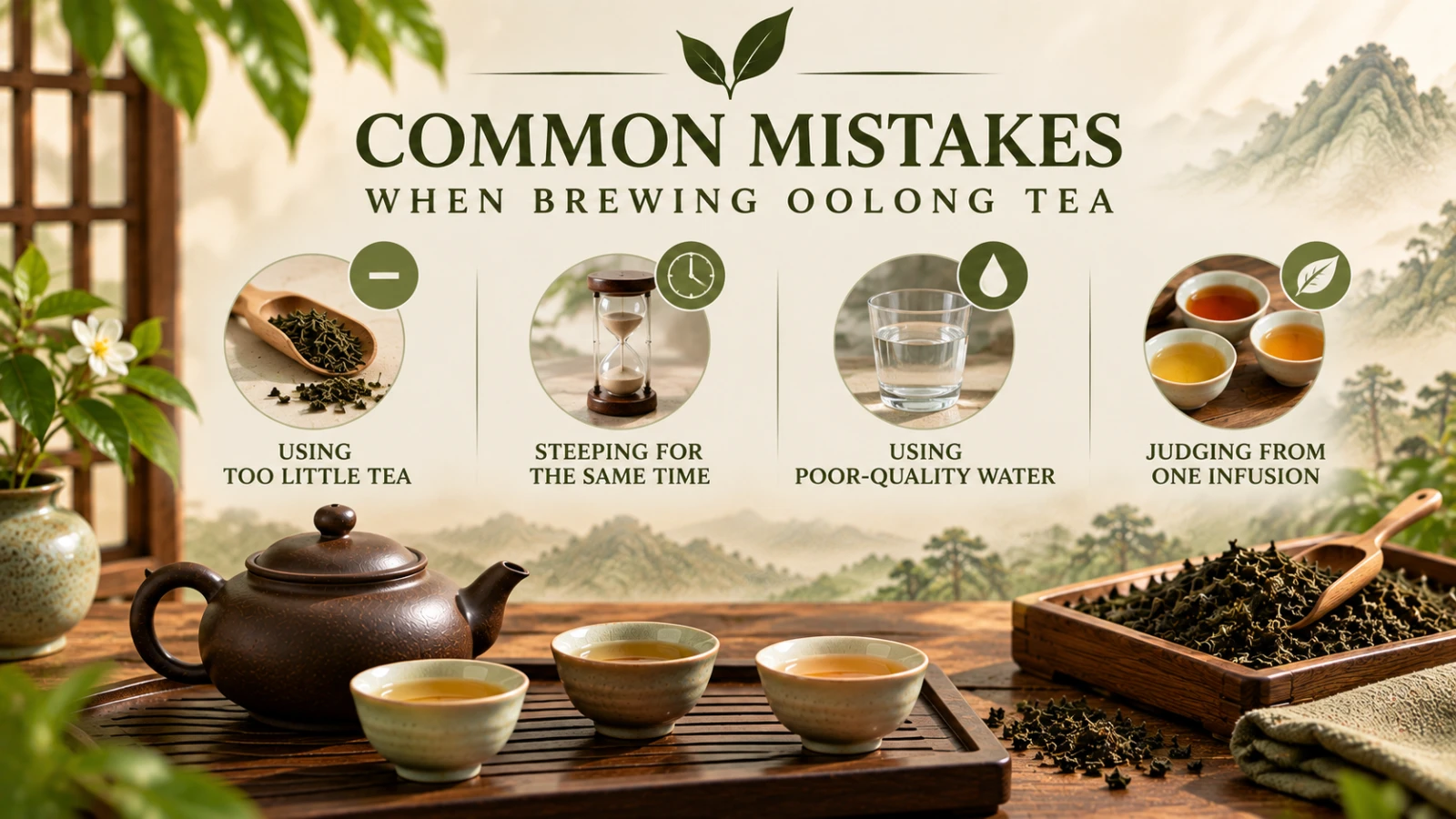
1. Using Too Little Tea
Using a very small amount of leaf with a large volume of water can produce a weak infusion. Gongfu brewing uses more leaf relative to water precisely because it is designed around multiple concentrated infusions.
2. Steeping Every Oolong for the Same Length of Time
A delicate Baozhong and a heavily roasted Wuyi oolong do not necessarily require the same brewing approach.
Start with a moderate infusion and adjust according to taste.
3. Using Poor-Quality Water
Water makes up most of the finished beverage, so its mineral composition can have a noticeable influence on flavor.
Fresh, clean drinking water is generally a good starting point. Extremely hard or heavily treated water may obscure delicate aromas.
4. Judging the Tea From One Infusion
Many oolongs are designed to develop over several infusions. If the first cup seems overly concentrated, weak, or unfamiliar, adjust the brewing parameters before deciding that the tea is not suitable.
Is Older Oolong Tea Better?
Unlike certain teas that are specifically produced and marketed for long-term aging, not every oolong is intended to become better with age.
Some traditionally processed and roasted oolongs can develop additional depth when stored appropriately. However, aging is not automatically an improvement, and storage conditions matter greatly.
Lightly oxidized aromatic oolongs are often appreciated for their fresh fragrance and may not benefit from prolonged storage in the same way as certain traditionally roasted teas.
The best approach is to understand the specific tea before deciding whether to store it for an extended period.
Why Oolong Tea Matters in Chinese Tea Culture
Oolong occupies an important place in Chinese tea culture because its production reflects an unusually high degree of control over the transformation of tea leaves.
Small changes in processing can produce substantial differences in the finished tea. The category therefore demonstrates how agricultural origin, cultivar, craftsmanship, and processing interact.
Oolong is also closely associated with traditional Chinese tea preparation. Teaware such as the gaiwan and small Yixing-style teapots is frequently used to prepare oolong through multiple infusions, allowing drinkers to observe how aroma, flavor, and texture evolve.
For someone beginning to explore Chinese tea, oolong can therefore provide an introduction to both the diversity of tea itself and the principles of traditional tea preparation.
Practical Tips for Exploring Oolong Tea
If you are new to oolong, it is useful to explore the category systematically rather than choosing teas based only on flavor descriptions.
Start by comparing different styles.
Try a lightly oxidized oolong to understand floral and fresh characteristics. Then compare it with a traditionally roasted oolong to experience deeper toasted and mineral notes.
You can also compare teas from different regions, such as Fujian and Taiwan.
When tasting, pay attention to:
- Dry-leaf aroma
- Wet-leaf fragrance
- First infusion
- Changes between infusions
- Texture or mouthfeel
- Aftertaste
- Overall balance
Keeping brief tasting notes can make differences easier to recognize over time.
Most importantly, avoid assuming that one oolong represents the entire category. The diversity of oolong is precisely what makes it useful for learning about Chinese tea.
Conclusion
Oolong tea is a broad and diverse category of partially oxidized tea made from the Camellia sinensis plant. Its identity comes primarily from how the leaves are processed, with oxidation, shaping, drying, and roasting all contributing to the finished character.
From fresh and floral Tieguanyin to mineral-rich Wuyi yancha and aromatic Phoenix Dancong, oolong demonstrates how dramatically tea can change according to region, cultivar, craftsmanship, and processing.
For the drinker, the most useful approach is to look beyond the word "oolong" and learn about the specific tea: where it was grown, how it was processed, how it was roasted, and how it responds to brewing.
If you'd like to explore this diversity firsthand, consider browsing Stepman's Tea, collection of authentic Chinese teas and comparing different oolong styles by origin and traditional processing method. The best way to understand oolong is ultimately to taste it, paying attention to how each tea develops from the first infusion through the last.
FAQs
1. Is oolong tea green tea or black tea?
Neither. Oolong is a distinct category of tea made from Camellia sinensis. It is generally partially oxidized, while green tea is processed to minimize oxidation and black tea undergoes substantially more oxidation.
2. Is oolong tea naturally sweet?
Oolong does not necessarily contain sugar, but some teas can have naturally perceived sweet, honeyed, fruity, or floral characteristics. These flavors result from the tea's cultivar, growing environment, processing, and brewing.
3. Can you drink oolong tea every day?
Oolong can be part of a regular tea-drinking routine for many people. Because it naturally contains caffeine, individual tolerance and overall caffeine consumption should be considered.
4. Does oolong tea need to be brewed with boiling water?
Not necessarily. Brewing temperature should depend on the specific oolong. Some teas can be brewed with very hot water, while delicate styles may benefit from slightly lower temperatures.
5. Can oolong tea be re-steeped?
Yes. Many oolongs are particularly well suited to multiple infusions. Rolled and whole-leaf teas can release different characteristics as the leaves gradually open.
6. What is the difference between Chinese and Taiwanese oolong?
Both traditions produce highly diverse teas, so there is no single difference. Chinese oolongs include styles such as Tieguanyin, Wuyi yancha, and Phoenix Dancong, while Taiwan is known for teas such as Baozhong, Dong Ding, and high-mountain oolong. Processing methods, cultivars, growing regions, and individual producers all influence the final tea.