Common Oolong Brewing Mistakes: How to Brew Better Oolong Tea
Oolong tea occupies a fascinating place between green and black tea. It can be light and floral, roasted and nutty, creamy and fragrant, or deep and mineral-rich depending on the tea and how it was produced. That range is part of what makes oolong rewarding to explore—but it also means that brewing mistakes can easily obscure the qualities that make a particular tea distinctive.
Fortunately, most brewing problems are straightforward to correct.
This guide explains the most common mistakes people make when brewing oolong tea, why they affect the cup, and how to adjust your technique. Whether you are new to oolong or already familiar with traditional Chinese tea preparation, understanding the relationship between tea quantity, water, temperature, time, and brewing method will help you get more from every infusion.
What Is Oolong Tea?
Oolong is a partially oxidized tea made primarily from the leaves of the Camellia sinensis plant. It is traditionally associated with China and Taiwan, where producers have developed a remarkably broad range of styles.
Unlike green tea, which is generally minimally oxidized, or black tea, which is typically fully oxidized, oolong occupies a broad middle ground. However, describing oolong simply as "halfway between green and black tea" can be misleading. Oolong production is much more complex.
Different oolongs can vary considerably in:
- Degree of oxidation
- Leaf cultivar
- Growing region
- Harvest season
- Withering
- Rolling and shaping
- Roasting
- Aging
- Processing tradition
As a result, there is no single brewing formula that works perfectly for every oolong.
A lightly oxidized, floral oolong may respond well to somewhat cooler water and shorter infusions, while a tightly rolled, roasted oolong may benefit from hotter water and repeated brewing.
Understanding the tea itself is therefore the first step toward avoiding brewing mistakes.
Why Brewing Technique Matters
Tea brewing is essentially an extraction process. Hot water draws soluble compounds and aromatic substances from the leaves, creating the flavor, aroma, body, and finish we experience in the cup.
Several variables influence that extraction:
- Water temperature
- Steeping time
- Amount of tea
- Amount and quality of water
- Leaf size and shape
- Brewing vessel
- Number of infusions
Changing one variable can significantly change the result.
For example, a long steep with very hot water generally extracts more compounds than a short steep with cooler water. That can produce a stronger cup, but "stronger" does not necessarily mean "better." If the tea is delicate, excessive extraction can overwhelm its floral or sweet characteristics.
The goal is not simply to extract as much as possible. The goal is to find a balance that allows the tea's character to come through clearly.
10 Common Oolong Brewing Mistakes
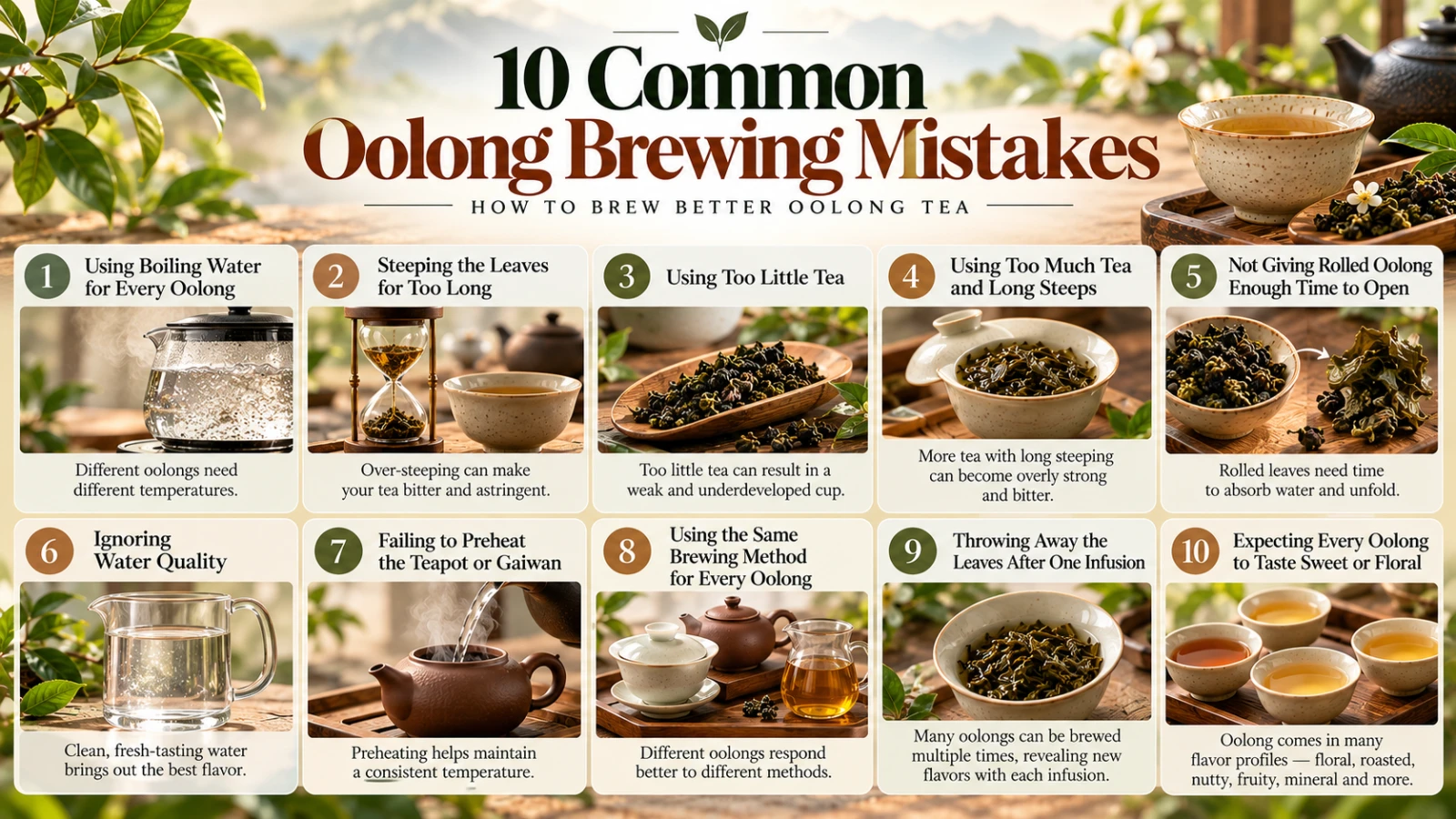
1. Using Boiling Water for Every Oolong
One of the most common assumptions about tea is that boiling water is always appropriate.
It is not.
Water around 100°C (212°F) can be useful for many oolongs, particularly robust, roasted, or tightly rolled teas. However, very delicate oolongs may become overly bitter, drying, or astringent when exposed to excessively hot water for too long.
This does not mean that delicate oolong should never encounter hot water. Rather, temperature should be considered alongside steeping time and the particular tea.
How to improve
As a general starting point:
- Light, delicate oolong: approximately 80–90°C (176–194°F)
- Medium-style oolong: approximately 85–95°C (185–203°F)
- Roasted or robust oolong: approximately 90–100°C (194–212°F)
These are starting ranges rather than strict rules.
If your tea tastes harsh or overly bitter, try lowering the water temperature slightly or shortening the infusion.
If it tastes thin or lacks aroma, increase the temperature or steep a little longer.
2. Steeping the Leaves for Too Long
Longer brewing does not necessarily produce a more flavorful cup.
When tea leaves remain in hot water for an extended period, extraction continues. Eventually, the balance of the infusion can shift from pleasant sweetness and aroma toward bitterness and astringency.
This is especially common when someone brews oolong using a tea bag or large mug and leaves the leaves sitting in the water until the cup is finished.
How to improve
Start with a relatively short infusion and taste the tea.
For Western-style brewing, approximately 2–5 minutes can be a useful starting range, depending on the tea.
For traditional Chinese-style brewing, infusions may be much shorter—often measured in seconds rather than minutes—with the leaves brewed repeatedly.
The important principle is simple: taste and adjust rather than relying on one fixed brewing time.
3. Using Too Little Tea
Another common mistake is assuming that using less tea automatically produces a better or more economical cup.
With some oolongs, particularly tightly rolled varieties, using too little leaf can result in a weak or underdeveloped infusion.
Rolled leaves also expand considerably as they absorb water. What initially appears to be a small amount of tea can become a substantial mass of leaves after several infusions.
How to improve
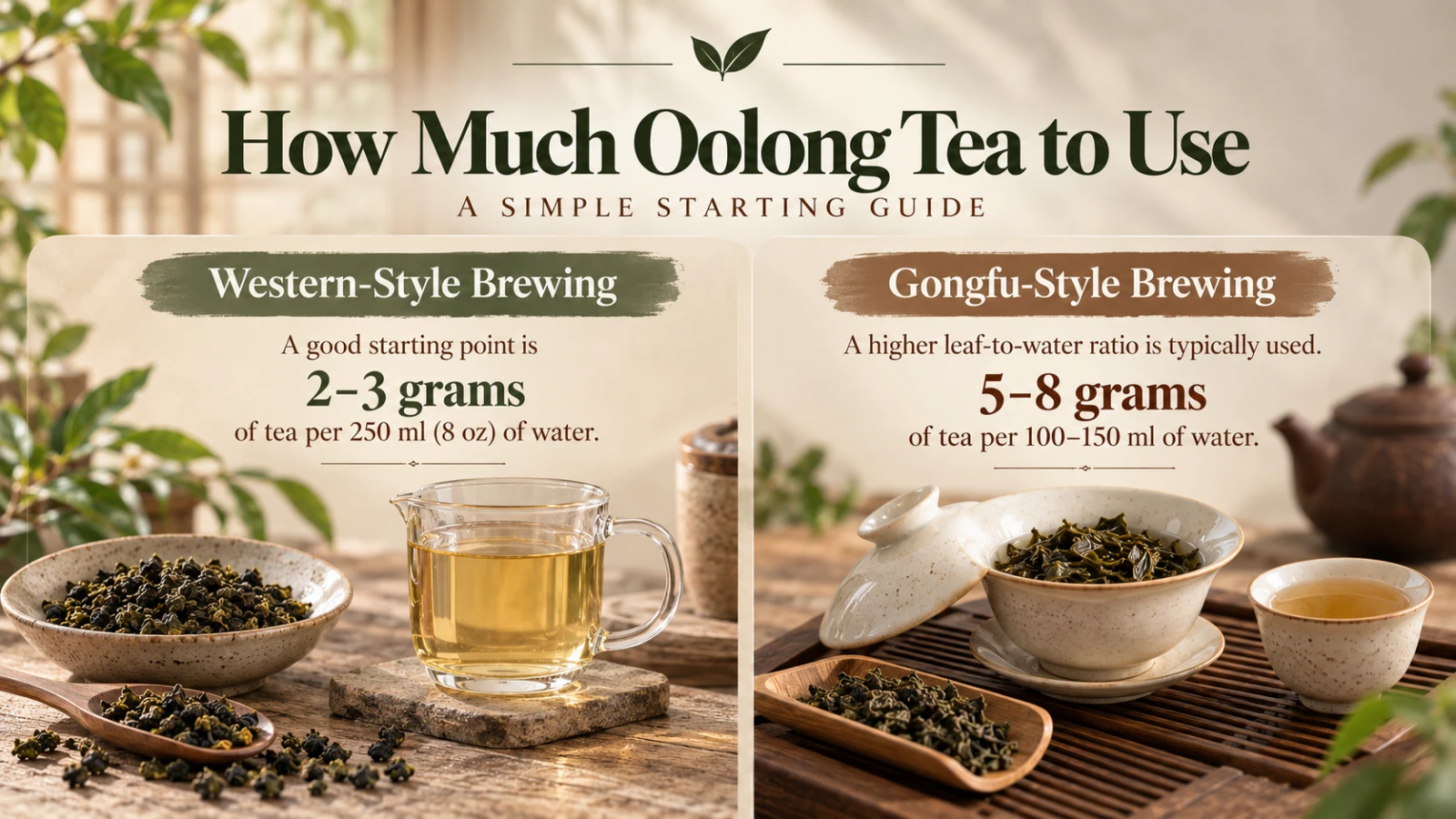
For Western-style brewing, a reasonable starting point is around 2–3 grams of tea per 250 ml (8 oz) of water.
For gongfu-style brewing, a higher leaf-to-water ratio is typical because the brewing vessel is smaller and the infusions are much shorter. Around 5–8 grams per 100–150 ml is often used as a starting point, although practices vary considerably.
The exact amount should depend on the tea and your preferred intensity.
4. Using Too Much Tea and Then Compensating With Long Steeps
The opposite problem is also common.
A brewer may use a large quantity of leaves but then leave them in the water for several minutes. The result can be an extremely concentrated infusion with pronounced bitterness or astringency.
The issue isn't necessarily the amount of tea alone. It is the relationship between leaf quantity, water volume, temperature, and time.
How to improve
If you increase the amount of tea, consider reducing the steeping time.
This is one reason traditional gongfu brewing can use a relatively large amount of leaf: the leaves are exposed to hot water for short periods and brewed repeatedly.
Instead of thinking:
More tea = longer steep
think:
More tea + shorter infusion = another way to control extraction.
5. Not Giving Rolled Oolong Enough Time to Open
Many Chinese and Taiwanese oolongs are tightly rolled into small balls or compact shapes.
A common mistake is judging the tea based on the appearance of the dry leaves or assuming that the first infusion represents the tea's full character.
Tightly rolled leaves need time to absorb water and unfold.
How to improve
Rinse or briefly steep the leaves according to your preferred brewing method, then allow subsequent infusions to reveal the tea gradually.
The flavor may change considerably as the leaves open.
This is one of the pleasures of traditionally produced oolong: the tea can develop across multiple infusions rather than delivering exactly the same flavor from beginning to end.
6. Ignoring Water Quality
Water makes up the vast majority of the finished beverage, yet it is often treated as an afterthought.
Water containing strong chlorine odors, excessive mineral content, or an unusual taste can interfere with the aroma and flavor of tea.
At the same time, extremely purified water is not automatically ideal for every tea either. The mineral composition of water can influence extraction and mouthfeel.
How to improve
Use clean, fresh-tasting water.
If your tap water has a noticeable chlorine taste or strong mineral character, filtered water may produce a clearer cup.
Avoid repeatedly boiling the same water when possible. Freshly heated water generally provides a better starting point for brewing.
7. Failing to Preheat the Teapot or Gaiwan
Pouring hot water into a cold brewing vessel can cause the water temperature to drop more rapidly than expected.
This matters particularly when brewing small quantities of tea with short infusion times.
How to improve
Before brewing, rinse the teapot, gaiwan, or other vessel with hot water.
This warms the vessel and helps maintain a more consistent brewing temperature.
Preheating is especially useful when brewing delicate teas where small temperature differences can influence extraction.
8. Using the Same Brewing Method for Every Oolong
There is no universal oolong brewing method.
A lightly oxidized floral oolong and a heavily roasted traditional oolong can behave very differently.
Likewise, a large-leaf loose tea may require a different approach from a tightly rolled tea.
How to improve
Begin by identifying the general style of the tea.
Ask:
- Is it lightly or heavily oxidized?
- Is it roasted?
- Is it tightly rolled?
- Is it loosely twisted?
- Is it young or aged?
- Is it delicate or robust?
Then choose your brewing approach accordingly.
A useful starting point is to brew according to the tea rather than according to a rigid recipe.
9. Throwing Away the Leaves After One Infusion
Many oolongs are designed to be brewed multiple times.
Discarding the leaves after one infusion can mean missing some of the tea's development.
The first infusion may emphasize fragrance, while later infusions can reveal sweetness, body, mineral qualities, roasted notes, or a lingering finish.
How to improve
If the tea is suitable for multiple infusions, continue brewing the same leaves.
You may need to gradually increase the steeping time as the leaves release their soluble compounds.
Pay attention to how the flavor changes.
This also provides a useful way to evaluate tea quality: a good tea may remain interesting across several infusions rather than becoming completely flat after the first cup.
10. Expecting Every Oolong to Taste Sweet or Floral
Oolong is not a single flavor profile.
Some teas are intensely floral. Others can be creamy, fruity, mineral, woody, roasted, nutty, honey-like, or earthy.
A common brewing mistake is assuming that every oolong should taste like a particular reference tea.
If the tea is roasted, for example, its defining character may be toast, nuts, cocoa, wood, or spice rather than fresh flowers.
How to improve
Taste the tea objectively before deciding that something has gone wrong.
Ask:
- What aromas do I notice?
- Is the flavor balanced?
- Is there excessive bitterness?
- Is the tea drying?
- Does sweetness emerge after swallowing?
- Does the flavor change as the tea cools?
- How does the next infusion compare?
These questions are more useful than asking whether the tea tastes exactly like another tea you have tried.
Western-Style Brewing vs. Gongfu Brewing
There are two broad approaches commonly used to brew oolong.
Western-Style Brewing
Western-style brewing generally uses:
- More water
- Less tea relative to the water volume
- Longer infusion times
- One or a few infusions
A practical starting point is:
2–3 grams of oolong + 250 ml (8 oz) water + 2–5 minutes
Adjust according to the tea.
This approach is convenient for everyday drinking and works particularly well when you want a full cup without repeatedly brewing the leaves.
Gongfu-Style Brewing
Gongfu brewing typically uses:
- More tea relative to water
- A smaller brewing vessel
- Shorter infusions
- Multiple rounds of brewing
A gaiwan is commonly used, although other small teapots can also work.
A starting point might be:
5–8 grams of tea + 100–150 ml water
The first infusion may be brief, with subsequent infusions adjusted according to taste.
There is no requirement that gongfu brewing be complicated or ceremonial. At its core, it is a method for controlling extraction and experiencing how tea changes across multiple infusions.
How to Troubleshoot an Oolong That Doesn't Taste Right
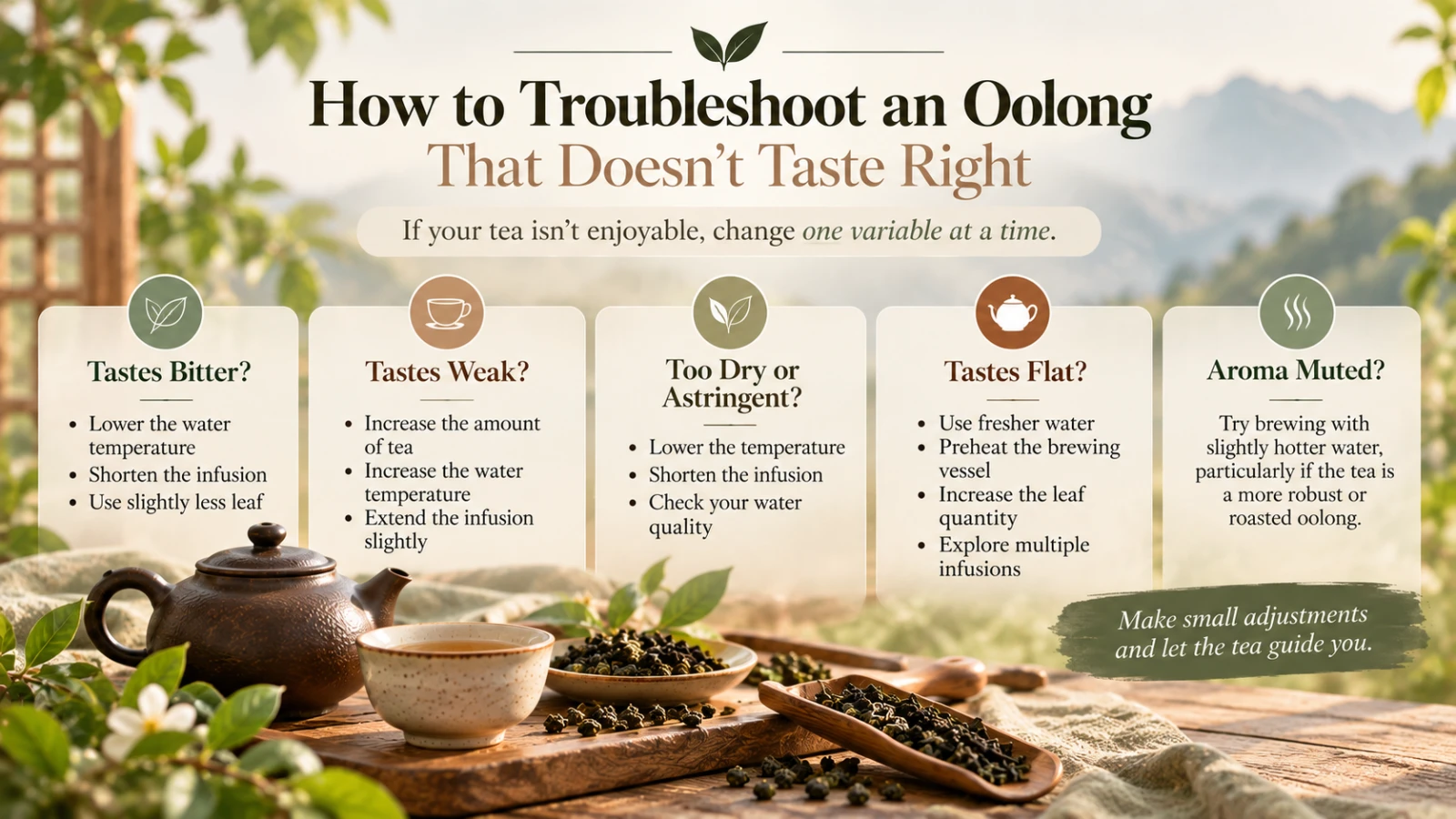
If your tea isn't enjoyable, change one variable at a time.
If the tea tastes bitter
Try:
- Lowering the water temperature
- Shortening the infusion
- Using slightly less leaf
If the tea tastes weak
Try:
- Increasing the amount of tea
- Increasing the water temperature
- Extending the infusion slightly
If the tea tastes overly dry or astringent
Try:
- Lowering the temperature
- Shortening the infusion
- Checking your water quality
If the tea tastes flat
Try:
- Using fresher water
- Preheating the brewing vessel
- Increasing the leaf quantity
- Exploring multiple infusions
If the aroma seems muted
Try brewing with slightly hotter water, particularly if the tea is a more robust or roasted oolong.
Most importantly, avoid changing everything simultaneously. Small adjustments make it easier to understand what the tea is telling you.
Practical Oolong Brewing Tips
For consistent results, keep a few basic principles in mind:
Start with the tea. Its style should influence your brewing method.
Use good water. Water quality has a noticeable effect on the finished cup.
Control temperature. Hotter water generally increases extraction, but the appropriate temperature depends on the tea.
Watch the clock. A small change in infusion time can significantly affect flavor.
Taste repeatedly. Especially with gongfu brewing, tasting each infusion teaches you how the tea develops.
Don't fear adjustment. Brewing recommendations are starting points, not immutable rules.
Keep notes. If you discover a particularly enjoyable combination of temperature, leaf quantity, and steeping time, record it.
The Key to Better Oolong Brewing
The biggest mistake when brewing oolong is looking for one universal recipe.
Oolong encompasses an exceptionally broad range of teas, and each one can respond differently to water temperature, infusion time, leaf quantity, and brewing vessel. The most reliable approach is to begin with sensible parameters and then adjust based on what you taste.
If the tea is bitter, reduce extraction. If it is weak, increase extraction. If the leaves are tightly rolled, give them time to open. If the tea remains interesting through several infusions, take advantage of that development.
Good brewing is less about following rigid rules than learning how tea responds.
At Stepman's Tea, we believe understanding the tea is an important part of enjoying it. If you'd like to explore authentic Chinese oolong prepared in traditional styles, you can browse our carefully selected collection and use the characteristics of each tea to guide your brewing approach.
FAQs
1. Should oolong tea be brewed with boiling water?
Some oolongs perform very well with water close to boiling, particularly robust and roasted varieties. More delicate oolongs may benefit from somewhat cooler water. The best temperature depends on the specific tea.
2. How long should oolong tea steep?
For Western-style brewing, approximately 2–5 minutes is a useful starting range. Gongfu brewing generally uses much shorter infusions. Adjust according to the tea and the flavor you want.
3. Can you brew oolong tea more than once?
Yes. Many traditional oolongs are well suited to multiple infusions. In fact, repeated brewing is an important part of exploring many Chinese and Taiwanese oolongs.
4. Why does my oolong taste bitter?
Common causes include excessive temperature, an infusion that is too long, too much leaf for the brewing method, or water characteristics. Try changing one variable at a time.
5. Should I rinse oolong tea before brewing?
A brief rinse is commonly used in some traditional Chinese brewing practices, particularly with tightly rolled or aged teas. However, it is not an absolute requirement for every oolong. A quick rinse can also help warm and awaken tightly compressed or rolled leaves.