What Does Oolong Tea Taste Like?
Oolong tea is known for having one of the broadest flavor ranges among traditional Chinese teas. Depending on the tea, it can taste light and floral, creamy and buttery, fruity and sweet, roasted and nutty, or rich and mineral-like. This variety comes largely from how the tea leaves are processed, particularly the degree of oxidation, rolling, roasting, and aging.
For someone trying oolong tea for the first time, this diversity can make the category difficult to describe. Two oolong teas can look completely different, smell different, and taste almost like entirely different beverages.
So, what does oolong tea actually taste like?
The most accurate answer is that oolong tea does not have one single flavor profile. Instead, it occupies a wide spectrum between the fresh, vegetal character often associated with green tea and the deeper, maltier or fruitier qualities commonly found in black tea.
This guide explains what oolong tea tastes like, why different oolongs have such different flavors, how production influences taste, and how to brew oolong tea so you can better appreciate its character.
What Is Oolong Tea?
Oolong tea is a partially oxidized tea traditionally associated with China and Taiwan. It is made from the leaves of the Camellia sinensis plant, the same species used to produce green, white, black, and pu-erh teas.
The major distinction is how the leaves are processed after harvesting.
Green tea is generally processed to minimize oxidation, while black tea is produced with substantially more oxidation. Oolong occupies a broad middle ground. However, describing oolong simply as "halfway between green and black tea" can be misleading because oolong production is much more varied than that description suggests.
Some oolongs are lightly oxidized and retain fresh, floral characteristics. Others are more heavily oxidized and roasted, producing deeper flavors of fruit, honey, toasted grain, nuts, wood, or spice.
Traditional oolong production can involve several stages, including:
- Harvesting
- Withering
- Bruising or shaking
- Partial oxidation
- Heat treatment
- Rolling or shaping
- Roasting
- Resting or further refinement
The balance between these steps plays a major role in determining the finished tea's aroma and taste.
What Does Oolong Tea Taste Like?
Oolong tea can taste very different depending on its style, origin, cultivar, processing, and age.
However, several flavor characteristics appear frequently.
Floral Oolong
Lightly oxidized oolongs are often associated with floral aromas and flavors.
You may notice impressions of:
- Orchid
- Jasmine
- Honeysuckle
- Gardenia
- Lilac
- Fresh flowers
These teas can have a delicate, fragrant character and are often relatively light in the mouth.
Some floral oolongs also have a naturally sweet finish. The sweetness may not resemble sugar or candy. Instead, it can appear as a lingering impression after swallowing.
Fruity Oolong
Some oolongs develop pronounced fruit-like characteristics.
Depending on the tea, you may notice flavors reminiscent of:
- Peach
- Apricot
- Plum
- Citrus
- Ripe fruit
- Dried fruit
Fruit flavors can occur naturally through the interaction of the tea's cultivar, growing environment, oxidation, and processing.
It is important to distinguish naturally occurring fruity aromas from flavored tea. A traditional oolong can smell strongly of fruit without having fruit or artificial flavoring added to the leaves.
Creamy and Milky Notes
Some oolongs are described as creamy, buttery, or milky.
These descriptions generally refer to the tea's aroma and mouthfeel rather than literal dairy flavors.
A tea may feel smooth and rounded on the palate and produce aromas that remind the drinker of cream, butter, vanilla, or sweet milk.
The popular term "milk oolong" can refer to different teas and styles, so it is useful to check how a particular tea was produced rather than assuming that every tea described this way contains milk flavoring.
Roasted Oolong
More heavily roasted oolongs can taste substantially deeper.
Common tasting notes include:
- Toasted grain
- Roasted nuts
- Caramel
- Cocoa
- Toast
- Brown sugar
- Warm spice
- Wood
Roasting changes the aromatic compounds in the tea and can reduce some of the sharper or greener characteristics found in less-roasted teas.
A well-made roasted oolong should not simply taste burnt. The roast can add depth while still allowing the underlying tea character to remain noticeable.
Fruity and Honeyed Oolong
Some traditionally produced oolongs develop rich aromas resembling ripe fruit, honey, flowers, or dried fruit.
These characteristics can become especially noticeable in teas made from particular cultivars or grown in specific environments.
The perceived sweetness of these teas can be quite strong even though the tea itself contains no added sugar.
Mineral and Rocky Notes
Certain Chinese oolongs, particularly teas associated with the Wuyi Mountains of Fujian, are often described using terms such as "mineral," "rocky," or "flinty."
These descriptions can be difficult for beginners because they do not necessarily mean the tea literally tastes like a rock.
Instead, "rocky" is commonly used to describe a combination of mineral-like sensations, roasted character, dryness, structure, and lingering flavor.
These oolongs can have a fuller and more structured character than delicate floral teas.
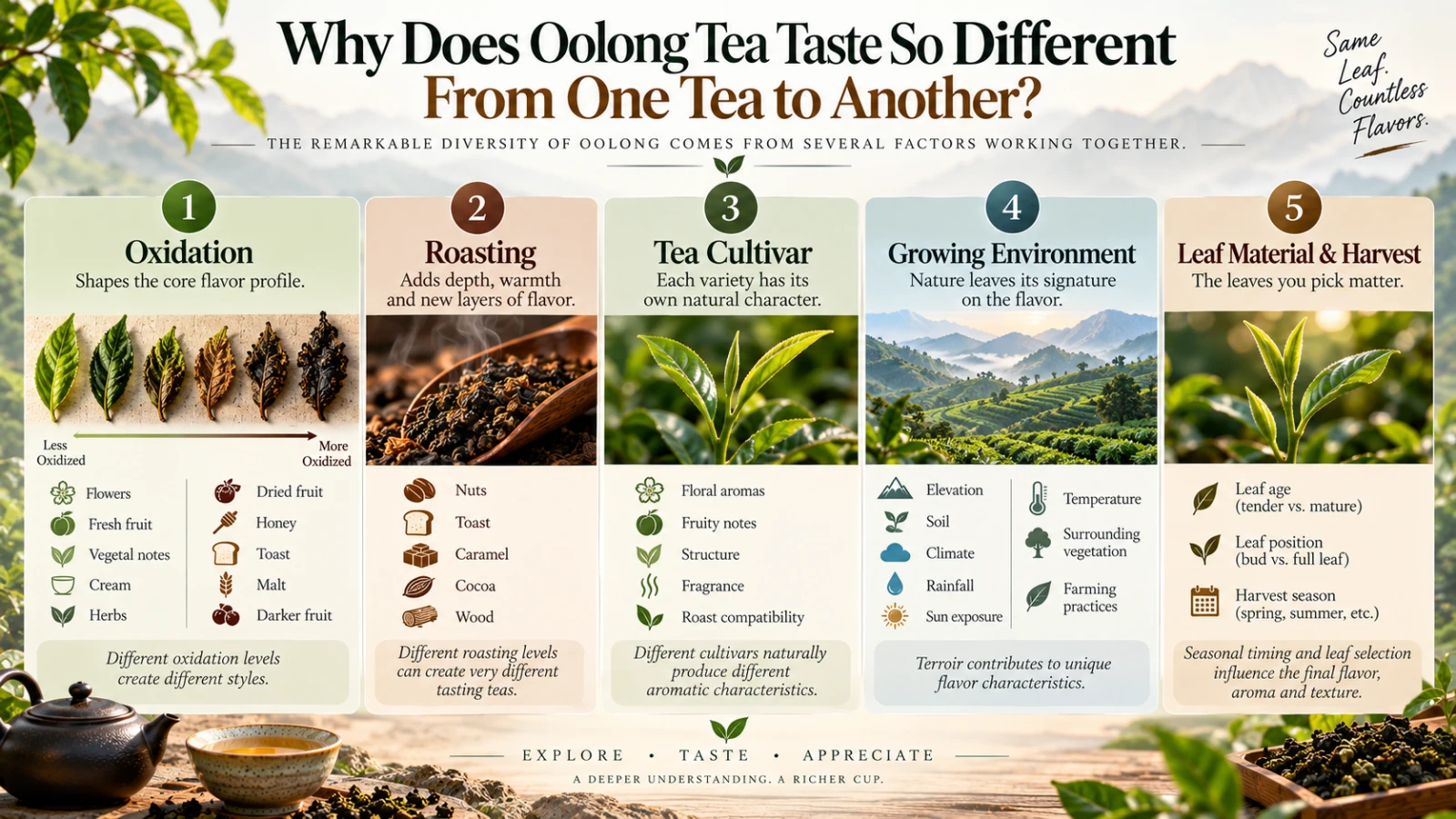
Why Does Oolong Tea Taste So Different From One Tea to Another?
The remarkable diversity of oolong comes from several factors working together.
1. Oxidation
Oxidation is one of the most important influences on oolong's flavor.
During oxidation, enzymes in the tea leaves interact with oxygen, changing the chemical composition of the leaves.
Less-oxidized oolongs often retain fresher characteristics, including:
- Flowers
- Fresh fruit
- Vegetal notes
- Cream
- Herbs
More heavily oxidized oolongs can develop characteristics such as:
- Dried fruit
- Honey
- Toast
- Malt
- Darker fruit
Oxidation is not simply a matter of "more is better." Different levels create different styles.
2. Roasting
Roasting can significantly transform the character of an oolong.
A lightly roasted tea may retain more floral or fruity qualities, while a deeper roast can introduce aromas reminiscent of nuts, toast, caramel, cocoa, or wood.
Traditional roasting may also be performed more than once, with periods of resting between roasting sessions.
This means two teas made from similar leaves can taste quite different if they receive different roasting treatments.
3. Tea Cultivar
The cultivar, or particular variety of Camellia sinensis, also affects flavor.
Different cultivars have different chemical compositions and can naturally produce different aromatic characteristics.
Some are particularly associated with floral aromas, while others are valued for fruitiness, structure, fragrance, or roast compatibility.
This is one reason experienced tea drinkers often pay attention to cultivar rather than treating all oolong tea as one category.
4. Growing Environment
Where tea is grown can influence its character.
Factors include:
- Elevation
- Soil
- Climate
- Rainfall
- Temperature
- Sun exposure
- Surrounding vegetation
- Farming practices
The concept of terroir is often used to describe the combined influence of environment and place on agricultural products.
For tea, terroir is only part of the equation. Processing remains extremely important, but growing conditions can contribute to differences between teas.
5. Leaf Material and Harvest
The age and position of leaves selected during harvesting can influence the finished tea.
Tender leaves and buds may produce different aromas and textures from more mature leaves.
Harvest season can matter as well. Seasonal environmental conditions influence how tea plants grow and can affect the resulting flavor.
Oolong Tea Taste by Style
One useful way for beginners to understand oolong is to compare broad styles rather than trying to memorize individual tasting notes.
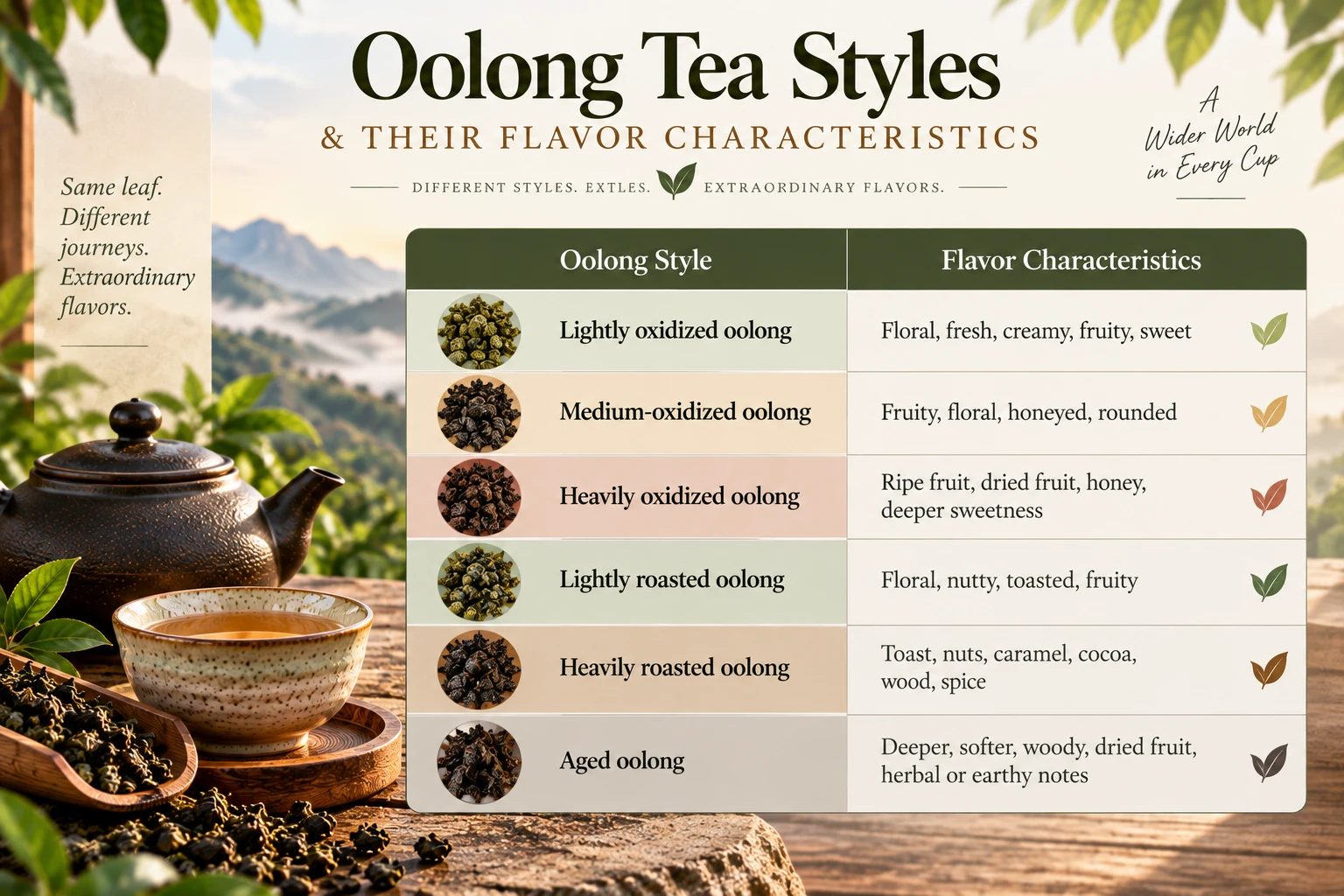
These descriptions are general rather than strict categories. Individual teas can fall outside these profiles.
What Does Oolong Tea Feel Like in the Mouth?
Flavor is only part of the experience.
Oolong tea can also differ considerably in mouthfeel.
A lightly processed or lightly roasted tea may feel:
- Light
- Silky
- Bright
- Refreshing
A fuller oolong may feel:
- Round
- Smooth
- Creamy
- Dense
- Structured
Some teas produce noticeable astringency, which creates a drying or puckering sensation. A small amount of astringency can provide structure, but excessive astringency may indicate over-extraction during brewing.
Some high-quality oolongs also have a long-lasting finish. After swallowing, the flavor can continue to develop for several seconds or longer.
This lingering character is sometimes called aftertaste or hui gan in Chinese tea terminology. The term is often used to describe a returning sweetness or evolving flavor after drinking.
Does Oolong Tea Taste Bitter?
Oolong tea does not necessarily taste bitter.
However, any tea can become bitter or excessively astringent when it is brewed too strongly.
Common causes include:
- Water that is too hot for the particular tea
- Too many leaves
- Excessively long steeping
- Repeated over-extraction
- Tea leaves that are not suited to the brewing method
Some oolongs naturally have a certain degree of bitterness or astringency, particularly when brewed at high concentrations. These characteristics are not automatically signs of poor quality.
The important distinction is balance.
A well-brewed oolong can have bitterness, astringency, sweetness, aroma, and body working together rather than one sensation overwhelming everything else.
How to Brew Oolong Tea to Taste Its Flavor
Brewing has a major effect on how an oolong tastes.
There is no single correct brewing method for every oolong, but a few principles are useful.
Western-Style Brewing
For a simple everyday preparation, place approximately 2–3 grams of tea in a cup or teapot and add hot water.
Depending on the style, water temperatures around 185–205°F (85–96°C) can work well.
Steep for roughly 2–4 minutes and adjust according to taste.
If the tea tastes too bitter or drying, reduce the steeping time or temperature. If it tastes weak, increase the amount of tea or steep slightly longer.
Gongfu-Style Brewing
Gongfu brewing uses a relatively high quantity of leaves with a smaller volume of water and short, repeated infusions.
This method is particularly useful for exploring oolong because the flavor can change significantly from one infusion to the next.
A typical starting point might be:
- Use approximately 5–8 grams of tea.
- Place the leaves in a small gaiwan or teapot.
- Add hot water.
- Steep briefly.
- Pour the tea completely.
- Repeat several times, gradually adjusting the infusion time.
The exact parameters depend on the tea.
One advantage of this approach is that it allows you to observe how the tea evolves. Early infusions may emphasize aroma, while later infusions can reveal sweetness, body, or deeper flavors.
How to Taste Oolong Tea Properly
You do not need professional tasting equipment to learn how to identify oolong's flavors.
Try the following approach.
First, Smell the Dry Leaves
Before adding water, smell the leaves.
Look for general impressions rather than trying to identify an exact flavor.
Is the aroma:
- Floral?
- Fruity?
- Toasted?
- Nutty?
- Fresh?
- Sweet?
- Woody?
Next, Smell the Wet Leaves
After brewing, smell the leaves again.
The aroma can change significantly once the leaves absorb water.
Taste the Tea
Take a small sip and allow the tea to move across your palate.
Consider:
- How strong is the flavor?
- Is it sweet, bitter, sour, or astringent?
- Does it feel light or full?
- Is the texture silky or drying?
- What remains after swallowing?
Pay Attention to the Finish
The aftertaste is particularly useful when comparing oolongs.
Some teas disappear quickly after swallowing. Others continue developing, leaving sweetness, flowers, fruit, roast, or mineral impressions behind.
Rather than asking whether a tea tastes "good" or "bad," try describing what you actually experience.
This makes tasting more objective and helps you develop your palate.
Common Mistakes When Drinking Oolong Tea
Assuming All Oolong Tastes the Same
This is perhaps the most common misunderstanding.
Oolong is an extensive category containing many styles. A lightly oxidized Taiwanese oolong may taste completely different from a heavily roasted Wuyi oolong.
Using the Same Brewing Method for Every Tea
A delicate floral oolong and a tightly rolled roasted oolong may require different brewing approaches.
Treat brewing instructions as a starting point rather than an absolute rule.
Confusing Aroma With Added Flavor
Natural tea can produce surprisingly strong aromas.
A tea that smells like flowers, fruit, cream, or honey does not necessarily contain those ingredients.
Using Very Long Steeps
Long steeping can extract excessive amounts of bitter and astringent compounds.
If your oolong tastes harsh, try shortening the infusion before assuming the tea itself is the problem.
Judging Tea From One Infusion
Especially with traditionally made oolong, one infusion may not reveal the tea's complete character.
Trying several infusions can provide a much better understanding of its aroma, texture, sweetness, and aftertaste.
How to Choose an Oolong Based on Flavor
If you are new to oolong, choosing a style based on the flavors you already enjoy can make the process easier.
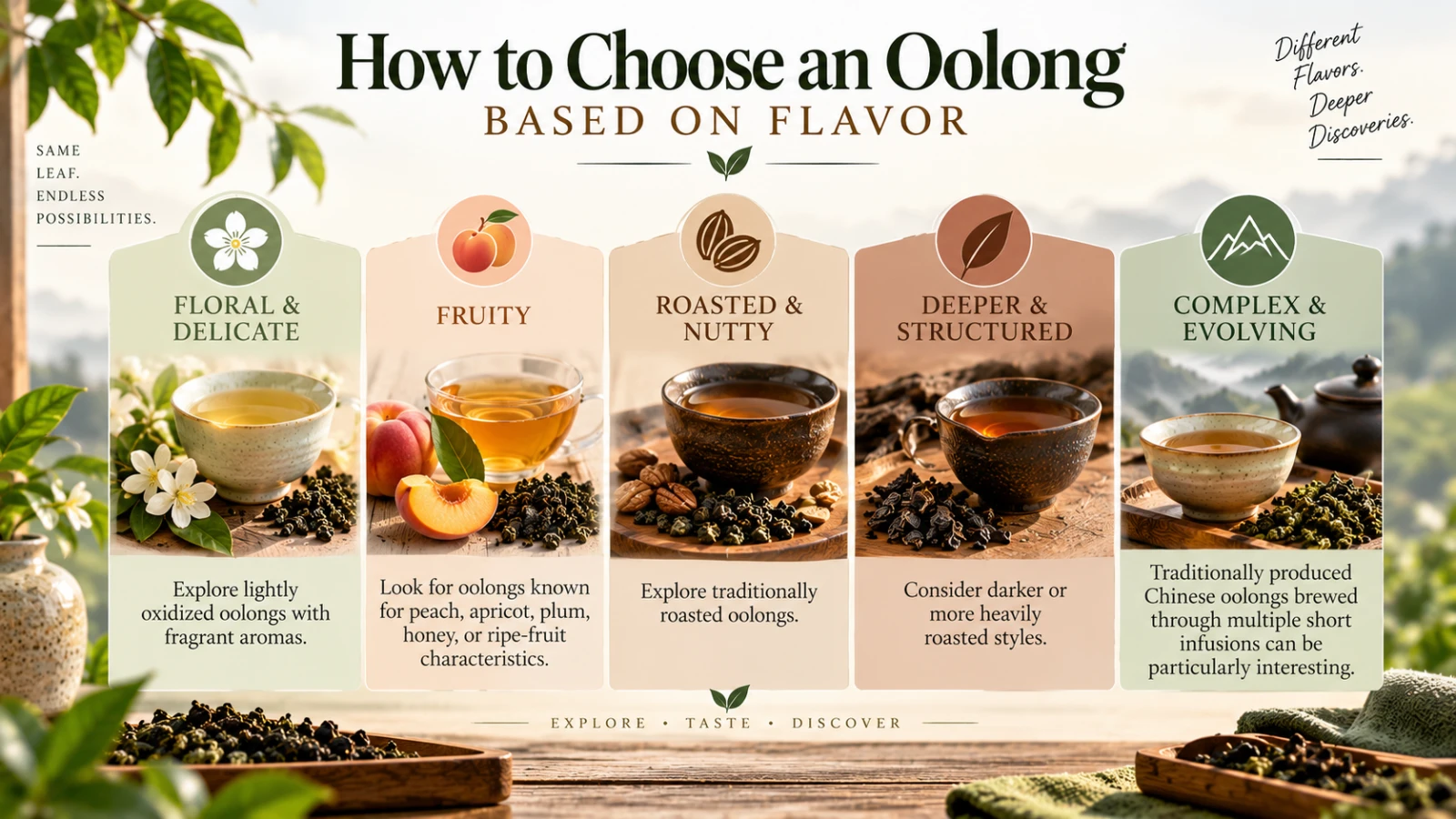
When purchasing tea, pay attention to the tea's origin, cultivar when available, harvest information, production style, and roasting level. These details can tell you considerably more about what to expect than simply the word "oolong."
Final Thoughts
So, what does oolong tea taste like?
Oolong can taste floral, fruity, creamy, honeyed, roasted, nutty, mineral, woody, or sweet, depending on how the tea is grown and processed. Its flavor is shaped by factors including cultivar, terroir, oxidation, roasting, harvesting, and brewing.
This diversity is what makes oolong such an interesting category for both beginners and experienced tea drinkers. Rather than expecting one defining flavor, approach each oolong as an individual tea with its own character.
For the best understanding, pay attention to the dry-leaf aroma, brewed leaves, mouthfeel, flavor, and aftertaste. Experiment with brewing parameters and, when possible, compare several different oolong styles side by side.
For readers interested in exploring traditional Chinese tea, Stepman's Tea offers an opportunity to learn about and experience teas produced within the long-standing traditions of Chinese tea culture. If you'd like to explore authentic Chinese oolong and compare the different flavor profiles described above, browse our carefully selected tea collection and use each tea's origin and production information as a guide to what you can expect in the cup.
FAQs
1. Is oolong tea sweet?
Some oolongs can taste naturally sweet, particularly in the aftertaste. However, they do not necessarily contain added sugar. The perception of sweetness can come from the tea's natural aromatic compounds, processing, and brewing.
2. Is oolong tea floral?
Many oolongs have floral characteristics, but not all. Lightly oxidized teas are often especially floral, while roasted or more heavily oxidized oolongs can have stronger nutty, fruity, woody, or toasted flavors.
3. Does oolong taste like green tea?
Some lightly oxidized oolongs share fresh and floral characteristics with green tea. However, oolong can also have considerably deeper roasted, fruity, creamy, or mineral characteristics.
4. Does oolong taste like black tea?
Some more heavily oxidized oolongs can share fruity, honeyed, or deeper characteristics with black tea. However, oolong generally has a much broader range of processing styles and flavor profiles.
5. Why does my oolong taste bitter?
The most common reason is over-extraction. Try using a shorter steeping time, slightly cooler water, or fewer leaves. If the tea remains strongly bitter, experiment with another brewing method.
6. Can oolong tea taste like fruit without added flavoring?
Yes. Naturally processed tea can develop aromas that remind you of peaches, apricots, plums, citrus, dried fruit, or other foods. These impressions can result from the tea cultivar, growing environment, oxidation, and processing.