How Sheng Pu-erh Is Made?
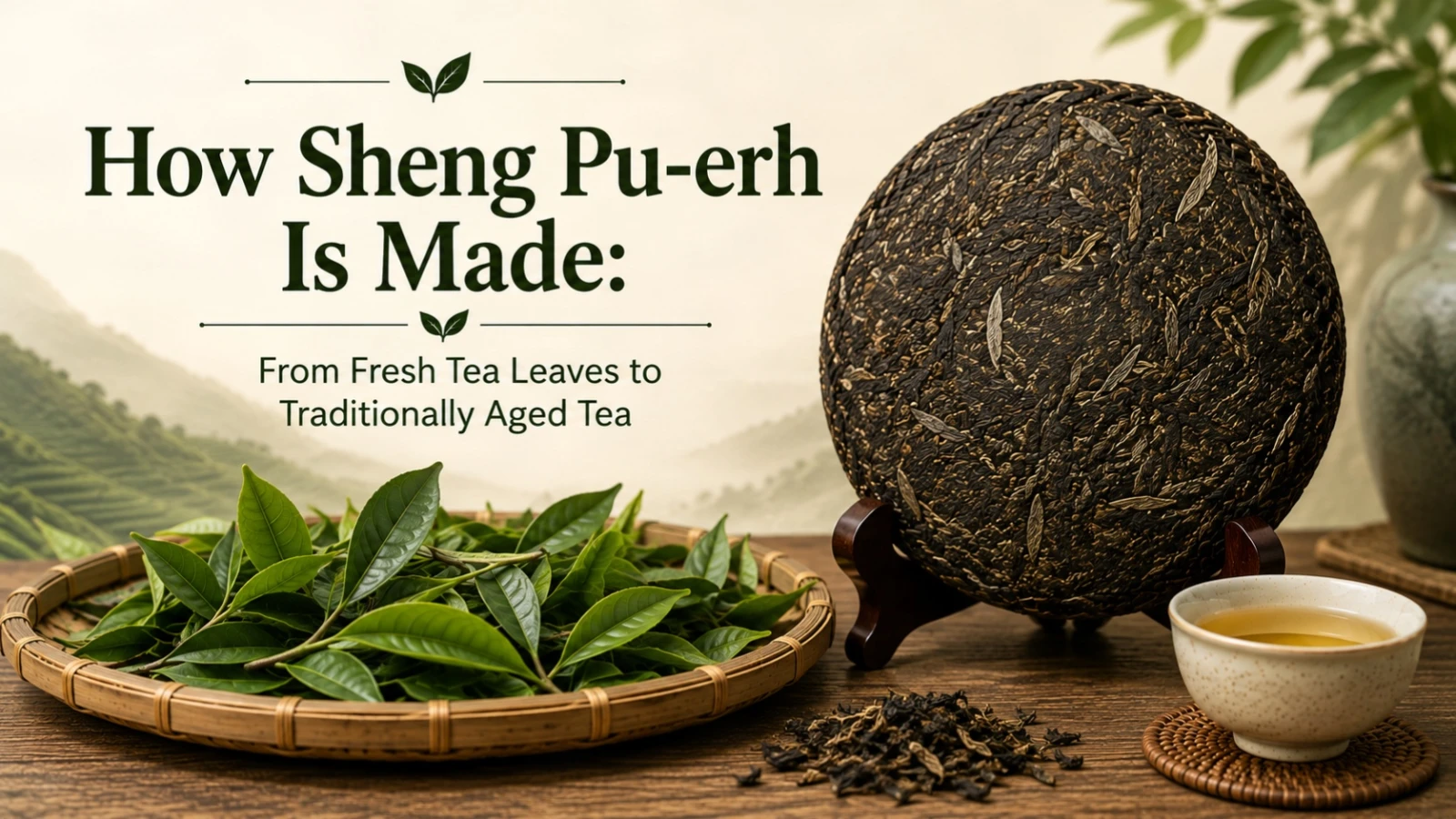
Sheng Pu-erh, often called raw Pu-erh, is one of China's most distinctive teas. Unlike many finished teas that are ready to drink shortly after production, Sheng Pu-erh is made in a way that allows the tea to continue changing over time. Its character can develop through careful aging, provided the tea is stored in an appropriate environment.
Understanding how Sheng Pu-erh is made helps explain why different cakes, regions, harvests, and ages can taste so different. It also makes it easier to recognize the difference between traditional Sheng Pu-erh production and the methods used to make other types of tea.
This guide explains what Sheng Pu-erh is, where it comes from, how fresh tea leaves are transformed into finished Pu-erh, why processing decisions matter, and what buyers should consider when selecting and storing authentic Sheng Pu-erh.
What Is Sheng Pu-erh?
Sheng Pu-erh is a style of Pu-erh tea made primarily from the leaves of Camellia sinensis var. assamica, particularly large-leaf tea cultivars traditionally associated with Yunnan Province in southwestern China.
The Chinese term sheng means "raw" or "sheng tea," while shou or shu refers to "ripe" or fermented Pu-erh. Sheng Pu-erh is therefore commonly distinguished from Shu Pu-erh by its production method.
However, "raw" does not mean that Sheng Pu-erh is simply unprocessed green tea.
Fresh leaves undergo several important stages, including withering, pan-firing, rolling, drying, sorting, and often compression. The resulting tea is generally referred to as maocha before it is compressed or further prepared for sale.
What makes Sheng Pu-erh particularly interesting is that the tea retains the potential to undergo gradual microbial and oxidative changes during storage. These changes can influence aroma, flavor, texture, color, and overall character.
In traditional production, this transformation occurs slowly rather than through the accelerated fermentation process used to produce Shu Pu-erh.
Where Does Sheng Pu-erh Come From?
The traditional home of Pu-erh is Yunnan Province, an area known for its mountainous terrain, diverse climates, ancient tea-growing regions, and long history of tea production.
Several famous tea-producing areas are associated with Sheng Pu-erh, including regions around:
- Xishuangbanna
- Pu'er
- Lincang
- Yiwu
- Jingmai
- Menghai
- Bulang
- Nannuo
Within these broad regions are numerous villages and mountain areas. Even neighboring villages can produce teas with noticeably different characteristics because of differences in elevation, cultivar, soil, climate, harvesting practices, and processing.
This is one reason Sheng Pu-erh is often discussed in terms of terroir. Much like wine, the environment in which tea is grown can contribute substantially to the final character of the finished product.
How Sheng Pu-erh Is Made
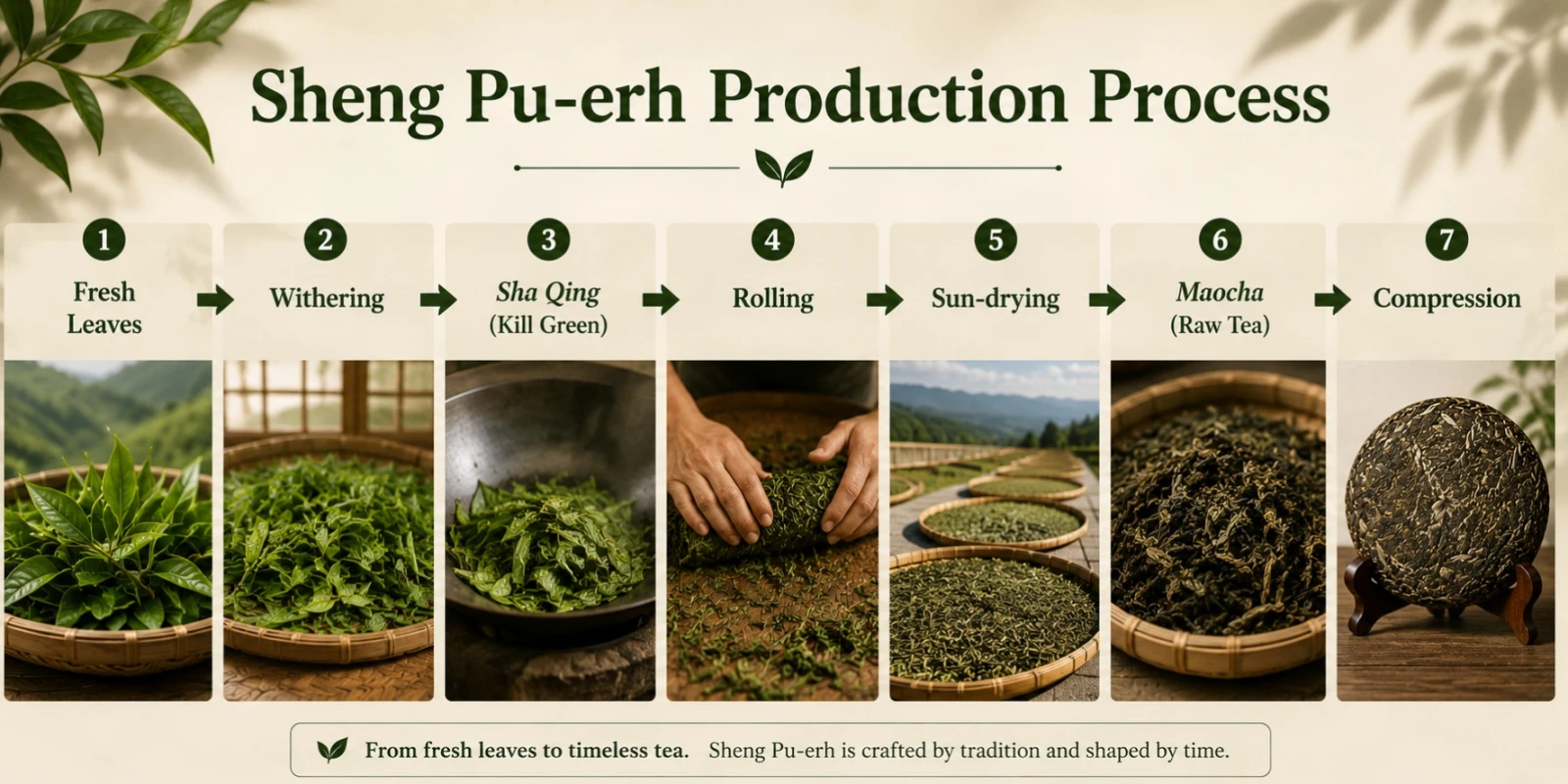
The production of Sheng Pu-erh begins with fresh tea leaves and ends with dried maocha or compressed tea. Although production practices vary by producer and region, the traditional process generally follows several stages.
1. Harvesting the Fresh Tea Leaves
The process begins in the tea garden.
Fresh leaves and young shoots are picked according to the desired style of tea. A common plucking standard may consist of a young bud accompanied by one or two leaves, although harvesting practices vary considerably.
The age and maturity of the leaves matter. Younger shoots can contribute aromatic qualities and a particular type of bitterness or astringency, while more mature leaves may contribute body, structure, and depth.
The timing of harvest also matters. Spring harvests are often highly valued, while teas produced from summer or autumn growth can have their own distinctive characteristics.
Importantly, the quality of the finished Sheng Pu-erh cannot be determined solely by the harvest season. Cultivar, growing environment, processing, storage, and production skill all influence the final tea.
2. Withering
After harvesting, the fresh leaves are spread out to lose some of their moisture.
This stage is known as withering.
Withering makes the leaves more flexible and prepares them for subsequent processing. Depending on the producer and conditions, the leaves may be spread on bamboo mats, trays, or other suitable surfaces.
Traditional production generally relies on careful handling rather than aggressive dehydration. Temperature, humidity, airflow, leaf thickness, and duration can all affect how the leaves develop.
Withering is therefore more than simply "letting the leaves dry." It is a controlled stage that influences the chemistry and physical condition of the leaves before fixation.
3. Sha Qing: Pan-Firing the Leaves
One of the most important steps in Sheng Pu-erh production is sha qing, often translated as "kill-green" or fixation.
The purpose of sha qing is to heat the leaves sufficiently to reduce the activity of enzymes responsible for rapid oxidation.
The leaves are traditionally heated in a wok or similar vessel. They are worked by hand so that heat is distributed throughout the batch.
This stage is critical because Sheng Pu-erh is intended to retain characteristics that allow it to transform during subsequent storage.
However, sha qing is not necessarily intended to stop every chemical and microbial change forever. The goal is to stabilize the fresh leaves enough for them to be processed while preserving the qualities associated with properly made Sheng Pu-erh.
The amount of heat applied, the duration of heating, and the skill of the producer can all influence the final tea.
Under-processing may leave excessive enzymatic activity, while excessive heat can alter the tea's aromatic and aging potential.
4. Rolling the Leaves
Once fixation has been completed, the leaves are rolled.
Rolling breaks down some of the leaf structure and helps shape the leaves. It also encourages the release and redistribution of compounds within the leaf.
The intensity of rolling varies according to production style.
More aggressive rolling can produce smaller particles and a stronger immediate extraction when brewed. Gentler rolling may preserve more of the leaf's physical integrity.
For traditionally produced Sheng Pu-erh, leaf appearance can therefore provide useful information, although it should never be treated as the only indicator of quality.
5. Sun-Drying
After rolling, Sheng Pu-erh is traditionally sun-dried.
This stage is particularly important in distinguishing traditional Pu-erh production from certain other tea-processing methods.
The processed leaves are spread out and dried, often using natural sunlight under appropriate conditions. The finished product at this stage is generally called maocha.
Sun-drying helps reduce moisture to a level suitable for storage and further processing.
The method and conditions of drying can affect the aroma and future character of the tea. Excessive heat or inappropriate drying may produce a different profile from carefully sun-dried material.
This is one reason traditional production emphasizes the relationship between processing technique and the tea's ability to develop over time.
What Is Maocha?
Maocha is essentially the loose-leaf form of Sheng Pu-erh before it is compressed into cakes, bricks, tuocha, or other shapes.
It has already undergone the major production steps required to create Sheng Pu-erh, but it has not necessarily been shaped into its final commercial form.
At this point, producers may sort, blend, age, or compress the tea.
Maocha can also be consumed as loose tea, although compressed Sheng Pu-erh is particularly common.
6. Sorting and Blending
Once the tea has been dried, it may be sorted according to leaf grade, size, appearance, or other production characteristics.
Some Sheng Pu-erh is produced from a single harvest or a particular village. Other teas are carefully blended.
Blending is not inherently a sign of inferior quality. In traditional tea production, blending can be used to create consistency or balance different characteristics.
For example, a producer may combine leaves with different levels of aroma, bitterness, body, or sweetness to achieve a particular profile.
The important distinction is between transparent, intentional blending and misleading labeling.
When purchasing Sheng Pu-erh, information about the region, harvest, production year, and producer can be useful when available, although claims surrounding provenance should always be evaluated carefully.
7. Compression Into Tea Cakes
A significant amount of Sheng Pu-erh is compressed into a recognizable round tea cake called a bing.
Other traditional forms include:
- Tuocha, or bowl-shaped nests
- Zhuancha, or bricks
- Fangcha, or square cakes
- Small compressed portions
Compression historically made tea easier to transport and store. It also became an important part of Pu-erh culture.
Traditionally, maocha may be steamed briefly to soften the leaves before being placed into a cloth bag or mold and compressed.
The degree of compression can vary.
A tightly compressed cake may take longer to break apart and can interact with air differently from a loosely compressed cake. Looser compression may make the tea easier to access and may influence how quickly different parts of the cake develop.
Compression itself does not automatically determine quality. It is one factor among many.
8. Drying and Final Preparation
After compression, the tea must be dried sufficiently before being packaged or placed into storage.
The finished Sheng Pu-erh can then begin its long-term development.
At this point, the tea is not necessarily considered "finished" in the same sense as many other teas. A young Sheng Pu-erh may taste fresh, floral, vegetal, bitter, astringent, or energetic.
Over time, appropriate storage can gradually change its profile.
This is the foundation of the traditional concept of aging Sheng Pu-erh.
Why Does Sheng Pu-erh Change With Age?
One of the defining characteristics of Sheng Pu-erh is its capacity for transformation.
After production, the tea continues to undergo chemical and microbial changes. The rate and direction of these changes depend on factors including:
- Temperature
- Relative humidity
- Ventilation
- Storage cleanliness
- Tea composition
- Compression
- Initial processing
- Age
- Regional environment
Young Sheng Pu-erh often has a brighter and more pronounced character. Depending on the tea, it may display bitterness, astringency, floral aromas, fresh herbs, fruit, or mineral-like notes.
As the tea matures under suitable conditions, these characteristics can become less sharp and more integrated. Aromas may develop toward dried fruit, wood, herbs, earth, camphor-like notes, honey, or other complex profiles.
Not every Sheng Pu-erh will develop in the same way.
Age alone does not guarantee quality. Poorly processed tea or improperly stored tea may deteriorate rather than improve.
Sheng Pu-erh vs. Shu Pu-erh: The Important Difference
Sheng and Shu Pu-erh are related but fundamentally different styles.
Sheng Pu-erh is traditionally produced without the accelerated wet-piling fermentation process used for Shu Pu-erh. Its transformation generally occurs gradually during storage.
By contrast, Shu Pu-erh, undergoes a controlled microbial fermentation process known as wo dui, in which moistened tea is piled and managed under controlled conditions.
This distinction is important because Shu Pu-erh is designed to reach a mature, mellow profile much more quickly, whereas Sheng Pu-erh traditionally develops over a longer period.
Neither style is inherently "better." They offer different experiences and are made for different purposes.
What Makes High-Quality Sheng Pu-erh?
Quality is not determined by age alone.
When evaluating Sheng Pu-erh, consider several factors together.
Origin
Specific information about the growing region or village can provide useful context. However, famous place names can also be used as marketing claims, so provenance should be considered alongside other evidence.
Leaf Material
Healthy, well-processed leaves should generally show reasonable consistency with the tea's stated style and production.
Whole or relatively intact leaves can provide useful visual information, although broken leaves are not automatically evidence of poor tea.
Processing
Good Sheng Pu-erh depends heavily on skilled processing.
Poor fixation, excessive heat, inappropriate drying, contamination, or excessive moisture during production can negatively affect the tea's long-term character.
Storage
Storage is critical.
Even an excellent tea can be damaged by unsuitable conditions. Exposure to excessive moisture, odors, smoke, mold, or extreme temperature fluctuations can compromise both aroma and safety.
Transparency
A reputable tea seller should provide as much useful information as reasonably available about the tea's origin, harvest, production, age, and storage.
No label can guarantee that a tea will taste a particular way, but transparent information allows buyers to make more informed decisions.
How Should Sheng Pu-erh Be Stored?
Sheng Pu-erh should be kept in a clean, dry, odor-free environment with moderate airflow and stable conditions.
It should not be stored next to strongly scented materials such as spices, perfumes, cleaning products, or heavily aromatic foods. Tea can absorb surrounding odors surprisingly easily.
Avoid environments that are excessively damp, particularly where condensation or visible mold can develop.
At the same time, extremely dry conditions can slow the natural transformation associated with aging.
For home storage, consistency is generally more useful than attempting to recreate extreme "wet storage" or "dry storage" conditions without a clear understanding of the risks.
A simple principle is:
Clean, stable, moderate, and well-ventilated storage is preferable to dramatic environmental fluctuations.
How Can You Apply This Knowledge When Buying Sheng Pu-erh?
Understanding production gives buyers a more useful framework than relying solely on age or price.
When choosing a Sheng Pu-erh, consider asking:
- Where was the tea grown?
- What year was it harvested or produced?
- What type of leaf material was used?
- How was the tea processed?
- How has it been stored?
- Is the tea single-origin or blended?
- What flavor profile should reasonably be expected?
It is also useful to taste tea before making assumptions about its value.
A young Sheng Pu-erh can be excellent without being expensive, while an older tea can be disappointing if its original material or storage history was poor.
Common Mistakes When Buying Sheng Pu-erh
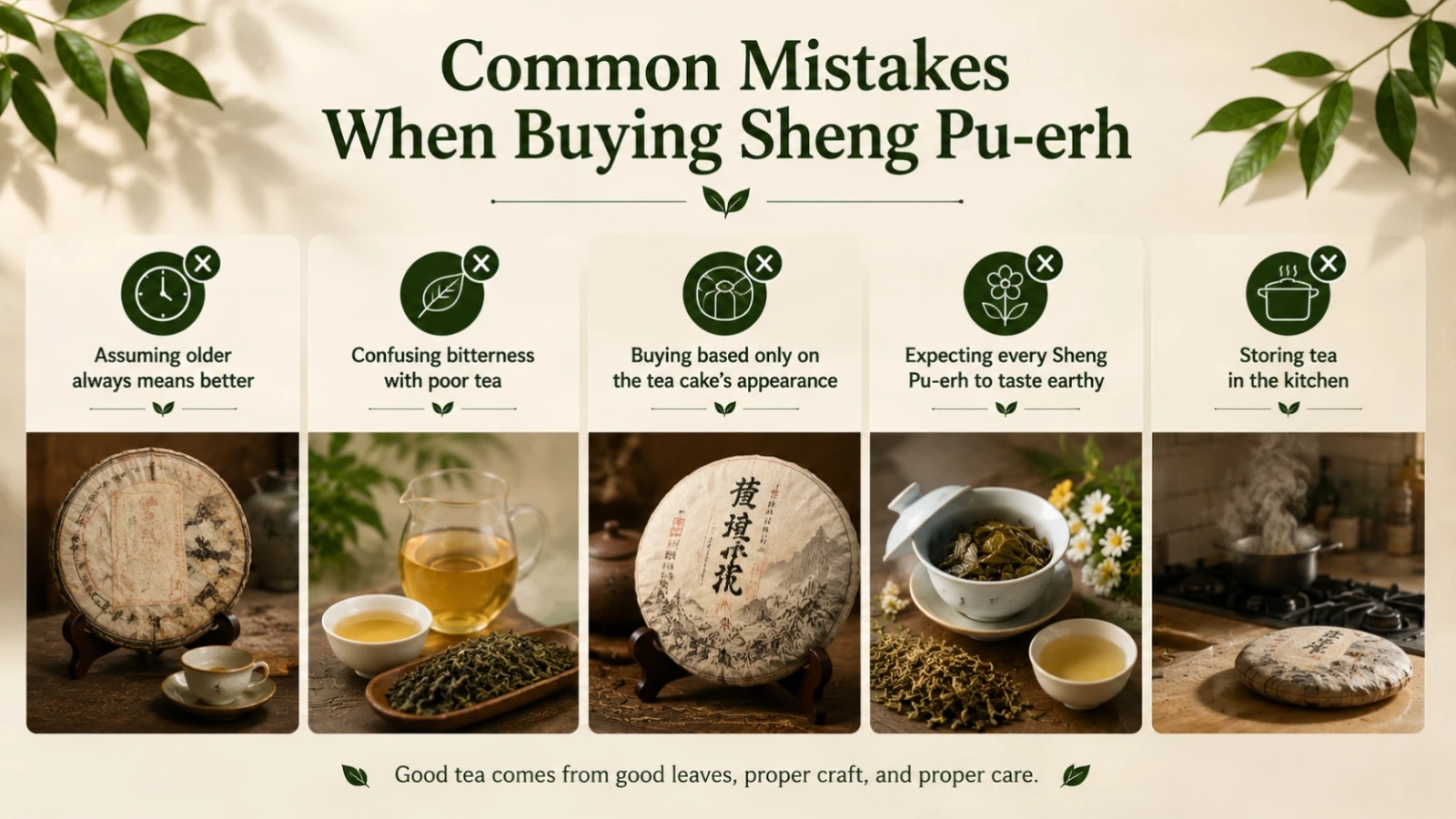
Assuming older always means better
Age is one characteristic, not a guarantee of quality.
Confusing bitterness with poor tea
Young Sheng Pu-erh can naturally be bitter or astringent. In some teas, these characteristics are part of the structure and can become more integrated with age.
Buying based only on the tea cake's appearance
Beautiful packaging and attractive leaves cannot replace information about origin, processing, and storage.
Expecting every Sheng Pu-erh to taste earthy
Earthy, mellow profiles are often associated with mature Pu-erh, particularly Shu Pu-erh. Young Sheng Pu-erh can be floral, fruity, vegetal, bitter, mineral, herbal, or highly aromatic.
Storing tea in the kitchen
Cooking odors, humidity, heat, and temperature fluctuations can create an unsuitable environment for long-term tea storage.
How Is Sheng Pu-erh Traditionally Brewed?
Once the tea has been produced and stored appropriately, brewing allows its characteristics to become apparent.
A practical starting point is to use approximately 5–7 grams of Sheng Pu-erh for a small gaiwan or teapot, adjusting according to personal preference.
Use water around 90–100°C (194–212°F) depending on the age and character of the tea.
A quick rinse can be used to awaken the compressed leaves and remove loose particles. Subsequent infusions can be short, often beginning around several seconds and gradually increasing as needed.
The key is flexibility.
Young, powerful Sheng Pu-erh may require a different approach from an older, softer tea. Rather than following a rigid recipe, adjust leaf quantity, water temperature, and steeping time according to the tea's response.
A good brewing method should reveal the tea rather than overpower it.
The Complete Journey of Sheng Pu-erh
The production of Sheng Pu-erh can be summarized as a sequence:
Fresh leaves → Withering → Sha Qing → Rolling → Sun-drying → Maocha → Sorting/blending → Compression → Drying → Storage and aging
Every stage contributes to the finished tea.
Harvesting determines the raw material. Withering prepares the leaves. Sha qing controls enzymatic activity. Rolling shapes and conditions the leaves. Sun-drying produces the traditional maocha. Compression creates the familiar tea cake or other form. Finally, storage allows the tea to develop over time.
This is why Sheng Pu-erh cannot be understood simply as "old tea."
It is the result of agricultural conditions, craftsmanship, processing decisions, storage, and time.
Conclusion
Sheng Pu-erh is traditionally made from large-leaf tea grown in Yunnan and processed through a sequence of harvesting, withering, fixation, rolling, sun-drying, and often compression. Unlike Shu Pu-erh, it does not undergo accelerated wet-pile fermentation. Instead, properly stored Sheng Pu-erh can gradually transform over time.
The most important lesson is that age is only one part of the story. The quality of the raw material, growing environment, processing technique, compression, storage conditions, and provenance all contribute to the tea's character.
For those beginning to explore Sheng Pu-erh, learning how the tea is made provides a practical foundation for choosing, brewing, and storing it with greater confidence.
If you'd like to experience authentic Chinese Sheng Pu-erh and explore teas selected with attention to traditional production and character, you can explore the carefully chosen collection at Stepman's Tea. The best way to understand Sheng Pu-erh is ultimately to taste teas from different regions, harvests, ages, and processing styles and observe how each one develops in the cup.
FAQ Section
1. What is Sheng Pu-erh?
Sheng Pu-erh is a traditionally produced style of Pu-erh tea, usually made from large-leaf tea cultivars grown in Yunnan, China. The leaves are processed through harvesting, withering, sha qing, rolling, and drying before being sold loose or compressed. Sheng Pu-erh can continue developing in character during suitable storage.
2. How is Sheng Pu-erh made?
Sheng Pu-erh is generally made by harvesting fresh tea leaves, withering them, applying sha qing to reduce enzymatic oxidation, rolling the leaves, and sun-drying them. The resulting maocha may then be sorted, blended, and compressed into cakes, bricks, or other forms.
3. What is the difference between Sheng Pu-erh and Shu Pu-erh?
The main difference is how they are produced and aged. Sheng Pu-erh is traditionally processed without the accelerated wet-pile fermentation used for Shu Pu-erh. Sheng generally develops gradually during storage, while Shu undergoes controlled microbial fermentation designed to produce a more mature character in a shorter period.
4. Is Sheng Pu-erh the same as green tea?
No. Although some young Sheng Pu-erh can share fresh or vegetal characteristics with green tea, they are produced according to different traditions and have different aging potential. Sheng Pu-erh is specifically associated with Pu-erh production in Yunnan and can undergo significant changes during storage.
5. What is maocha?
Maocha is the loose tea produced after the primary processing of Pu-erh leaves. In Sheng Pu-erh production, the leaves are typically harvested, withered, fixed, rolled, and dried before becoming maocha. Maocha can then be sold loose or compressed into forms such as tea cakes.
6. What does sha qing mean?
Sha qing, written as 杀青, is a tea-processing step commonly translated as "kill-green" or fixation. Tea leaves are heated, traditionally in a wok, to reduce enzymatic activity and stabilize the leaves for subsequent processing.
7. Why is Sheng Pu-erh sun-dried?
Traditional Sheng Pu-erh is commonly sun-dried after rolling. Sun-drying reduces moisture while contributing to the characteristics of the finished maocha. The drying process is an important part of traditional Pu-erh production.
8. Does Sheng Pu-erh get better with age?
Not necessarily. Sheng Pu-erh can change significantly with age, but age alone does not guarantee better quality. The original tea material, processing, storage environment, and overall condition all influence how a tea develops.
9. How should Sheng Pu-erh be stored?
Sheng Pu-erh should generally be stored in a clean, odor-free environment with stable conditions and moderate airflow. Excessive moisture, mold, strong odors, and extreme temperature fluctuations should be avoided.
10. Why is Sheng Pu-erh compressed into cakes?
Compression historically made Pu-erh easier to transport and store. Today, tea cakes remain one of the most recognizable forms of Sheng Pu-erh. Different degrees of compression can also affect how easily the tea is broken apart and how it interacts with its storage environment.
11. Where does Sheng Pu-erh come from?
Sheng Pu-erh is traditionally associated with Yunnan Province in southwestern China. Important tea-producing areas include Xishuangbanna, Pu'er, Lincang, and numerous mountain and village regions within these areas.
12. Is older Sheng Pu-erh always better?
No. Age is only one factor in evaluating Sheng Pu-erh. A well-made, properly stored younger tea may be more enjoyable than an older tea that was poorly processed or stored.