How to Brew Shu Pu-erh Using Gongfu Style
Brewing Shu Pu-erh using the Gongfu method is a simple way to explore the tea's changing character from one infusion to the next. Rather than preparing one large pot and steeping the leaves once, Gongfu brewing uses a small teapot or gaiwan, a relatively high leaf-to-water ratio, and multiple short infusions.
This method is especially well suited to Shu Pu-erh. The tea's earthy, mellow character can develop gradually as the leaves open, revealing changes in aroma, texture, and flavor throughout a session.
In this guide, we will explain how to brew Shu Pu-erh using Gongfu style, what equipment you need, how much tea and water to use, and how to adjust brewing when the results are too weak, too strong, or unbalanced. The goal is not to follow a rigid formula, but to understand the brewing process well enough to make practical adjustments.
What Is Gongfu-Style Brewing?
Gongfu brewing, often written as Gongfu Cha, is a traditional Chinese tea preparation method that focuses on careful brewing and repeated infusions. The word “Gongfu” is commonly associated with skill, effort, and practiced technique.
Unlike Western-style brewing, where a larger amount of water is usually used to steep tea for several minutes, Gongfu brewing generally involves:
- A small brewing vessel
- More tea leaves relative to the amount of water
- Shorter steeping times
- Multiple infusions
The method allows the brewer to observe how a tea changes over time.
For Shu Pu-erh, this is important because the leaves may release their flavor and aroma gradually. A first infusion may be quiet and smooth, while later infusions can show more depth and body. The exact experience depends on the tea, its compression, leaf grade, age, and storage.
Why Brew Shu Pu-erh Gongfu Style?
Shu Pu-erh can be prepared in several ways, including a mug, teapot, or Western-style teapot. Gongfu brewing is not the only correct method. Its value is that it gives the brewer greater control over the tea.
It highlights changes between infusions
The short brewing cycles make it easier to notice how Shu Pu-erh develops. Instead of tasting one final cup, you experience a series of infusions.
It provides more control
If the tea is too strong, the next infusion can be shortened. If the flavor is too light, you can steep the leaves longer. Gongfu brewing allows adjustments throughout the session.
It works well with compressed tea
Many Shu Pu-erh teas are sold in cakes, bricks, or other compressed forms. Once the leaves are carefully separated, the tea can be brewed repeatedly.
It encourages careful tasting
The Gongfu method places attention on aroma, flavor, mouthfeel, and changes in the leaves. For anyone learning more about Chinese tea, this makes it a useful educational brewing style.
What You Need to Brew Shu Pu-erh Gongfu Style
You do not need an elaborate tea setup to begin. A few basic items are enough.
1. Shu Pu-erh tea
Loose-leaf Shu Pu-erh is convenient for beginners. If you are using a compressed cake or brick, you will also need a tea pick or another suitable tool for carefully loosening the leaves.
2. A gaiwan or small teapot
A gaiwan is a lidded Chinese tea bowl traditionally used for brewing tea. A small teapot can also work well.
A vessel holding approximately 90–150 milliliters is a practical size for Gongfu brewing. Smaller vessels make it easier to maintain a higher tea-to-water ratio and control individual infusions.
3. Kettle
A temperature-controlled kettle is useful, although a standard kettle can also work. Shu Pu-erh is commonly brewed with very hot water.
4. Cups
Small tasting cups are traditionally used, but any small cup will work. The important thing is to pour each infusion completely rather than leaving brewed tea sitting with the leaves.
5. Optional tea tray or serving vessel
A tea tray, fairness pitcher, or serving vessel can make the process more convenient. None of these are essential for learning how to brew Shu Pu-erh.
How Much Shu Pu-erh Should You Use?
A useful starting point is approximately 5–8 grams of Shu Pu-erh for 100–150 milliliters of water.
This is only a starting range. The right amount depends on several factors:
- The size of your brewing vessel
- The type of Shu Pu-erh
- How tightly the tea is compressed
- Your preferred strength
- How quickly the leaves open
If you are new to Gongfu brewing, using slightly less tea can make the session easier to control. You can always increase the amount later.
A practical starting ratio
For a 100-milliliter gaiwan, try 5–6 grams of Shu Pu-erh.
For a 150-milliliter teapot, try 7–8 grams.
These amounts are not strict rules. Gongfu brewing is a method that rewards observation and adjustment.
Step-by-Step: How to Brew Shu Pu-erh Using Gongfu Style
Step 1: Warm the brewing vessel
Pour hot water into your gaiwan or teapot, swirl it briefly, and discard the water.
Warming the vessel helps reduce the temperature difference between the hot water and the brewing equipment. It also begins to warm the tea leaves once they are added.
This step is simple, but it can make the brewing process more consistent.
Step 2: Add the Shu Pu-erh
Measure your tea and place it into the gaiwan or teapot.
If you are using compressed Shu Pu-erh, separate the leaves carefully. Avoid crushing the tea into small pieces whenever possible. The goal is to loosen the tea while preserving the structure of the leaves.
Very tightly compressed tea may need more time to open during the first few infusions.
Step 3: Smell the dry leaves
Before adding water, take a moment to examine the dry tea.
You may notice aromas that are difficult to identify at first. The dry leaves can offer an initial impression of the tea's character.
This is also a useful habit when learning to evaluate tea. Paying attention before brewing helps you compare how the aroma changes once the leaves are warmed and hydrated.
Step 4: Rinse the tea
Pour hot water over the leaves and allow the tea to sit briefly. Then pour the water off completely.
For Shu Pu-erh, one or two quick rinses are commonly used.
The purpose of rinsing is to hydrate the leaves and prepare them for brewing. With compressed tea, a rinse can also help begin loosening the leaves.
A rinse should generally be short. It is not intended to be a full drinking infusion.
Should you always rinse Shu Pu-erh?
Not necessarily.
Rinsing is a common practice, particularly when preparing compressed or older teas, but the best approach can depend on the tea and the brewer. If you are working with a clean, well-made Shu Pu-erh and want to minimize discarded tea, you may choose to use a very brief first infusion instead.
For a traditional Gongfu session, however, one quick rinse is a reasonable starting point.
Step 5: Brew the first infusion
Add hot water to the tea and begin your first infusion.
For a starting point, try approximately 5–10 seconds after the rinse.
Pour the tea out completely.
The first infusion may be lighter than expected, especially if the tea is tightly compressed. Do not assume the tea is weak based on this infusion alone.
Step 6: Taste and observe
Take a moment to taste the tea.
Rather than focusing only on whether you “like” it, consider a few basic questions:
- What does the tea smell like?
- Is the flavor light or full?
- Does the tea feel smooth or drying?
- Is the flavor primarily earthy, woody, sweet, or something else?
- How does the aftertaste develop?
You do not need advanced tasting vocabulary. Simple observations are enough.
Step 7: Continue with short infusions
Continue brewing the Shu Pu-erh in repeated infusions.
A practical starting schedule might look like this:
| Infusion | Approximate Time |
|---|---|
| 1 | 5–10 seconds |
| 2 | 5–10 seconds |
| 3 | 5–15 seconds |
| 4 | 10–20 seconds |
| 5 onward | Adjust as needed |
These times are only guidelines. Some Shu Pu-erh will require longer steeping, while others may become strong quickly.
The most important rule is to taste and adjust.
What Water Temperature Is Best for Shu Pu-erh?
Shu Pu-erh is generally brewed with very hot water, often close to boiling.
Unlike delicate green teas, Shu Pu-erh typically benefits from high brewing temperatures. Hot water helps extract the tea's flavor and allows the leaves to open during repeated infusions.
For most Gongfu sessions, water around 95–100°C (203–212°F) is a useful starting range.
If your tea tastes overly intense or rough, you can experiment with slightly cooler water. However, lowering the temperature is not always the first adjustment to make. Often, shortening the steeping time is a simpler way to control strength.
How Long Should You Steep Shu Pu-erh?
There is no single correct steeping time for every Shu Pu-erh.
This is one of the most important things to understand when learning how to brew Shu Pu-erh.
Steeping time is affected by:
- Leaf size
- Compression
- Tea-to-water ratio
- Age and storage
- The structure of the tea
- Your personal preference
A short infusion can produce a lighter cup. A longer infusion generally extracts more flavor.
If the tea tastes too weak
Try one of the following:
- Increase the steeping time
- Use slightly more tea
- Make sure the water is hot enough
- Give the leaves more time to open
If the tea tastes too strong
Try:
- Shortening the next infusion
- Using slightly less tea
- Pouring the infusion out more quickly and completely
Do not change several variables at once. If you alter the tea amount, water temperature, and steeping time together, it becomes difficult to understand what actually changed.
A Simple Gongfu Brewing Schedule for Beginners
If you want a straightforward starting method, use this process:
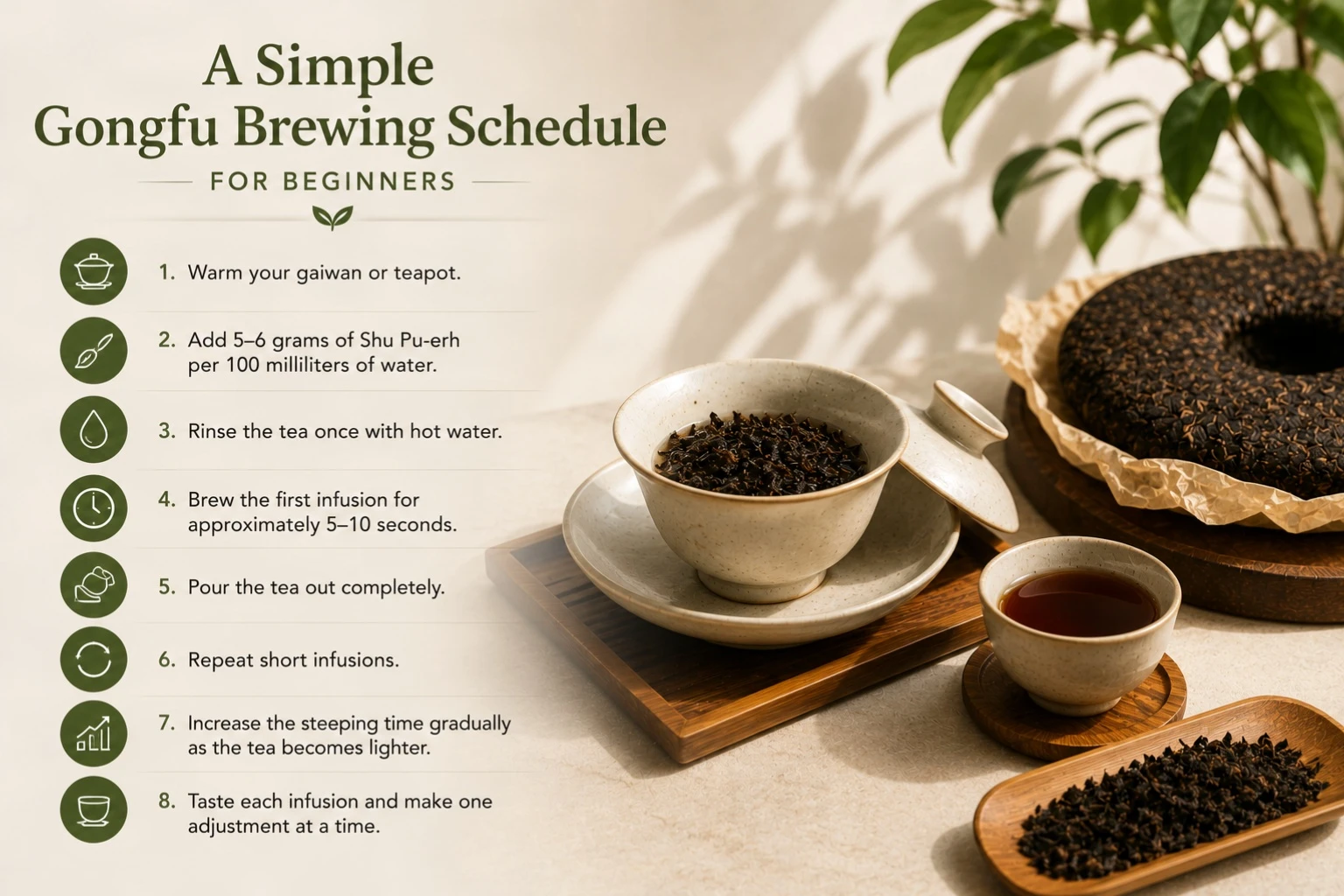
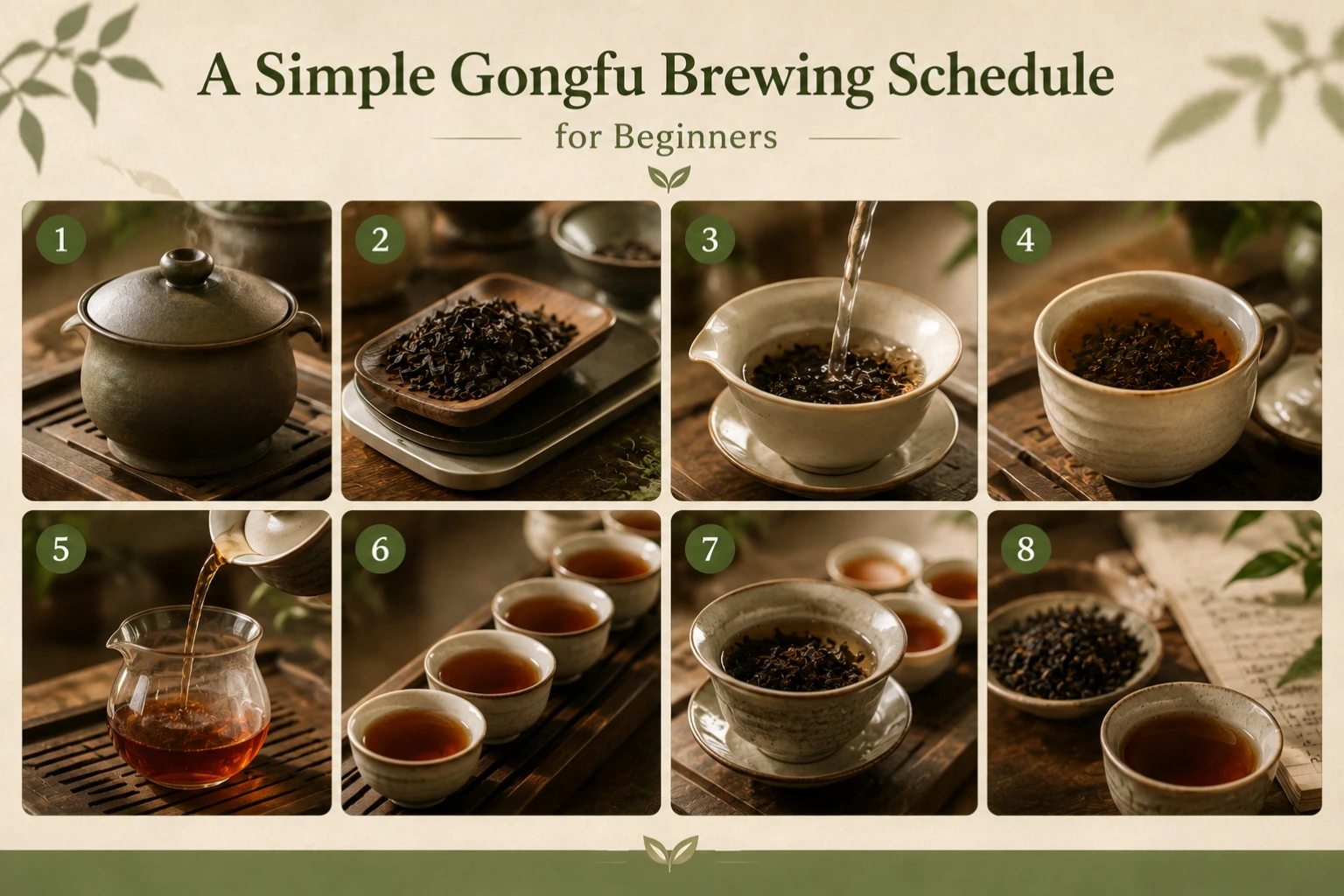
- Warm your gaiwan or teapot.
- Add 5–6 grams of Shu Pu-erh per 100 milliliters of water.
- Rinse the tea once with hot water.
- Brew the first infusion for approximately 5–10 seconds.
- Pour the tea out completely.
- Repeat short infusions.
- Increase the steeping time gradually as the tea becomes lighter.
- Taste each infusion and make one adjustment at a time.
This approach gives you a reliable starting point without treating Gongfu brewing as a strict formula.
Common Mistakes When Brewing Shu Pu-erh Gongfu Style
- Using too little tea in a large vessel
Gongfu brewing generally uses a higher tea-to-water ratio than Western brewing. If you use a small amount of tea in a large teapot, the result may be thin and difficult to evaluate.
- Steeping for several minutes immediately
Long steeping times are not usually necessary at the beginning of a Gongfu session. Start with short infusions and increase the time gradually.
- Leaving brewed tea with the leaves
If tea remains in the gaiwan or teapot between infusions, the leaves continue to release flavor. This can make the next infusion unexpectedly strong.
Pour the tea out completely after each infusion.
- Treating brewing times as fixed rules
A chart can be helpful, but it cannot account for every Shu Pu-erh. Tea changes depending on its structure and condition.
Use brewing times as a starting point rather than a requirement.
- Overworking compressed tea
When breaking apart a Shu Pu-erh cake, avoid aggressively crushing the leaves. Smaller fragments can brew more quickly than larger pieces and may produce a less balanced session.
How Many Times Can Shu Pu-erh Be Infused?
Many Shu Pu-erh teas can be brewed through multiple Gongfu infusions.
The exact number varies significantly. Some teas may offer several enjoyable infusions, while others continue developing over a much longer session.
The tea's quality, leaf material, compression, and brewing approach all influence how long it remains flavorful.
Rather than counting infusions as a fixed number, pay attention to the tea itself. When the flavor has become very light and additional steeping no longer produces much character, the session is generally coming to an end.
How to Improve Your Gongfu Brewing Over Time
The best way to improve is to brew the same tea more than once.
During your first session, focus on becoming familiar with the basic process. On a later session, try changing just one variable.
For example:
- Use the same tea but add slightly more leaves.
- Keep the tea amount the same but shorten the infusions.
- Compare a 100-milliliter gaiwan with a larger vessel.
- Try a slightly different water temperature.
Keeping simple notes can also be helpful. Record the tea, approximate leaf amount, water temperature, and steeping times.
You do not need to create formal tasting notes. A few words such as “light,” “smooth,” “woody,” or “strong” are enough to help you recognize patterns.
Final Thoughts on Brewing Shu Pu-erh Gongfu Style
Learning how to brew Shu Pu-erh using Gongfu style is less about memorizing exact times and more about understanding how the tea responds to water.
Use a small gaiwan or teapot, start with a moderate amount of tea, rinse the leaves briefly if appropriate, and begin with short infusions. From there, taste each infusion and adjust gradually.
The Gongfu method is particularly useful for exploring Shu Pu-erh because it allows the tea to develop over a series of brews. With practice, you will become more comfortable recognizing when to shorten a steep, increase the time, or simply allow the leaves more time to open.
If you'd like to experience authentic Shu Pu-erh prepared in the traditional Chinese style, explore Stepman's Tea collection of carefully selected Chinese teas and discover a tea that suits your own brewing journey.
FAQs
1. What is the best temperature for brewing Shu Pu-erh?
Shu Pu-erh is generally brewed with water between 95°C and 100°C (203°F–212°F). The high temperature helps fully extract the tea's smooth, earthy character while encouraging compressed leaves to open during successive infusions.
2. How much Shu Pu-erh should I use for Gongfu brewing?
A good starting point is 5–8 grams of tea for every 100–150 ml of water. The exact amount can be adjusted depending on the tea, brewing vessel, and personal taste preferences.
3. Should Shu Pu-erh be rinsed before brewing?
Many tea drinkers perform one quick rinse before the first infusion. Rinsing helps hydrate compressed leaves and prepares them for brewing. While common in traditional Gongfu preparation, it is ultimately a matter of personal preference.
4. How long should I steep Shu Pu-erh?
The first few Gongfu infusions are typically brewed for 5–10 seconds, with steeping times gradually increasing as the leaves release less flavor. Rather than following fixed times, adjust each infusion based on taste.
5. How many infusions can Shu Pu-erh produce?
Quality Shu Pu-erh can often produce multiple flavorful infusions when brewed Gongfu style. The exact number depends on the tea's quality, leaf material, compression, and brewing technique.
6. Can beginners brew Shu Pu-erh using Gongfu style?
Yes. Gongfu brewing is approachable for beginners once the basic principles are understood. Using a small gaiwan or teapot, hot water, and short infusions allows new tea drinkers to gradually learn how different brewing adjustments affect flavor.
7. Do I need a gaiwan to brew Shu Pu-erh?
A gaiwan is traditional and offers excellent control, but it is not essential. A small teapot of similar size works equally well for Gongfu brewing.
8. Why does Shu Pu-erh taste different with each infusion?
As the leaves gradually open, different compounds dissolve into the water at different rates. This allows aroma, body, sweetness, and earthy notes to evolve throughout the brewing session, making Gongfu brewing particularly rewarding.