What Does Sheng Pu-erh Taste Like?
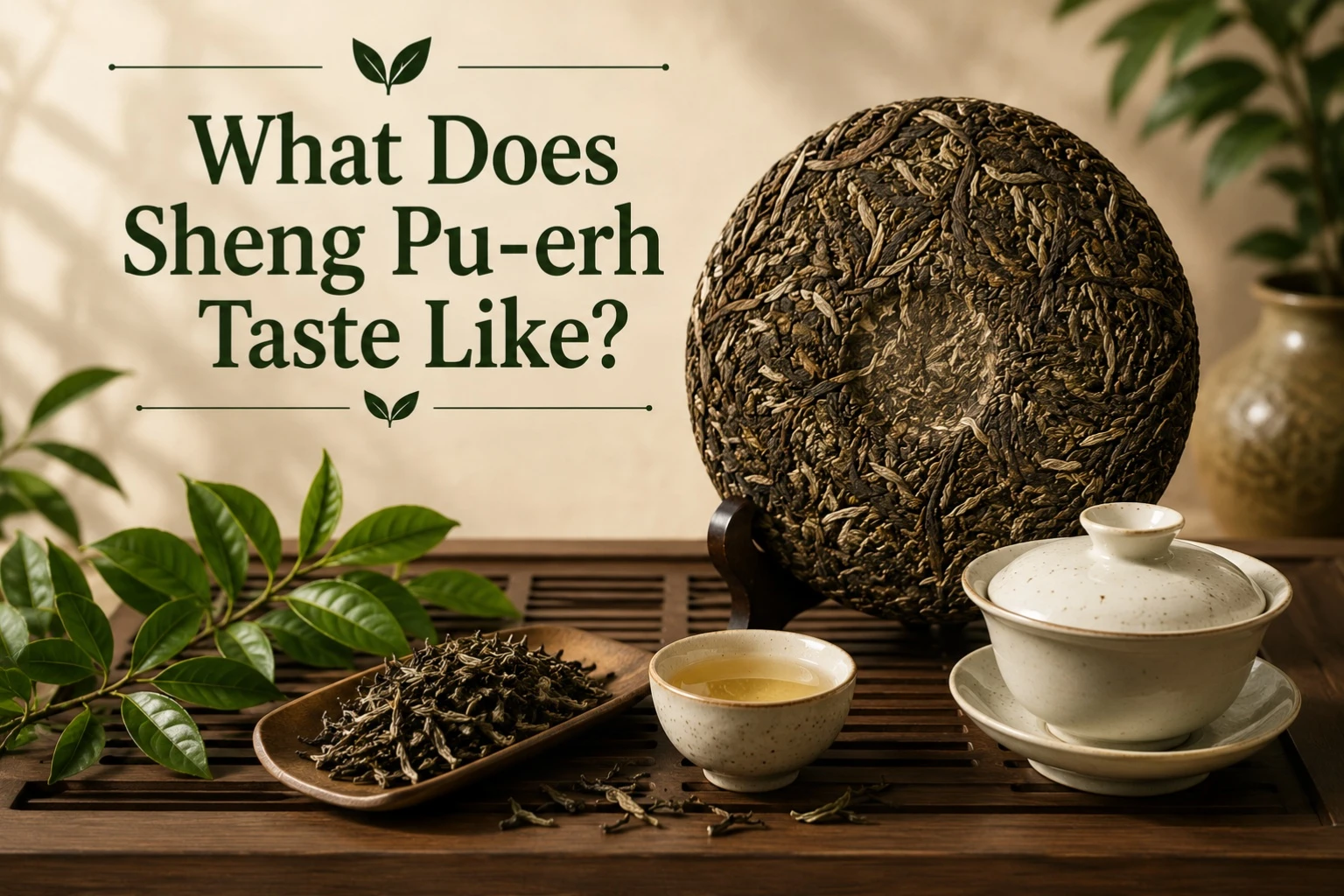
Sheng Pu-erh, also called raw Pu-erh tea, is known for a flavor profile that can change dramatically depending on the tea’s age, origin, processing, storage, and brewing method. A young Sheng Pu-erh may taste fresh, vegetal, floral, bitter, or distinctly astringent, while an older tea can become smoother, sweeter, deeper, and more aromatic.
This range is one of the defining characteristics of Sheng Pu-erh. Unlike many teas that have a relatively recognizable flavor profile, raw Pu-erh develops over time. Its taste is not fixed at production; it can continue to evolve during storage.
In this guide, we’ll look at what Sheng Pu-erh tastes like when young and aged, why bitterness and astringency are important, how processing and aging influence flavor, and how to brew and evaluate a tea for yourself.
What Is Sheng Pu-erh?
Sheng Pu-erh is a traditional style of Pu-erh tea made primarily from large-leaf tea varieties grown in Yunnan, China. The fresh leaves are processed into a sun-dried tea known as maocha, which can then be compressed into cakes, bricks, tuos, or other forms.
The defining distinction between Sheng and Shu Pu-erh is processing.
Sheng Pu-erh is not artificially pile-fermented to accelerate maturation. Instead, Sheng Pu-erh is traditionally made and then allowed to change gradually through storage. Over time, exposure to oxygen, temperature, humidity, and the tea's surrounding environment contributes to chemical and sensory changes.
This is why Sheng Pu-erh is often described as a tea with an evolving character.
Research published in recent years has confirmed that storage produces measurable changes in both the volatile compounds responsible for aroma and the non-volatile compounds associated with taste and mouthfeel. Studies have observed decreases in bitterness and astringency alongside increases in sweetness, mellow character, and certain aged aromas as raw Pu-erh matures.
So, What Does Sheng Pu-erh Actually Taste Like?
There is no single flavor that defines every Sheng Pu-erh.
However, several characteristics appear frequently:
- Bitterness
- Astringency
- Freshness
- Floral aromas
- Herbal or vegetal notes
- Fruity characteristics
- Sweetness
- Mineral or earthy impressions
- Long-lasting aftertaste
- Increasingly woody or mature aromas with age
The balance among these qualities is what makes one Sheng Pu-erh taste very different from another.
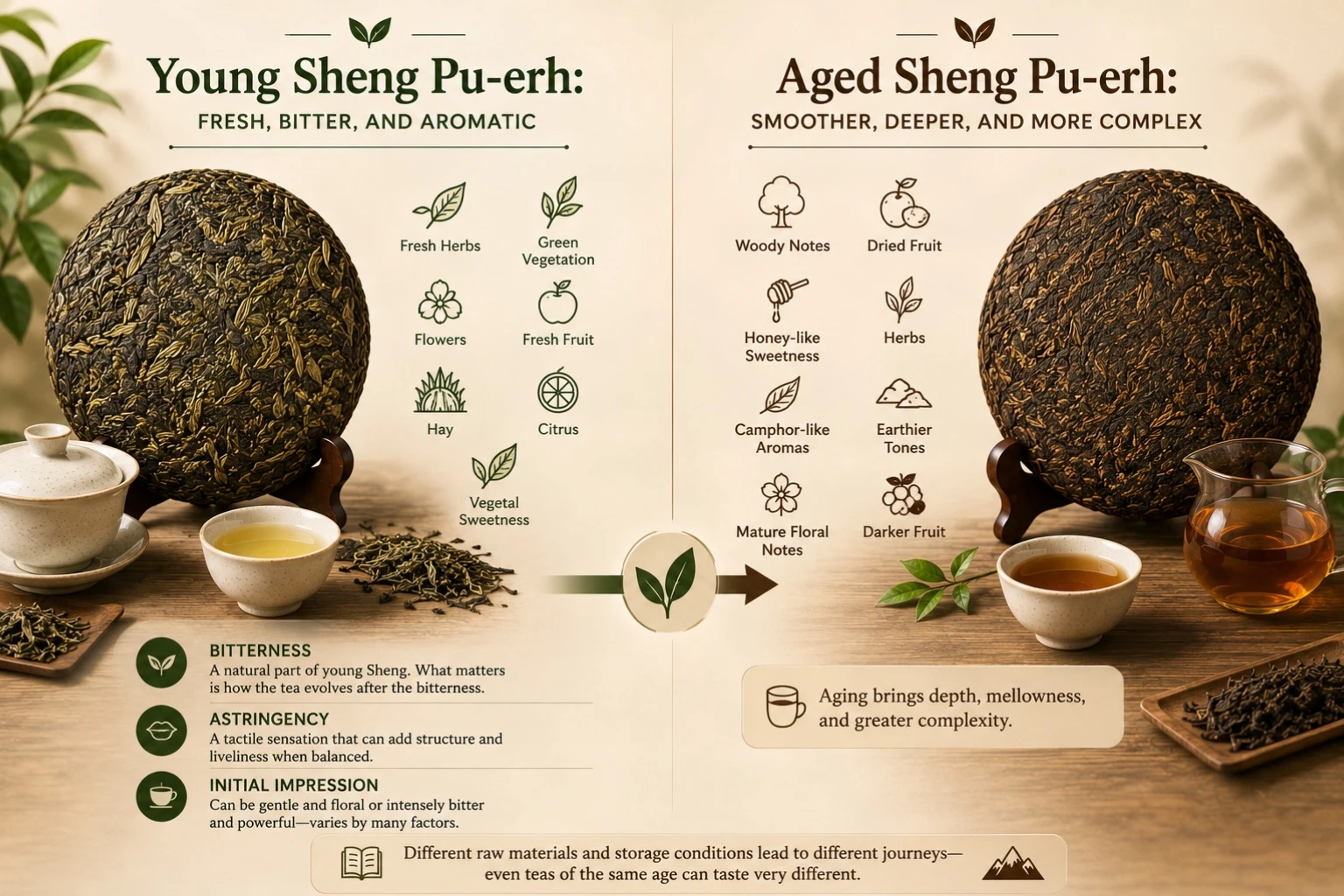
A young tea might remind you of fresh vegetation, flowers, herbs, stone fruit, or green tea, with a pronounced bitterness and drying sensation. A more mature Sheng may offer honeyed sweetness, dried fruit, wood, herbs, camphor-like aromas, earthier tones, and a softer mouthfeel.
Importantly, bitterness does not automatically mean poor quality. In traditional Pu-erh tasting, bitterness and astringency can be evaluated alongside sweetness, texture, aroma, persistence, and the way the tea changes in the mouth.
Young Sheng Pu-erh: Fresh, Bitter, and Aromatic
Young Sheng Pu-erh generally has the most pronounced fresh character.
Depending on the material and processing, the dry leaves and brewed liquor may show aromas reminiscent of:
- Fresh herbs
- Green vegetation
- Flowers
- Fresh fruit
- Hay
- Citrus
- Vegetal sweetness
The flavor can be lively and energetic, often accompanied by noticeable bitterness or astringency.
Some young Sheng teas are relatively gentle and floral. Others can be intensely bitter, powerful, and drying. This difference can come from factors such as tea cultivar, harvest material, growing environment, leaf maturity, processing, and brewing.
Bitterness
Bitterness is one of the most recognizable characteristics of young Sheng Pu-erh.
Tea leaves naturally contain compounds such as catechins and caffeine that contribute to bitterness and astringency. Research examining raw Pu-erh has found that galloylated catechins are particularly important contributors to changes in astringency during storage.
A bitter first impression is therefore not unusual in young Sheng.
What matters is what happens after the bitterness appears.
A tea may begin bitter and then quickly become sweet. Another may leave a persistent drying sensation. Some teas have a sharp bitterness, while others have a rounded or deep bitterness.
This is one reason experienced drinkers often pay attention to the tea's aftertaste rather than judging it solely from the first sip.
Astringency
Astringency is different from bitterness.
Bitterness is a taste sensation. Astringency is primarily a tactile sensation that can make the mouth feel dry, puckered, or slightly tightened.
Young Sheng Pu-erh can have considerable astringency, particularly when brewed strongly.
Astringency is not necessarily undesirable. In a well-balanced tea, it may contribute to structure and liveliness. Excessive astringency, however, can make a tea feel harsh or difficult to drink.
Recent research on raw Pu-erh has found that storage can reduce astringency while increasing perceptions of sweetness and mellowness.
Aged Sheng Pu-erh: Smoother, Deeper, and More Complex
One of the reasons Sheng Pu-erh attracts long-term interest is that its flavor can evolve substantially during storage.
As the tea ages, its original fresh character may gradually give way to more mature aromas and flavors.
Depending on the tea and its storage conditions, you may encounter:
- Woody notes
- Dried fruit
- Honey-like sweetness
- Herbs
- Camphor-like aromas
- Earthier tones
- Mature floral notes
- Darker fruit
- A deeper, smoother mouthfeel
The transformation is gradual rather than uniform. Two Sheng Pu-erh teas of the same nominal age can taste quite different if they come from different raw materials or have been stored under different conditions.
A 2025 study examining raw Pu-erh stored for different periods identified substantial changes in aroma composition and found that longer storage was associated with more complex profiles involving floral, fruity, woody, and aged characteristics.
Another study examining samples from one to ten years found distinct aging stages, with a general progression toward reduced astringency and increased sweetness and mellowness.
Does Sheng Pu-erh Get Sweeter With Age?
Often, yes—but "sweeter" needs some explanation.
Aging does not mean that the tea suddenly contains large amounts of sugar. Instead, chemical transformations change how the tea is perceived.
Research has found that bitterness and astringency can decrease during raw Pu-erh storage while sweetness, kokumi, and mellow qualities become more prominent.
This can create the impression of a sweeter tea even though the underlying process is more complicated than simply increasing sugar content.
Some Sheng Pu-erh also produces a lingering sweetness after swallowing. Tea drinkers may describe this as hui gan, a Chinese term commonly used to describe returning sweetness or a sweet aftertaste.
The experience can be especially noticeable when a tea begins with some bitterness and then develops sweetness afterward.
Why Does Sheng Pu-erh Change Flavor?
Several processes contribute to the evolution of Sheng Pu-erh.
1. The Original Tea Material
The starting material matters enormously.
Tea from different mountains, villages, cultivars, elevations, and harvest periods can have very different aromatic and taste characteristics.
Even before aging begins, one Sheng may be floral and fragrant while another is bitter, powerful, fruity, or herbaceous.
2. Processing
After harvesting, the leaves undergo several stages of processing, including fixation, rolling, and drying.
The processing choices influence the chemical composition and sensory character of the finished tea.
The drying method, for example, can affect taste and mouthfeel. Recent research found that differences in drying techniques were associated with measurable differences in compounds related to sweetness, umami, bitterness, and astringency.
3. Aging
Once produced, Sheng Pu-erh can continue changing during storage.
Polyphenols, catechins, amino acids, pigments, and volatile compounds can undergo transformations that influence flavor and aroma.
Recent metabolomic research identified hundreds of characteristic metabolites associated with different stages of raw Pu-erh storage and found significant changes in bitterness, astringency, umami, sourness, and kokumi.
4. Storage Environment
Storage is not simply about the number of years a tea has been kept.
Temperature, humidity, ventilation, light exposure, packaging, and surrounding odors can all influence the direction and quality of aging.
This means "10 years old" does not automatically tell you what a Sheng Pu-erh will taste like.
Two teas of the same age may have substantially different sensory profiles because their storage histories were different.
Sheng Pu-erh Taste by Age
Age is only one factor, but this general framework can help beginners understand the broad progression.
Young Sheng Pu-erh
Typical characteristics:
Fresh, floral, herbal, vegetal, fruity, bitter, astringent, lively.
The tea may have a bright aroma and a pronounced mouthfeel. Some examples can be quite approachable, while others are intentionally powerful.
Mid-Aged Sheng Pu-erh
Typical characteristics:
Less aggressive bitterness, greater smoothness, developing sweetness, dried-fruit or woody notes, and more integrated aromas.
The original character of the tea may still be recognizable, but the sharper edges can begin to soften.
Older Sheng Pu-erh
Typical characteristics:
Mellow, woody, sweet, earthy, aromatic, smooth, and complex.
Depending on the tea and storage, mature aromas can become much more prominent. Scientific studies have documented shifts toward woody and aged aroma compounds as raw Pu-erh spends more time in storage.
These categories should not be treated as strict rules. There is no universal flavor timetable for every Sheng Pu-erh.
How Brewing Changes the Taste of Sheng Pu-erh
Your brewing method can dramatically change how Sheng Pu-erh tastes.
Using more leaf, hotter water, or a longer infusion generally extracts more compounds from the leaves. The result can be a stronger infusion with greater bitterness and astringency.
For a more approachable introduction, try:
- Use approximately 5–7 grams of tea for a small gaiwan or teapot.
- Use water around 195–205°F (90–96°C).
- Rinse the leaves briefly if appropriate for the tea.
- Begin with a relatively short infusion.
- Taste the tea before increasing the brewing time.
- Gradually extend each infusion as the leaves open.
There is no single "correct" recipe. Brewing is partly a process of discovering how a particular tea responds.
If the tea tastes too bitter or drying, shorten the infusion or use slightly cooler water. If it tastes thin or lacks character, increase the infusion time or leaf quantity.
How to Taste Sheng Pu-erh Properly
You do not need professional tasting equipment.
Pay attention to four things.
Aroma
Smell the dry leaves before brewing. Then smell the warmed leaves and the brewed liquor.
Do you notice flowers, herbs, fruit, wood, earth, smoke, or something else?
First Taste
Notice the immediate flavor.
Is it sweet, bitter, sour, vegetal, floral, fruity, or savory?
Mouthfeel
Pay attention to texture and astringency.
Does the tea feel thin, thick, dry, smooth, oily, or soft?
Aftertaste
Finally, notice what remains after swallowing.
Does sweetness return? Does the flavor disappear quickly? Does an aroma remain in the mouth for several minutes?
This last stage can be particularly useful when comparing Sheng Pu-erh teas.
Common Mistakes When Buying Sheng Pu-erh
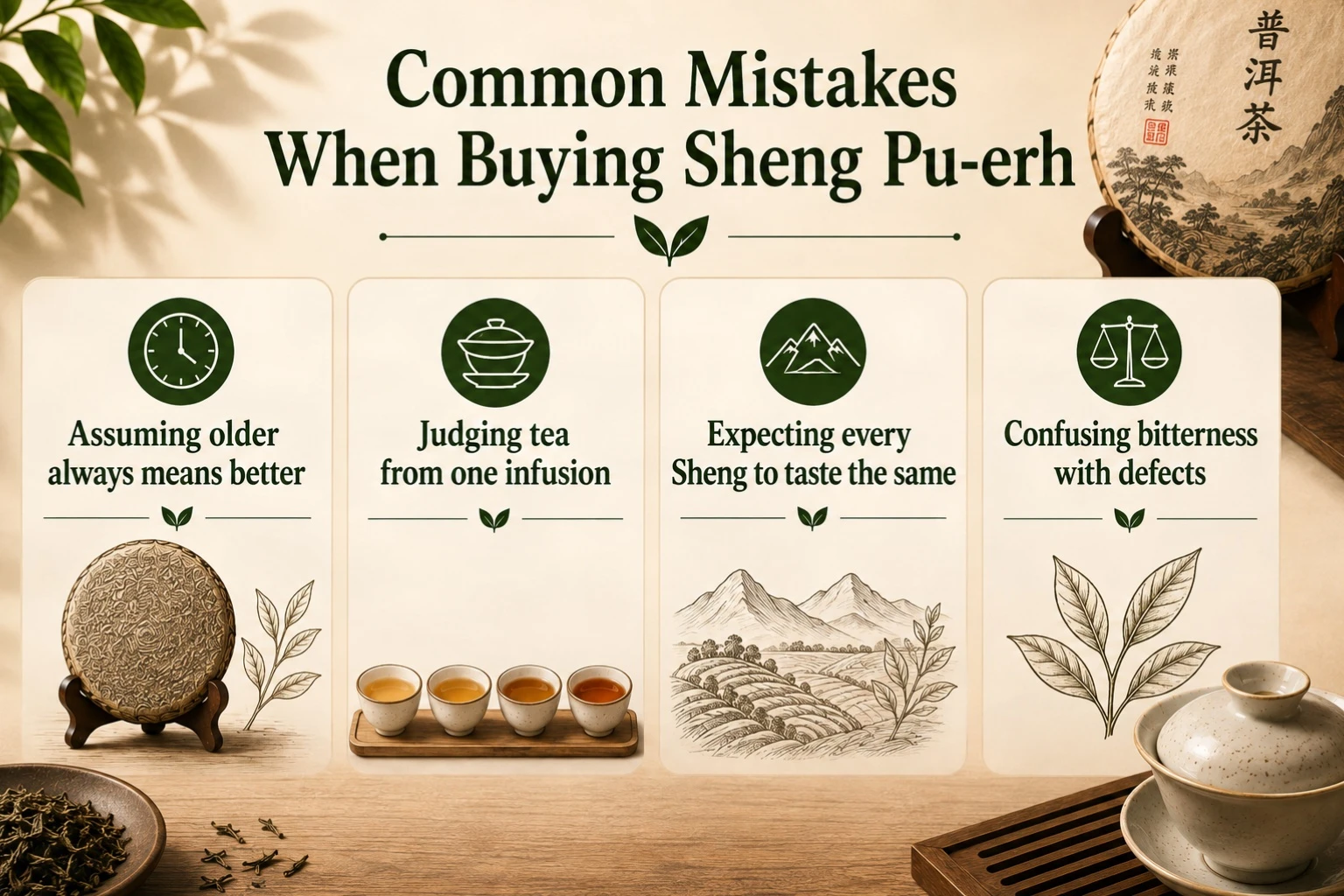
Assuming older always means better
Age is important, but it is not a guarantee of quality.
A well-made, well-stored younger tea can be more enjoyable than an older tea with poor storage or undesirable characteristics.
Judging tea from one infusion
Sheng Pu-erh is often designed to be brewed multiple times. The flavor can change significantly as the leaves open.
Try several infusions before deciding what you think of the tea.
Expecting every Sheng to taste the same
Origin, cultivar, harvest, processing, storage, and age all matter.
The phrase "Sheng Pu-erh" describes a category, not one standardized flavor.
Confusing bitterness with defects
Some bitterness is characteristic of young Sheng Pu-erh.
Instead of asking only whether the tea is bitter, consider whether the bitterness is balanced by sweetness, aroma, texture, and a pleasant aftertaste.
How to Choose a Sheng Pu-erh
If you are new to raw Pu-erh, consider starting with a tea whose flavor profile matches your preferences.
If you enjoy fresh and lively teas, a younger Sheng with floral, herbal, or fruity characteristics may be a good starting point.
If you prefer smoother and deeper flavors, explore more mature Sheng Pu-erh with woody, sweet, or mellow characteristics.
When comparing teas, look beyond age. Pay attention to:
- Origin
- Harvest year
- Tea material
- Processing
- Storage history
- Compression
- Brewing recommendations
- Aroma and flavor descriptions
Most importantly, buy from a source that provides clear information about what the tea is and where it comes from.
How Should Sheng Pu-erh Be Stored?
If you plan to keep Sheng Pu-erh for future drinking, storage deserves careful attention.
The basic objective is to protect the tea from extreme environmental conditions while allowing it to develop naturally.
Keep it:
- Away from strong odors
- Away from direct sunlight
- Protected from excessive moisture
- In a reasonably stable environment
- Free from contaminants and household aromas
Avoid storing tea beside spices, perfumes, cleaning products, or strongly scented foods.
Storage conditions can influence the direction of flavor development, and recent research continues to demonstrate that environmental conditions affect the chemical and sensory evolution of raw Pu-erh.
Sheng Pu-erh vs. Shu Pu-erh: A Quick Taste Comparison
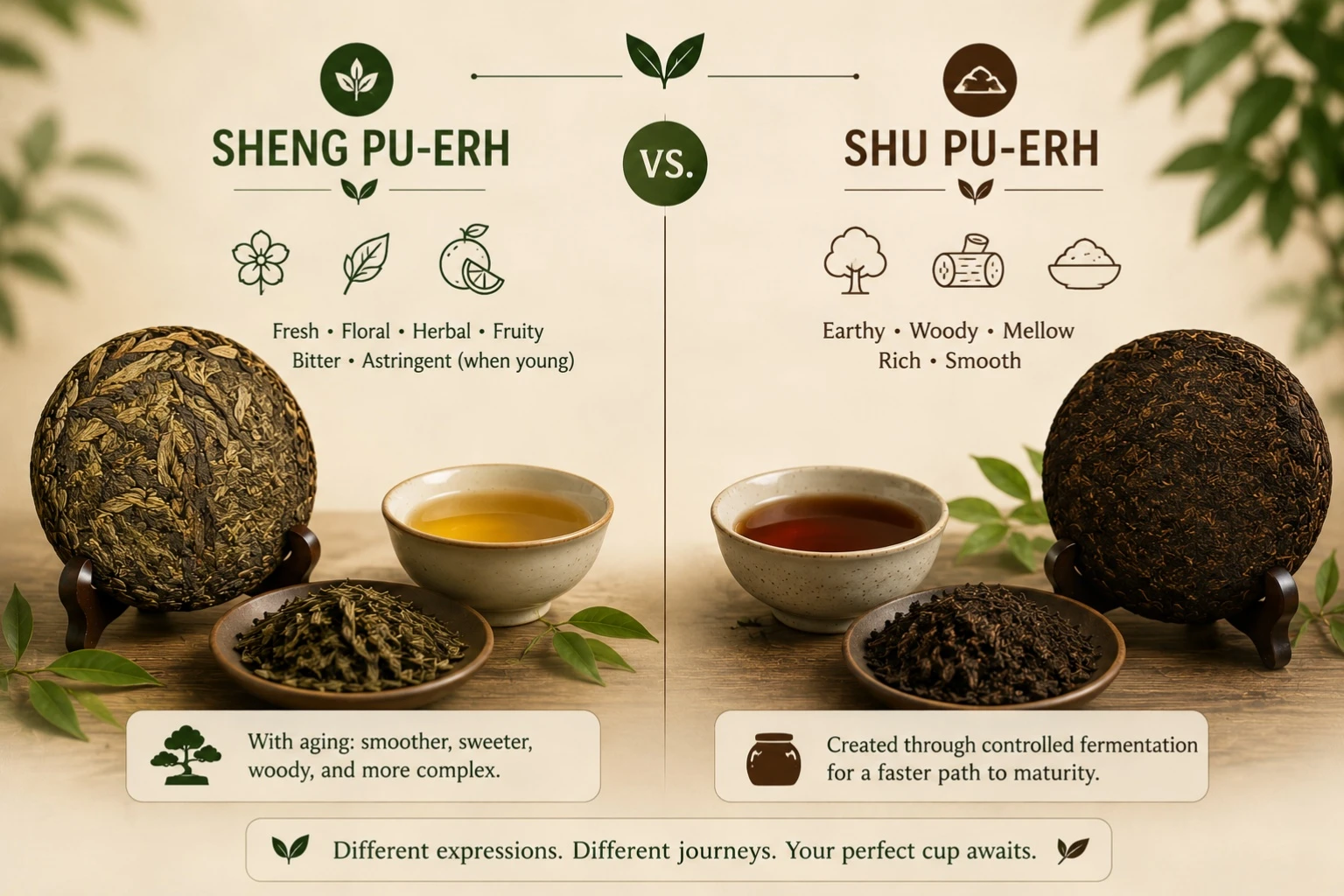
The easiest way to understand Sheng Pu-erh is often to compare it with Shu Pu-erh.
Sheng Pu-erh is generally more likely to show fresh, floral, herbal, fruity, bitter, and astringent characteristics when young. With aging, it can become smoother, sweeter, woody, and more complex.
Shu Pu-erh, by contrast, undergoes a controlled fermentation process designed to accelerate the development of mature characteristics. It is typically associated with darker liquor and deeper earthy, woody, mellow flavors.
Neither style is inherently better. They are different expressions of Pu-erh and appeal to different preferences.
The Best Way to Discover What Sheng Pu-erh Tastes Like
The most useful approach is to taste Sheng Pu-erh at different stages rather than relying only on descriptions.
Try a young tea first. Notice its bitterness, freshness, aroma, and aftertaste. Then compare it with a more mature example.
You may find that the qualities that initially seem surprising—particularly bitterness and astringency—are actually part of what makes Sheng Pu-erh interesting.
Over time, storage can soften some of these characteristics and bring forward new layers of sweetness, aroma, and mouthfeel. Scientific research supports this broad sensory progression, although the exact result varies significantly between teas and storage environments.
Conclusion: What Should Sheng Pu-erh Taste Like?
There is no single answer to what Sheng Pu-erh "should" taste like.
A young Sheng may be fresh, floral, herbal, fruity, bitter, and astringent. As it matures, those sharper characteristics may gradually soften, while sweetness, mellowness, woody aromas, and greater complexity become more noticeable.
The important point is that Sheng Pu-erh is an evolving tea. Its taste reflects not only the original leaves and how they were processed, but also how the tea has been stored and how it is brewed.
For the drinker, this means there is no need to chase a single flavor profile. Instead, pay attention to aroma, bitterness, astringency, mouthfeel, sweetness, and aftertaste—and let those qualities guide your preferences.
If you'd like to explore authentic Chinese tea and experience the range of flavors that Sheng Pu-erh can offer, you can browse Stepman's Tea carefully selected collection and choose a tea that suits your preferred style and level of Pu-erh experience.
FAQs
1. What does Sheng Pu-erh taste like?
Sheng Pu-erh can taste very different depending on its age, origin, processing, storage, and brewing method. Young Sheng often has fresh, floral, herbal, fruity, bitter, or astringent characteristics. With age, it may develop smoother, sweeter, woody, earthy, and more mellow flavors.
2. Is Sheng Pu-erh supposed to be bitter?
Young Sheng Pu-erh can naturally be bitter, particularly when brewed strongly. Bitterness is not necessarily a sign of poor quality. When evaluating a tea, consider how the bitterness interacts with sweetness, aroma, mouthfeel, and aftertaste.
3. Is Sheng Pu-erh astringent?
It can be. Astringency creates a drying or puckering sensation in the mouth and is particularly common in some young Sheng Pu-erh teas. Brewing temperature, infusion time, and leaf quantity can all influence how noticeable the astringency becomes.
4. Does Sheng Pu-erh get sweeter with age?
Sheng Pu-erh can develop a sweeter and mellower sensory profile as it ages. Research has found that storage can reduce perceptions of bitterness and astringency while increasing characteristics associated with sweetness and mellow flavor. The exact result depends on the tea and its storage conditions.
5. What does aged Sheng Pu-erh taste like?
Aged Sheng Pu-erh may have woody, dried-fruit, herbal, earthy, sweet, or mellow characteristics. Older teas can also develop more complex aromas and a smoother mouthfeel, although age alone does not guarantee a particular flavor profile.
6. What does young Sheng Pu-erh taste like?
Young Sheng Pu-erh often tastes fresh and lively, with possible notes of flowers, herbs, fresh fruit, or vegetation. It may also have noticeable bitterness and astringency. Some young teas are relatively gentle, while others are much more intense.
7. Why does Sheng Pu-erh taste different from one tea to another?
Flavor varies because Sheng Pu-erh is influenced by many factors, including tea cultivar, growing region, elevation, harvest material, processing, compression, age, storage environment, and brewing technique.
8. How should I brew Sheng Pu-erh?
A practical starting point is approximately 5–7 grams of tea in a small gaiwan or teapot, using water around 195–205°F (90–96°C). Begin with short infusions and adjust according to taste. If the tea is too bitter or drying, shorten the infusion or reduce the water temperature.
9. Can Sheng Pu-erh be aged at home?
Yes, Sheng Pu-erh can be stored for long-term aging, but the storage environment matters. Keep it away from strong odors, direct sunlight, excessive moisture, and unstable environmental conditions. Storage should be clean, stable, and appropriate for tea.
10. What is the difference between Sheng and Shu Pu-erh?
Sheng Pu-erh is traditionally produced without the accelerated pile-fermentation process used to make Shu Pu-erh. Young Sheng is often fresher, more bitter, floral, or astringent, while Shu Pu-erh generally has darker, earthier, smoother characteristics.
11. Is older Sheng Pu-erh always better?
No. Age is only one factor in evaluating Sheng Pu-erh. Tea material, processing, storage conditions, and personal taste all matter. A well-made younger tea may be more enjoyable to one drinker than an older tea.
12. How can I learn to appreciate Sheng Pu-erh?
The best approach is to taste several Sheng Pu-erh teas and compare them. Try teas of different ages and origins, brew them consistently, and pay attention to aroma, bitterness, astringency, mouthfeel, sweetness, and aftertaste.