What Is Sheng Pu-erh? A Complete Beginner’s Guide
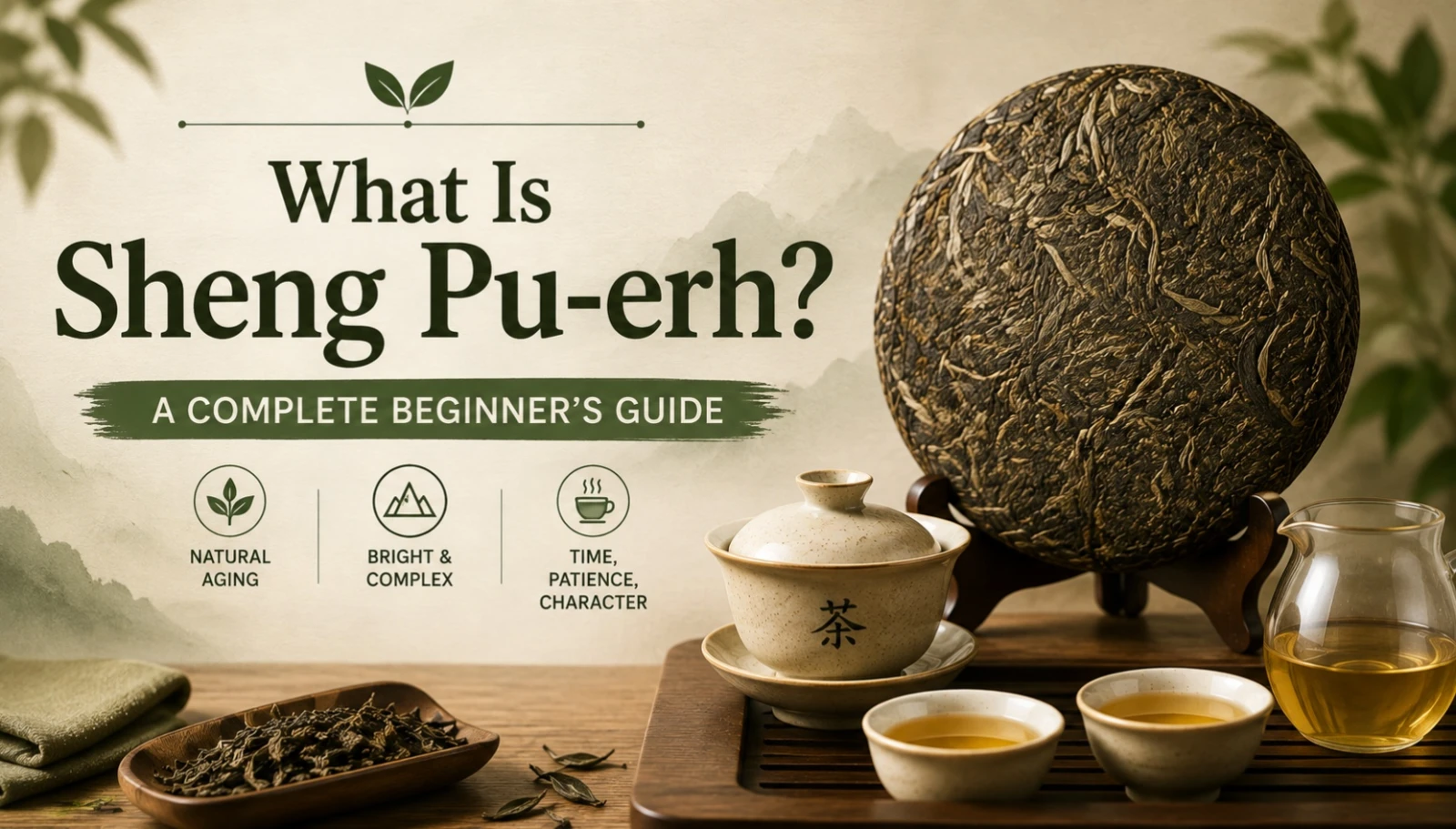
Sheng Pu-erh is one of the most distinctive categories of Chinese tea. Often translated as raw Pu-erh, it is made from the leaves of the Camellia sinensis plant and processed in a way that allows the tea to develop and change over time.
Unlike many teas that are finished shortly after production, Sheng Pu-erh can continue to transform during storage. Its character may shift from fresh, floral, grassy, or astringent when young toward deeper, smoother, more complex flavors as it ages.
That aging potential is one reason Sheng Pu-erh has attracted generations of tea drinkers and collectors. However, understanding Sheng Pu-erh does not require an interest in collecting rare teas. For beginners, the most useful starting point is understanding what Sheng Pu-erh is, how it is made, how aging works, how to brew it, and how to choose and store it properly.
What Is Sheng Pu-erh?
Sheng Pu-erh is a traditionally processed Pu-erh tea that is not subjected to the accelerated microbial fermentation used to produce Shu Pu-erh. The Chinese term sheng means “raw” or “living,” while Pu-erh refers to a distinctive category of tea traditionally associated with Yunnan Province in southwestern China.
Sheng Pu-erh begins with tea leaves that are typically processed into maocha, or unfinished tea. The leaves are then often compressed into cakes, bricks, tuocha, or other forms, although Sheng Pu-erh can also be sold loose.
The important distinction is that Sheng Pu-erh is not simply “unfinished green tea.”
Although young Sheng Pu-erh can share characteristics with green tea, including fresh aromas, vegetal notes, bitterness, and astringency, it is processed differently and is intended to evolve differently during storage. Over time, chemical and microbial processes occurring within the tea can gradually alter its aroma, flavor, color, texture, and overall character.
This is what makes Sheng Pu-erh particularly interesting: the finished tea is not necessarily the end of the story.
Where Does Sheng Pu-erh Come From?
Pu-erh tea is traditionally associated with Yunnan, a mountainous province in southwestern China known for its biodiversity and long history of tea cultivation.
The region includes many famous tea-producing areas, particularly throughout the mountains surrounding the Lancang River basin. Villages, mountains, elevations, cultivars, harvesting practices, and processing traditions can all influence the character of a Sheng Pu-erh.
For this reason, two Sheng Pu-erh teas produced in the same year can taste remarkably different.
Factors such as:
- Tea-growing region
- Elevation
- Soil and climate
- Tea plant variety
- Age of the tea trees
- Harvest season
- Picking standard
- Processing technique
- Storage conditions
- Aging environment
can all contribute to the final cup.
This regional diversity is one reason experienced Pu-erh drinkers often pay close attention to origin and production details, rather than evaluating a tea solely by its age.
How Is Sheng Pu-erh Made?
Understanding production makes Sheng Pu-erh much easier to understand.
While individual producers use different techniques, traditional Sheng Pu-erh production generally follows several important stages.
1. Harvesting the Tea Leaves
Fresh leaves are harvested from tea plants, often according to a particular picking standard.
The composition of the harvested material matters. Young buds and leaves contain different proportions of compounds than more mature leaves, influencing the resulting tea's flavor, aroma, body, and aging potential.
2. Withering
After harvesting, the leaves are spread out and allowed to lose some moisture.
This stage helps prepare the leaves for further processing and can influence aroma development.
The duration and conditions of withering vary according to local practices and the producer.
3. Shaqing: Heat-Fixing the Leaves
One of the most important stages is sha qing, commonly translated as “kill-green” or heat-fixing.
The leaves are heated in a wok or similar vessel to reduce the activity of enzymes responsible for rapid oxidation.
This distinguishes Sheng Pu-erh from fully oxidized teas such as black tea.
However, the heat treatment is generally not intended to completely sterilize the tea or stop all future transformation.
That distinction is important.
The processing leaves room for the tea to undergo further changes during storage.
4. Rolling
The leaves are rolled to shape them and encourage the release and distribution of internal compounds.
Rolling also affects the physical structure of the leaves, which can influence how they release flavor during brewing.
5. Drying
The processed tea is traditionally dried, often producing what is known as maocha.
At this point, the tea can be consumed as loose-leaf Sheng Pu-erh or further processed.
6. Compression
Much Sheng Pu-erh is compressed into familiar forms such as:
- Tea cakes
- Tuocha
- Tea bricks
- Mushrooms or other traditional shapes
Compression makes tea easier to transport and store and has historically been practical for trade.
It also affects how the tea interacts with air and moisture during aging.
Compressed tea does not necessarily age “better” simply because it is compressed. The quality of the original tea and its storage environment remain fundamental.
What Makes Sheng Pu-erh Different From Shu Pu-erh?
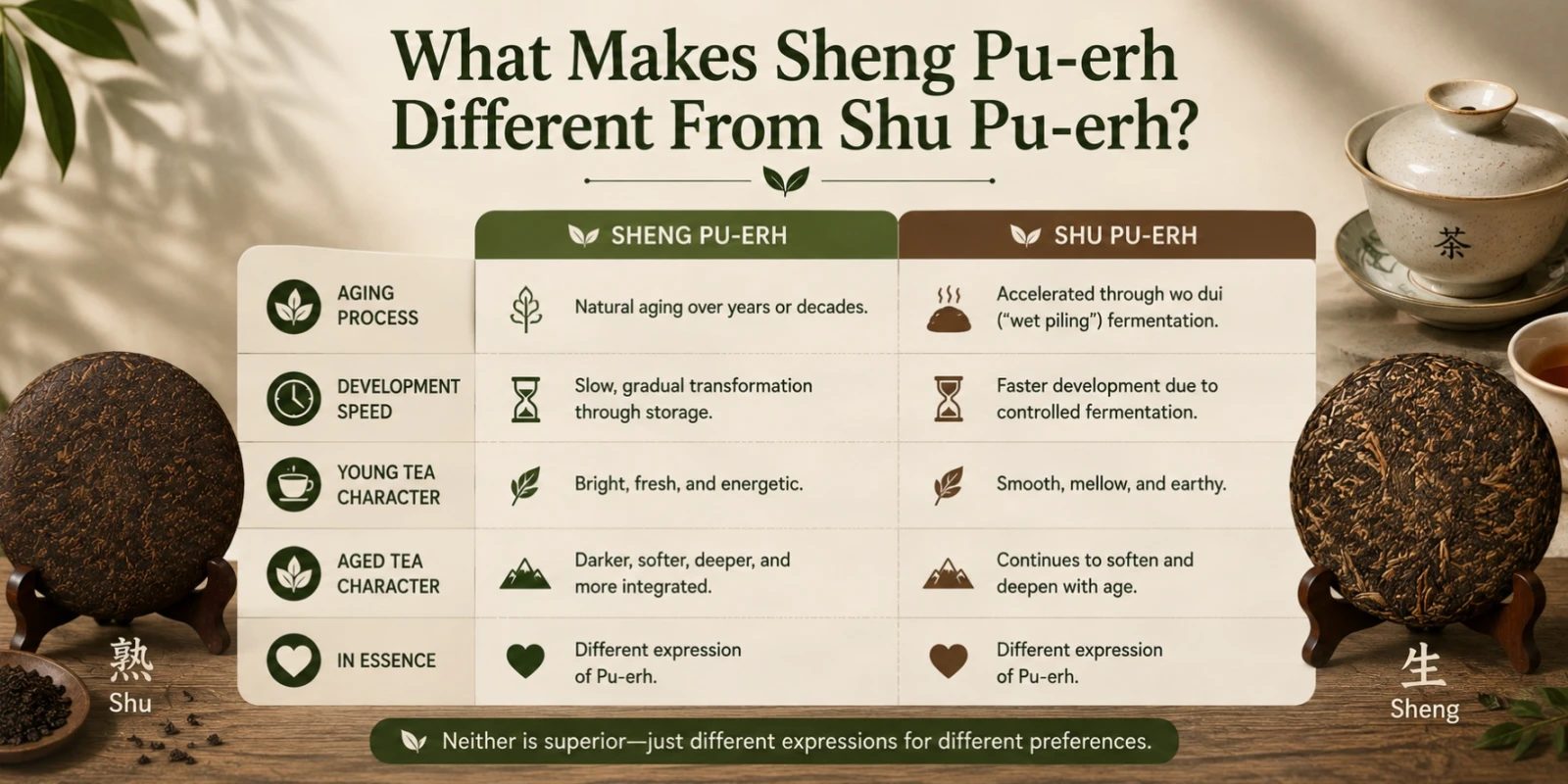
The simplest comparison is this:
Sheng Pu-erh undergoes natural aging, while Shu Pu-erh is intentionally accelerated through a controlled fermentation process.
Shu Pu-erh was developed in the modern era partly to create a tea with characteristics resembling aged Pu-erh without requiring decades of natural aging.
In the wo dui process used for Shu Pu-erh, tea is piled under controlled conditions involving moisture, warmth, and microbial activity.
Sheng Pu-erh does not undergo this same accelerated fermentation process.
Instead, its character changes gradually through storage.
Young Sheng therefore tends to retain brighter and more energetic characteristics, while aged Sheng can develop darker, softer, deeper, and more integrated flavors. Neither style is inherently superior.
They are different expressions of Pu-erh and appeal to different preferences.
What Does Young Sheng Pu-erh Taste Like?
There is no single flavor profile for Sheng Pu-erh.
Young Sheng may display notes of:
- Fresh herbs
- Flowers
- Grass
- Stone fruit
- Citrus
- Honey
- Vegetation
- Fresh wood
- Minerals
It may also have noticeable bitterness and astringency. For beginners, bitterness can sometimes be surprising. However, bitterness in tea is not automatically a sign of poor quality. Sheng Pu-erh contains naturally occurring compounds, including caffeine and polyphenols, that contribute to bitterness and astringency.
The important question is how these characteristics behave.
A well-made tea may show bitterness that is balanced by sweetness, aromatic complexity, salivation, or a lingering finish. Brewing parameters also have a major influence on perceived bitterness.
Water temperature, leaf quantity, infusion time, and the age of the tea can all change the experience.
What Happens When Sheng Pu-erh Ages?
Aging is one of the defining characteristics of Sheng Pu-erh. During storage, the tea gradually undergoes chemical and microbial changes. Oxygen, humidity, temperature, microorganisms, and the tea's original composition all influence this process.
Over time, some young characteristics may soften while new aromas and flavors emerge. A younger Sheng might taste bright, floral, bitter, or vegetal.
An older, well-stored Sheng may develop characteristics such as:
- Dried fruit
- Herbs
- Camphor-like aromas
- Wood
- Honey
- Earth
- Spice
- Darker fruit
- Smooth, mellow textures
However, age alone does not guarantee quality.
A poorly made tea does not automatically become excellent because it has been stored for many years. Likewise, improper storage can damage an otherwise excellent tea. This is an important principle for anyone beginning to explore aged Pu-erh:
Age is a characteristic, not a quality grade.
How Long Does Sheng Pu-erh Take to Age?
There is no universal aging timetable. Sheng Pu-erh can change noticeably over relatively short periods, but significant transformation generally takes years rather than months. The pace depends on factors including storage temperature, humidity, airflow, compression, tea composition, and environmental conditions.
Traditional storage environments in southern China can produce faster transformation because of warmer and more humid conditions. Drier climates generally result in slower changes.
The idea that every Sheng Pu-erh reaches a specific “peak” at a particular age should therefore be treated cautiously. There is no universally correct age at which a tea becomes “ready.” Some drinkers prefer young Sheng for its freshness and intensity. Others enjoy middle-aged teas for their balance. Some seek much older teas for their depth and softness.
The preferred stage is ultimately a matter of tea style and personal taste.
How Should Sheng Pu-erh Be Brewed?
Sheng Pu-erh is particularly well suited to gongfu-style brewing, although it can also be prepared successfully in a teapot, gaiwan, or Western-style teacup.
For beginners, a gaiwan provides an excellent way to explore the tea because it allows brewing parameters to be adjusted easily.
A Simple Gongfu Starting Point
For approximately 100–120 ml of brewing vessel capacity, a beginner might start with around 5–7 grams of tea.
Use hot water and begin with relatively short infusions.
A typical approach is:
- Place the tea in a warmed gaiwan or teapot.
- Rinse the tea briefly if desired.
- Drain completely.
- Add hot water.
- Steep for a short period.
- Pour completely.
- Taste the infusion.
- Gradually increase brewing time as needed.
The exact temperature should depend on the tea.
Young, delicate Sheng may respond well to slightly cooler water, while robust or aged Sheng can often handle very hot water.
There is no single “correct” brewing recipe. Learn more about Gongfu Tea Guide on Stepman's Tea.
The goal is to understand how the tea responds.
If the tea tastes overly bitter or harsh, reduce the infusion time, use slightly cooler water, or use less leaf.
If the tea tastes weak, increase the leaf quantity or steep for longer.
Should Sheng Pu-erh Be Rinsed?
A brief rinse is common when preparing Pu-erh, particularly when using compressed tea.
The rinse can help loosen the leaves and prepare them for brewing.
It should be brief, and the rinse water is generally discarded.
However, rinsing should not be treated as a mandatory purification ritual.
Clean, properly stored tea from a reputable source should not require repeated washing.
The purpose is primarily practical: to awaken and open the leaves before drinking.
How Should Sheng Pu-erh Be Stored?
Storage is critical to Sheng Pu-erh.
The objective is to create an environment where the tea can continue to transform without being exposed to conditions that cause deterioration.
Protect Tea From Strong Odors
Tea absorbs surrounding aromas surprisingly easily.
Avoid storing Sheng Pu-erh near:
- Spices
- Coffee
- Perfumes
- Cleaning products
- Strongly scented foods
- Smoke
A tea that spends years absorbing unwanted odors may never recover its original character.
Avoid Excessive Moisture
Humidity plays a role in Pu-erh aging, but excessive moisture creates risks.
Very damp conditions can encourage unwanted mold and deterioration.
The tea should therefore be protected from water, condensation, and persistently wet environments.
Avoid Extreme Dryness
Extremely dry conditions can slow the aging process considerably.
That does not necessarily make the tea unusable, but it can result in a much slower transformation.
Maintain Stable Conditions
Large and frequent fluctuations in temperature and humidity are generally less desirable than relatively stable conditions.
For home storage, a clean, odor-free environment with reasonable airflow and protection from direct sunlight is a practical starting point.
How Can Beginners Choose a Good Sheng Pu-erh?
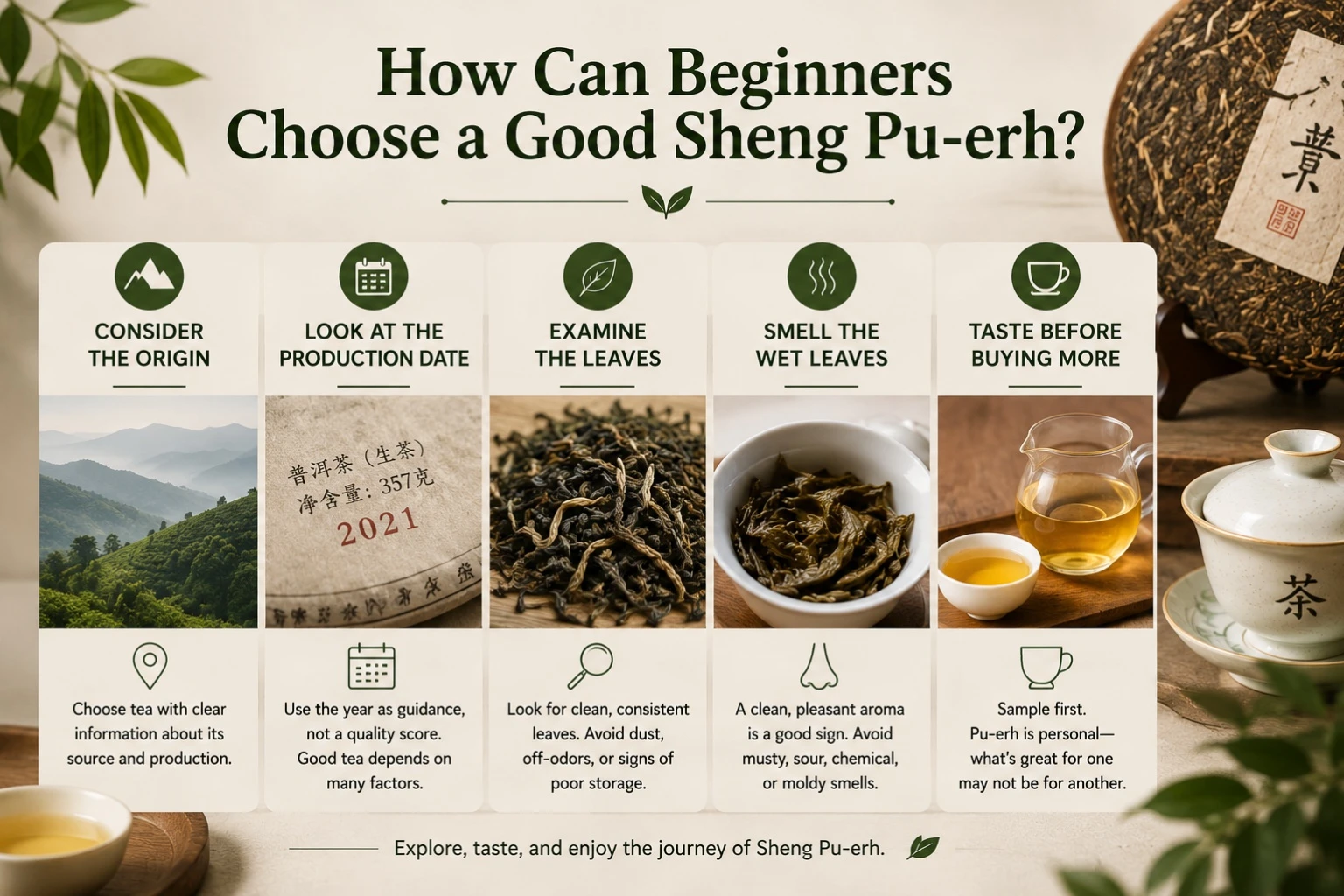
Choosing Sheng Pu-erh can be confusing because packaging often emphasizes age, mountain names, tree claims, or production dates.
Beginners should look beyond a single selling point.
Consider the Tea's Origin
Specific information about the tea's production area can be valuable.
A reputable seller should be able to provide meaningful information about where and how the tea was produced rather than relying entirely on vague claims.
Look at the Production Date
The production year helps establish the tea's age, but it should not be interpreted as a quality score.
A younger tea from good raw material can be more enjoyable than a poorly stored older tea.
Examine the Leaves
When possible, inspect the dry leaves.
Good Sheng Pu-erh should generally show a reasonably consistent appearance appropriate to its processing style.
Excessive dust, unusual odors, or obvious signs of poor storage deserve caution.
Smell the Wet Leaves
After brewing, the leaves can reveal useful information.
A clean, pleasant aroma is generally a positive sign.
Musty, sour, chemical, or strongly moldy smells can indicate storage problems.
Taste Before Buying Large Quantities
Perhaps the most practical advice for beginners is simple:
Sample first whenever possible.
Pu-erh is highly individual. A tea described as exceptional by one drinker may not match another person's preferences.
Sampling also allows the drinker to learn the difference between young and aged Sheng, different regions, processing styles, and storage environments.
Common Beginner Mistakes With Sheng Pu-erh
Mistake 1: Assuming Older Always Means Better
Age matters, but it is only one variable.
Tea quality, raw material, processing, storage, and personal preference all matter.
Mistake 2: Brewing It Like Ordinary Green Tea
Young Sheng can resemble green tea in some respects, but it does not necessarily respond best to the same brewing method.
Short infusions and careful adjustment often provide better control.
Mistake 3: Using Too Much Tea
Pu-erh is commonly brewed with relatively generous leaf quantities in gongfu preparation.
That does not mean beginners should automatically use large amounts.
Start moderately and adjust according to taste.
Mistake 4: Expecting Immediate Smoothness
Some young Sheng teas are intentionally intense.
Bitterness and astringency may be prominent, particularly when the tea is brewed strongly.
This does not necessarily indicate a defect.
Mistake 5: Ignoring Storage History
For older Sheng Pu-erh, storage history can be as important as the production year.
Two teas made in the same year can develop very differently depending on where and how they were stored.
Is Sheng Pu-erh Right for a Beginner?
Yes—but beginners should approach it as a category rather than a single flavor.
Someone accustomed to mild, sweet teas may find young Sheng surprisingly bitter or astringent.
Another drinker may appreciate exactly those qualities.
A useful introduction is to taste several styles side by side:
- Young Sheng
- More mature Sheng
- Different production regions
- Different harvesting seasons
- Loose-leaf and compressed teas
This creates a practical understanding of how Sheng Pu-erh can vary.
There is no requirement to begin with expensive aged cakes. In fact, affordable, well-made teas are often better educational tools because they allow beginners to explore the category without making age or rarity the central focus.
Sheng Pu-erh: What to Remember
Sheng Pu-erh is a traditionally produced Chinese tea with the ability to transform through storage.
Its defining characteristics include:
- Traditional production in Yunnan and other recognized Pu-erh-producing areas
- Processing that differs from both green and fully oxidized teas
- Natural transformation during storage
- Significant variation according to origin, material, processing, and environment
- A wide range of flavor profiles
- Strong compatibility with gongfu-style brewing
- The ability to age, although aging does not automatically improve every tea
Most importantly, Sheng Pu-erh is best understood as a living category of tea rather than a fixed flavor profile.
Young Sheng can be fresh, aromatic, bitter, and energetic. With time and appropriate storage, some teas become softer, deeper, and more complex. Others may develop differently depending on their raw material and environment.
Understanding these differences makes it easier to select tea based on quality and preference rather than marketing claims.
Conclusion
Sheng Pu-erh, or raw Pu-erh, is a traditional Chinese tea distinguished by its production method and its capacity to change during storage. Unlike Shu Pu-erh, it does not undergo the same accelerated fermentation process. Instead, its character gradually develops through a combination of chemical and microbial changes influenced by time and storage conditions.
For beginners, the most valuable approach is not to focus exclusively on age or rarity. Start with reputable tea, learn where it comes from, understand how it was produced, brew it carefully, and pay attention to how storage affects its character.
Over time, tasting different Sheng Pu-erh teas becomes an education in itself.
For readers interested in exploring authentic Chinese tea, Stepman's Tea offers an opportunity to experience carefully selected teas while continuing to learn about the traditions, production methods, brewing techniques, and regional diversity behind them.
FAQs
1. What is Sheng Pu-erh?
Sheng Pu-erh, also called raw Pu-erh, is a traditionally processed Pu-erh tea that is not subjected to the accelerated fermentation process used to produce Shu Pu-erh. It can gradually change in flavor, aroma, and texture during storage.
2. What is the difference between Sheng and Shu Pu-erh?
Sheng Pu-erh undergoes natural aging, while Shu Pu-erh is subjected to a controlled accelerated fermentation process known as wo dui. The two styles therefore develop different flavors, aromas, textures, and appearances.
3. Is Sheng Pu-erh the same as green tea?
No. Although young Sheng Pu-erh can have fresh, vegetal, or bitter characteristics similar to some green teas, it is produced differently and has the potential to transform through long-term storage.
4. Does Sheng Pu-erh get better with age?
Not necessarily. Aging can change Sheng Pu-erh substantially, but age alone does not guarantee better quality. Original tea material, processing, storage conditions, and personal preference all influence whether an aged tea is desirable.
5. How long does Sheng Pu-erh take to age?
There is no universal aging timeline. Sheng Pu-erh can begin changing relatively early, but substantial transformation generally takes years. Temperature, humidity, airflow, compression, tea composition, and storage conditions all affect the rate of aging.
6. How do you brew Sheng Pu-erh?
Sheng Pu-erh can be brewed in a gaiwan, teapot, or other suitable vessel. Gongfu brewing commonly uses a relatively high leaf-to-water ratio with short infusions. Brewing time and water temperature should be adjusted according to the tea's age and character.
7. How should Sheng Pu-erh be stored?
Store Sheng Pu-erh in a clean, dry environment away from direct sunlight, excessive moisture, strong odors, and large environmental fluctuations. Storage should allow appropriate airflow without exposing the tea to damp conditions.
8. Why is Sheng Pu-erh sometimes bitter?
Bitterness is a natural characteristic of many Sheng Pu-erh teas and can be influenced by the tea's plant material, age, processing, and brewing method. Excessive bitterness can often be reduced by using less leaf, cooler water, or shorter infusions.
9. Where does Sheng Pu-erh come from?
Pu-erh is traditionally associated with Yunnan Province in southwestern China. Different mountains, villages, elevations, cultivars, harvesting practices, and processing methods contribute to the wide range of Sheng Pu-erh styles.
10. Is Sheng Pu-erh good for beginners?
Yes. Beginners can explore Sheng Pu-erh by starting with approachable, well-made teas and comparing younger and more mature examples. Sampling before purchasing larger quantities is a practical way to discover individual preferences.