How to Brew Sheng Pu-erh: A Practical Guide to Brewing Raw Pu-erh Tea
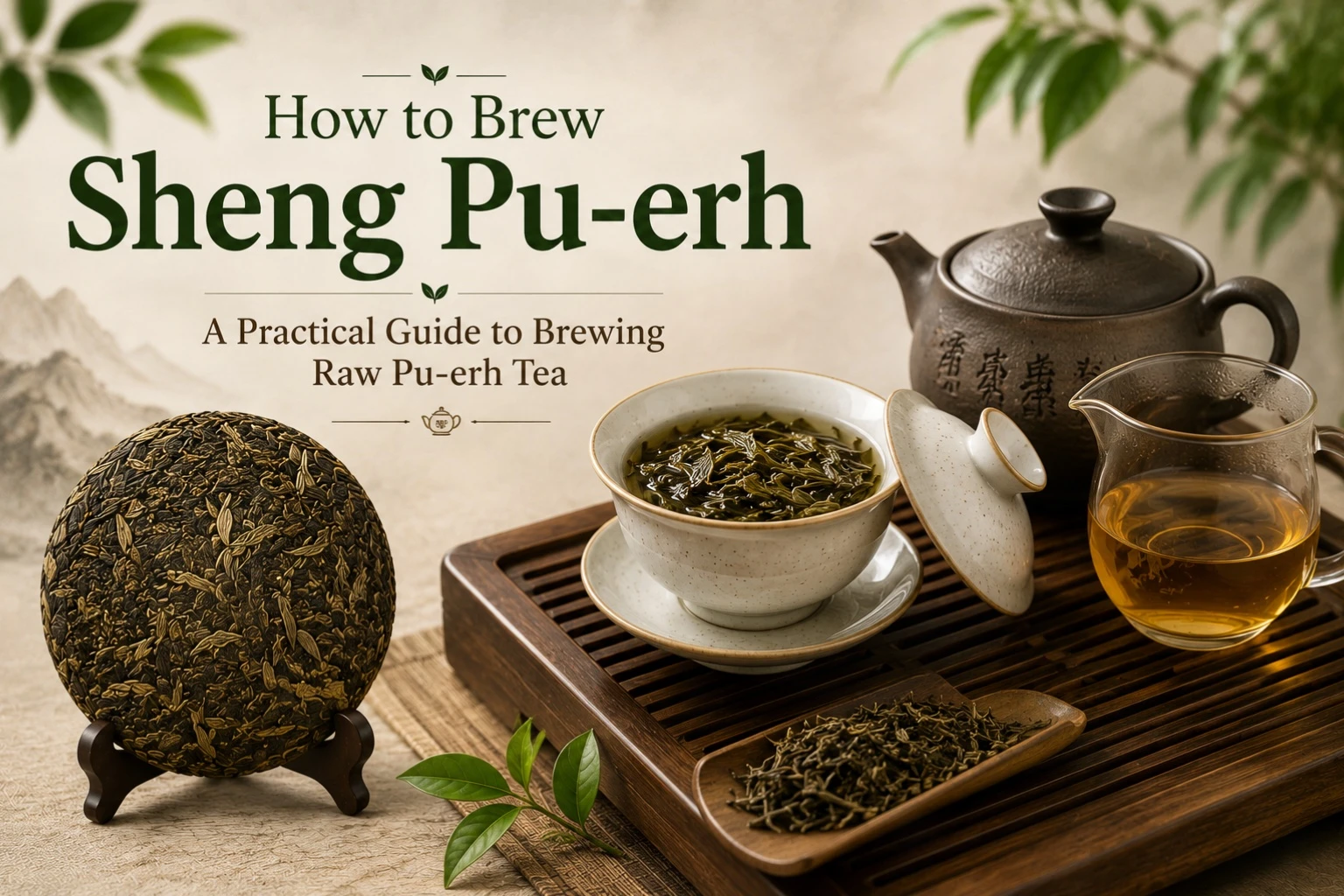
Sheng Pu-erh, also called raw Pu-erh or sheng puer, is a distinctive style of Chinese tea that rewards careful brewing. Unlike ripe or shu Pu-erh, sheng Pu-erh is not made through accelerated wet-piling fermentation. Instead, it is traditionally produced from tea leaves that are processed and sun-dried before being compressed or left loose, allowing the tea to develop gradually through storage and aging.
Because sheng Pu-erh can vary considerably in age, leaf material, processing, compression, and storage, there is no single brewing recipe that works perfectly for every tea. A young sheng may be bright, floral, vegetal, bitter, or astringent, while an aged sheng can become deeper, softer, sweeter, and more rounded.
The good news is that brewing sheng Pu-erh does not need to be complicated.
This guide explains what sheng Pu-erh is, why brewing technique matters, how to brew it step by step, how to adjust temperature and steeping time, which teaware and water to use, and how to avoid common mistakes.
What Is Sheng Pu-erh?
Sheng Pu-erh, literally refers to “raw” Pu-erh tea. It is one of the two broad styles of Pu-erh, the other being Shu Pu-erh, or ripe Pu-erh.
Sheng Pu-erh traditionally begins with fresh leaves from Camellia sinensis, often associated with Yunnan's large-leaf tea varieties. The leaves are processed through steps including withering, pan-firing, rolling, and sun-drying. The resulting tea is known as mao cha. It may then be compressed into cakes, bricks, or tuocha, or kept loose.
Unlike shu Pu-erh, sheng does not undergo the controlled wet-piling process used to accelerate microbial transformation. Instead, changes occur gradually during storage.
This distinction is important when brewing because age and processing strongly influence how sheng Pu-erh responds to water.
Young sheng can have considerable bitterness and astringency, along with floral, grassy, fruity, or herbaceous aromas. Older teas may develop darker fruit, wood, mineral, herbal, honeyed, or camphor-like characteristics, depending on the tea and its storage history.
Why Does Brewing Technique Matter?
Sheng Pu-erh is particularly interesting because the leaves can produce substantially different cups depending on how they are brewed.
Three variables are especially important:
- Tea-to-water ratio
- Water temperature
- Steeping time
These variables work together.
Using more leaf in a small vessel creates a concentrated infusion, but short steeping times keep the extraction controlled. This is the basic principle behind Gongfu-style brewing, a traditional Chinese approach involving relatively large amounts of tea, small brewing vessels, and multiple short infusions.
There is no requirement to brew sheng Pu-erh this way, however. A larger teapot or cup can also work well.
The goal is not to follow a rigid formula. The goal is to learn how the particular tea behaves and make adjustments accordingly.
How to Brew Sheng Pu-erh Gongfu Style
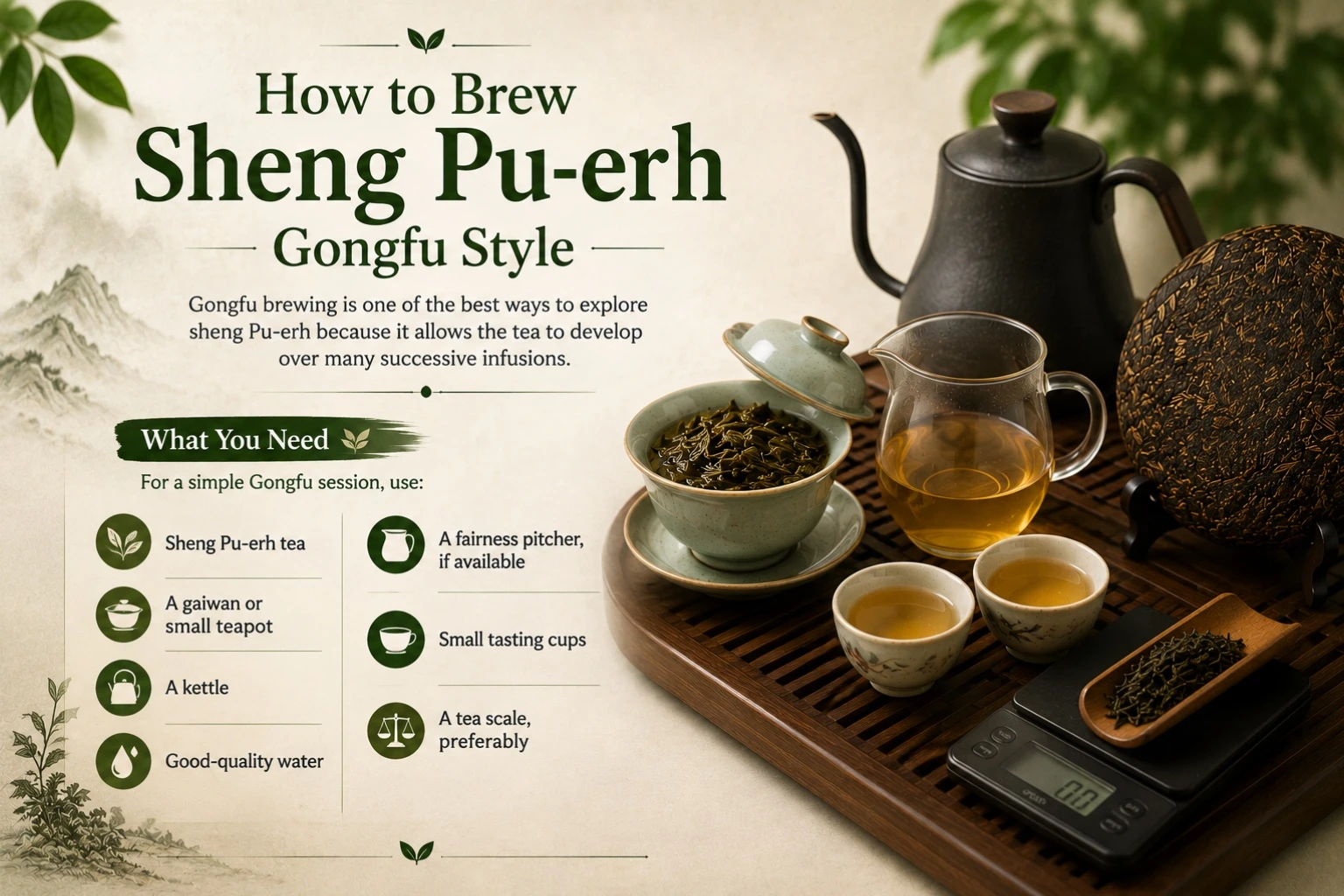
Gongfu brewing is one of the best ways to explore sheng Pu-erh because it allows the tea to develop over many successive infusions.
What You Need
For a simple Gongfu session, use:
- Sheng Pu-erh tea
- A gaiwan or small teapot
- A kettle
- Good-quality water
- A fairness pitcher, if available
- Small tasting cups
- A tea scale, preferably
A porcelain gaiwan is an excellent starting vessel because it is relatively neutral and allows you to observe both the liquor and the leaves. It also makes it easy to control infusion time.
You do not need expensive equipment to begin.
Step 1: Choose Your Tea
Before brewing, consider what kind of sheng Pu-erh you have.
Is it:
- Young or recently produced?
- Semi-aged?
- Older and traditionally stored?
- Loose-leaf or compressed?
- Made from relatively tender leaves or larger mature leaves?
These characteristics can influence your starting parameters.
For example, a young sheng with tender leaves may respond better to slightly cooler water and shorter infusions, particularly if it is already quite bitter or astringent. A more mature or tightly compressed tea may benefit from hotter water and additional time for the leaves to open.
This is why a brewing recommendation should be treated as a starting point rather than a fixed rule.
Step 2: Measure the Tea
A useful starting point for Gongfu brewing is approximately 5–7 grams of tea for every 100 ml of brewing capacity.
For example:
- 100 ml gaiwan: about 5–7 g
- 120 ml gaiwan: about 6–8 g
- 150 ml gaiwan: about 7–10 g
You can use less tea if you prefer a lighter cup.
A scale is particularly useful when learning because it allows you to reproduce a successful session. Once you become familiar with your tea, measuring by sight can be perfectly practical.
Step 3: Warm the Teaware
Pour hot water into your gaiwan or teapot and rinse the vessel.
You can also warm the drinking cups.
Discard this water.
Preheating the vessel reduces the temperature shock when you add the brewing water and helps maintain a stable brewing environment.
Step 4: Gently Prepare Compressed Tea
If your sheng comes in a cake, brick, or tuocha, avoid breaking the leaves aggressively.
Use a Pu-erh tea knife or pick to gently work between the compressed layers.
Try to preserve the leaves as much as possible.
Breaking the tea into very small pieces can increase the amount of exposed surface area and may cause the tea to extract more quickly, potentially making the early infusions harsher.
For tightly compressed tea, allow some loose pieces and larger intact sections rather than turning the entire portion into fragments.
Step 5: Rinse or “Awaken” the Tea
Place the tea in your warmed vessel.
Add hot water and allow the leaves to sit briefly—often around 5–10 seconds for a compressed tea—then pour the water away.
This first rinse is generally not intended as a drinking infusion.
It serves several practical purposes:
- Hydrating compressed leaves
- Helping the tea begin to open
- Warming the leaves
- Removing surface dust or particles
- Allowing you to smell the warmed leaves
The wet-leaf aroma is worth paying attention to. It can give you an early indication of the tea's character before you taste it.
For clean, loose sheng, a very quick rinse may be sufficient, and some drinkers choose to skip rinsing altogether.
What Temperature Should You Use for Sheng Pu-erh?
Water temperature is one of the most debated aspects of brewing sheng Pu-erh.
A useful starting range is approximately 90–95°C (194–203°F) for younger sheng, while more mature or robust teas may work well at 95–100°C (203–212°F).
There is no universal rule.
Some producers and experienced brewers use water close to boiling even for young sheng, while others prefer slightly cooler water to reduce bitterness and emphasize aroma.
The tea itself should determine your final temperature.
If the tea tastes too bitter or harsh
Try:
- Lowering the water temperature slightly
- Shortening the infusion
- Using slightly less leaf
- Pouring more quickly and completely
If the tea tastes weak or flat
Try:
- Increasing the temperature
- Adding slightly more leaf
- Extending the infusion by a few seconds
- Allowing compressed leaves more time to open
The important principle is change one variable at a time. Otherwise, it becomes difficult to understand what actually improved the cup.
Step 6: Brew the First Infusion
After rinsing, add your brewing water.
For a starting point, try approximately 8–15 seconds for the first drinking infusion.
Pour the tea out completely.
Do not worry if the first infusion seems relatively light. Sheng Pu-erh often changes significantly as the leaves hydrate and open.
Some current brewing guides recommend very short early infusions—sometimes only a few seconds—while others begin around 10–15 seconds. Both approaches illustrate the same principle: avoid extracting young sheng too aggressively at the beginning.
Step 7: Continue With Multiple Infusions
One of the pleasures of sheng Pu-erh is watching the tea change from infusion to infusion.
A simple starting sequence might look like this:
| Infusion | Approximate Time |
|---|---|
| Rinse | 5–10 seconds, discard |
| 1 | 8–10 seconds |
| 2 | 10–15 seconds |
| 3 | 15–20 seconds |
| 4 | 20 seconds |
| 5 | 20–30 seconds |
| 6 onward | Increase gradually |
These numbers are not rules.
If the tea is already strong, keep the next infusion short. If it is becoming lighter, add several seconds.
Many sheng Pu-erh teas can provide 10 or more infusions, depending on the leaf quality, amount used, vessel size, and brewing style.
The later infusions are often where the character of the tea becomes particularly interesting.
How Should Sheng Pu-erh Taste?
There is no single flavor profile for sheng Pu-erh.
Young sheng may display notes such as:
- Fresh herbs
- Flowers
- Green fruit
- Citrus
- Stone fruit
- Vegetal notes
- Mineral character
- Bitterness
- Astringency
With age and suitable storage, the character can become progressively softer and more developed. Depending on the tea and its storage conditions, older sheng may show notes reminiscent of:
- Dried fruit
- Honey
- Wood
- Herbs
- Camphor
- Minerals
- Sweet spices
- Darker fruit
Bitterness and astringency are not automatically signs of poor-quality tea. In some sheng Pu-erh, they are part of the tea's structure and can be accompanied by sweetness and a lingering finish.
What matters is balance and how the tea develops in the mouth.
What Is “Returning Sweetness”?
One characteristic tea drinkers often pay attention to with sheng Pu-erh is huigan, commonly translated as “returning sweetness.”
This refers to sweetness that becomes noticeable after the initial taste, particularly after bitterness or astringency.
Rather than focusing only on the first sip, pay attention to what happens several seconds after swallowing.
Does the mouth become sweeter?
Does the flavor linger?
Does the tea leave a clean or drying sensation?
Does the next sip taste different?
These observations are more useful than simply asking whether a tea tastes “strong.”
Choosing the Right Water
Water has a surprisingly large influence on tea.
If your tap water has a strong chlorine taste, high mineral content, or an unpleasant flavor, those characteristics can interfere with the tea.
Filtered water or a clean, neutral-tasting spring water is generally a better choice.
The exact mineral profile that works best is partly a matter of preference. The simplest test is also the most useful: taste the water by itself.
If you would not enjoy drinking the water on its own, it is unlikely to make an excellent cup of sheng Pu-erh.
Which Teaware Should You Use?
Porcelain Gaiwan
For beginners, porcelain is arguably the most practical option.
It is:
- Neutral
- Easy to clean
- Inexpensive compared with specialized teapots
- Easy to use for multiple teas
- Excellent for observing the leaves
A gaiwan is particularly useful when you are evaluating a new sheng because it allows the tea's character to come through without relying heavily on the brewing vessel.
Clay Teapot
Unglazed clay teapots are traditionally associated with Gongfu brewing and can be enjoyable with Pu-erh.
However, clay is porous and can retain aromas.
For this reason, it is sensible to dedicate a particular clay vessel to a consistent category of tea rather than brewing many unrelated teas in the same pot.
If you are still learning about sheng Pu-erh, porcelain gives you greater flexibility.
Common Sheng Pu-erh Brewing Mistakes
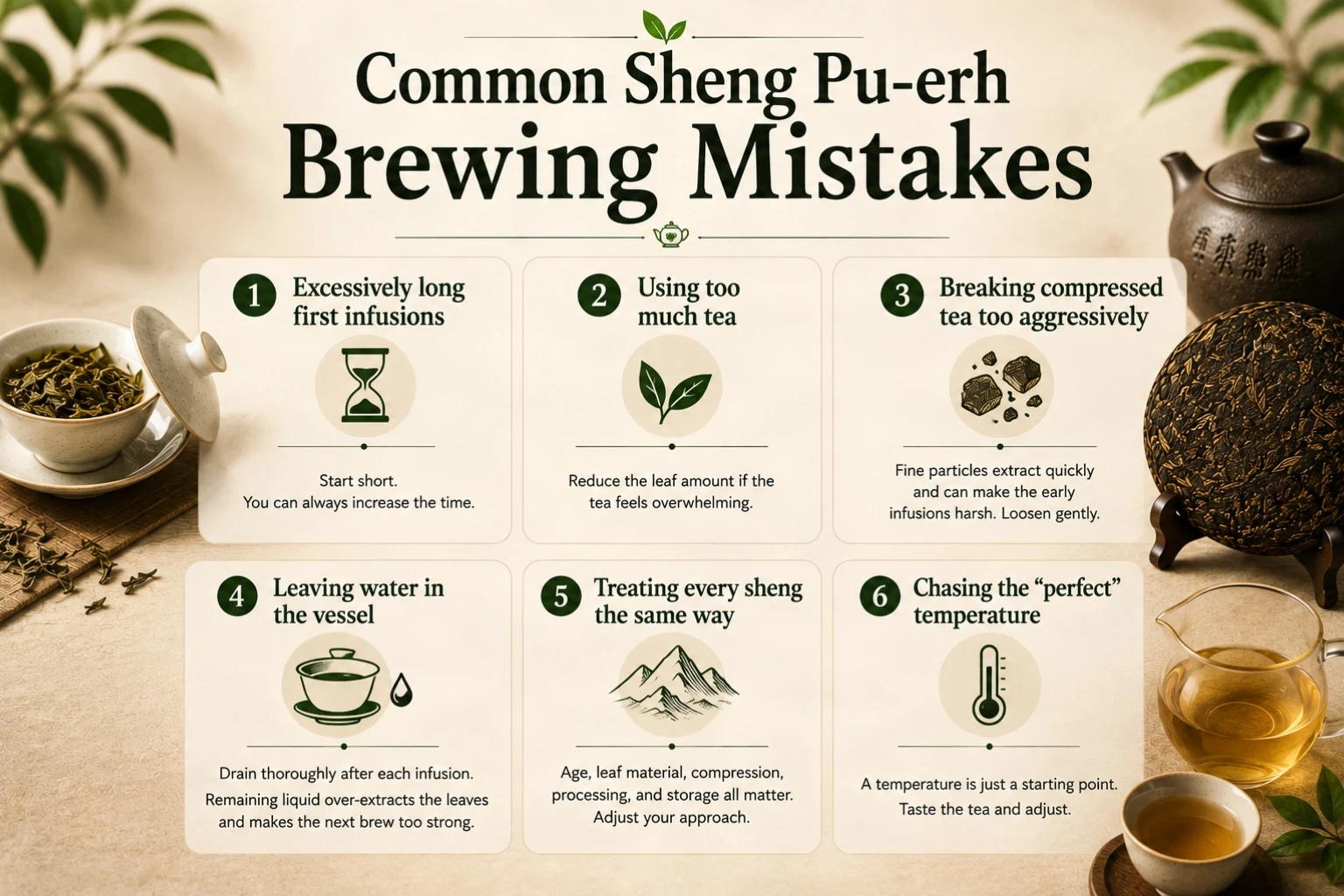
1. Using excessively long first infusions
This is perhaps the easiest way to make young sheng unpleasantly bitter or astringent.
Start short.
You can always increase the time.
2. Using too much tea
A large amount of leaf in a small vessel can produce a very concentrated infusion.
If the tea feels overwhelming, reduce the leaf amount before changing everything else.
3. Breaking compressed tea too aggressively
Fine particles extract quickly and can make the early infusions harsh.
Gently loosen the tea instead.
4. Leaving water in the vessel
After each infusion, drain the vessel thoroughly.
Remaining liquid continues extracting the leaves and can make the next infusion unexpectedly strong.
5. Treating every sheng the same way
A fresh, young sheng and a decades-old sheng are not necessarily going to respond identically to the same brewing parameters.
Age, leaf material, compression, processing, and storage all matter.
6. Chasing the “perfect” temperature
A temperature recommendation is a starting point, not a law.
Taste the tea and adjust.
A Simple Beginner Recipe
If you are brewing sheng Pu-erh for the first time, start here:
Tea: 5–7 g
Water: 100 ml
Temperature: 90–95°C for young sheng
Vessel: porcelain gaiwan
Rinse: 5–10 seconds, discard
First infusion: 8–10 seconds
Following infusions: gradually increase the time
Number of infusions: Continue until the tea becomes noticeably weak
If the tea tastes bitter, shorten the infusion or reduce the temperature.
If it tastes thin, increase the temperature, leaf quantity, or infusion time.
Make only one adjustment at a time.
Can You Brew Sheng Pu-erh in a Mug?
Absolutely.
Gongfu brewing is useful for studying tea, but it is not the only way to enjoy it.
For a larger mug or teapot, use a smaller amount of tea and allow it to steep for longer. A reasonable starting point is approximately 3–5 grams per 300 ml of water, with a steep of around 2–4 minutes.
Then taste.
If the tea is too strong, shorten the next steep or use less leaf. If it is too weak, increase the amount or brewing time.
This method is less concentrated than Gongfu brewing but can be convenient for everyday drinking.
How to Get Better at Brewing Sheng Pu-erh
The most useful brewing skill is not memorizing numbers. It is learning to read the tea.
During each session, notice:
- The dry-leaf aroma
- The wet-leaf aroma
- The color of the liquor
- The first taste
- Bitterness and astringency
- Sweetness
- Mouthfeel
- Aftertaste
- How the flavor changes between infusions
Keeping brief notes can also help.
Record the tea, date, approximate leaf weight, water temperature, and infusion times. If you discover a particularly enjoyable combination, you can reproduce it later.
Over time, you will begin to recognize which teas prefer hotter water, which need longer hydration, and which require especially short early infusions.
The Most Important Principle: Brew the Tea in Front of You
There are many published brewing formulas for sheng Pu-erh, and they can differ substantially. Some recommend cooler water for young teas, while others use near-boiling water throughout. Some favor very short flash infusions; others begin with longer steeps.
This is not necessarily a contradiction.
Sheng Pu-erh is a broad category rather than a single standardized flavor profile. A young, tender tea from one region may behave very differently from a mature, tightly compressed tea from another.
Use recommended parameters as your starting point, then let the tea guide you.
Too bitter? Extract less.
Too weak? Extract more.
Too sharp? Try slightly cooler water or shorter steeps.
Too closed? Give the leaves more time or heat.
That simple approach will take you further than trying to follow a rigid recipe.
Conclusion
Brewing Sheng Pu-erh is ultimately about finding a balance between leaf quantity, water temperature, infusion time, and the character of the tea itself.
For beginners, a porcelain gaiwan, approximately 5–7 grams of tea per 100 ml, a quick rinse, and short initial infusions provide a practical starting point. Young sheng often benefits from careful extraction, while older or tightly compressed teas may respond better to more heat and additional time.
Most importantly, do not judge the tea from a single infusion. Sheng Pu-erh is designed to evolve in the cup. Taste each infusion, observe how the leaves open, and adjust gradually.
With practice, brewing becomes less about following instructions and more about understanding the tea.
If you would like to explore authentic Chinese teas and experience different styles of Pu-erh for yourself, you can explore the carefully selected collection at Stepman's Tea and use these brewing principles as a starting point for your own tasting sessions.
FAQs
1. What is the best temperature for brewing Sheng Pu-erh?
A good starting temperature is approximately 90–95°C (194–203°F) for young Sheng Pu-erh. More mature or robust teas may respond well to water closer to 95–100°C (203–212°F). If the tea tastes excessively bitter or astringent, try lowering the temperature or shortening the infusion.
2. How much Sheng Pu-erh should I use?
For Gongfu brewing, approximately 5–7 grams per 100 ml of brewing capacity is a practical starting point. You can use less tea for a lighter infusion or adjust the amount according to the particular tea and your preferred strength.
3. Should Sheng Pu-erh be rinsed before brewing?
A quick rinse is commonly used, particularly with compressed Pu-erh. It helps hydrate the leaves and allows them to begin opening. A rinse of approximately 5–10 seconds can be sufficient, after which the water is discarded. Very clean, loose-leaf tea may not require a rinse.
4. How long should I steep Sheng Pu-erh?
For Gongfu brewing, begin with relatively short infusions, often around 8–15 seconds, and gradually increase the time as the leaves open and the tea becomes lighter. The exact timing depends on the tea, water temperature, leaf quantity, and personal preference.
5. How many times can Sheng Pu-erh be brewed?
Many good-quality Sheng Pu-erh teas can be infused repeatedly. Depending on the tea and brewing method, 10 or more infusions may be possible. Later infusions generally require progressively longer steeping times.
6. Can I brew Sheng Pu-erh with boiling water?
Yes. Some Sheng Pu-erh teas respond well to water close to boiling, particularly mature or tightly compressed teas. However, young or delicate Sheng may become quite bitter or astringent when extracted aggressively. If the tea tastes harsh, try slightly cooler water or shorter infusions.
7. Can I brew Sheng Pu-erh in a regular mug?
Yes. Gongfu brewing is not required. For a larger mug, use less tea and a longer infusion. Approximately 3–5 grams per 300 ml is a reasonable starting point, followed by adjustments according to taste.
8. Why does my Sheng Pu-erh taste bitter?
Bitterness can result from several factors, including young tea material, high water temperature, a high tea-to-water ratio, or an infusion that is too long. Try shortening the steep, reducing the temperature, or using slightly less tea. Bitterness can also be a natural characteristic of some Sheng Pu-erh.
9. What is the difference between Sheng and Shu Pu-erh?
Sheng Pu-erh is traditionally processed without the accelerated wet-piling fermentation used to produce Shu Pu-erh. Sheng can change gradually through aging and storage, while Shu Pu-erh undergoes a controlled fermentation process designed to produce a more immediately mature character.
10. Is Sheng Pu-erh better when it is older?
Age does not automatically determine quality. Sheng Pu-erh can be enjoyable when young, semi-aged, or mature. Quality depends on factors including raw material, processing, storage, and individual preference. Aging can substantially change a tea's character, but older does not always mean better.