How to Choose Quality Oolong Tea
Oolong tea occupies a distinctive place among the traditional teas of China and Taiwan. It is neither simply a green tea nor a black tea, but a broad category of partially oxidized teas that can range from light, floral and fresh to dark, roasted and deeply aromatic.
For anyone new to oolong, choosing a quality tea can be difficult. Tea leaves may look similar while producing very different flavors, aromas and brewing experiences. Price alone is not a reliable indicator of quality, and terms such as Tieguanyin, Da Hong Pao, Dancong and Wuyi oolong describe different tea traditions rather than a single standard of quality.
This guide explains what quality oolong tea is, why production and origin matter, how to evaluate dry and brewed leaves, and how to choose an oolong that suits your preferences.
What Is Oolong Tea?
Oolong tea is a category of tea made from the leaves of the Camellia sinensis plant. Its defining characteristic is partial oxidation.
During tea processing, freshly harvested leaves undergo controlled changes in which enzymes within the leaves interact with oxygen. Green tea is generally processed to minimize oxidation, while black tea is intentionally oxidized more extensively. Oolong occupies the broad middle ground between these styles.
However, describing oolong simply as "partially oxidized tea" does not fully capture its diversity. Oolong production can involve withering, bruising or shaking, oxidation, fixation, rolling, drying and, in some cases, roasting. Small differences in these stages can produce dramatically different teas.
Some oolongs are lightly oxidized and may have fresh floral, vegetal or creamy characteristics. Others are more heavily oxidized or roasted and can develop flavors reminiscent of dried fruit, toasted grain, nuts, wood or cocoa.
This diversity is one of the reasons oolong is particularly interesting to explore.
Why Is Oolong Tea Quality Important?
Quality affects far more than appearance or price. It influences aroma, flavor, texture, aftertaste, brewing tolerance and the overall consistency of the tea.
A well-made oolong generally reflects careful handling of the leaf from cultivation through processing and storage. The goal is not necessarily to create the strongest possible flavor. Instead, quality is often expressed through balance, clarity and complexity.
A good oolong may reveal different characteristics as it cools or as additional infusions are prepared. Floral notes may become more apparent after the first infusion, for example, while sweetness, minerality or roasted characteristics may emerge later.
Quality is also closely connected to the identity of the tea. Traditional oolongs are often associated with particular regions, cultivars, processing methods and styles. Understanding these factors makes it easier to evaluate whether a tea is appropriate for its stated category.
The Major Factors That Determine Oolong Quality
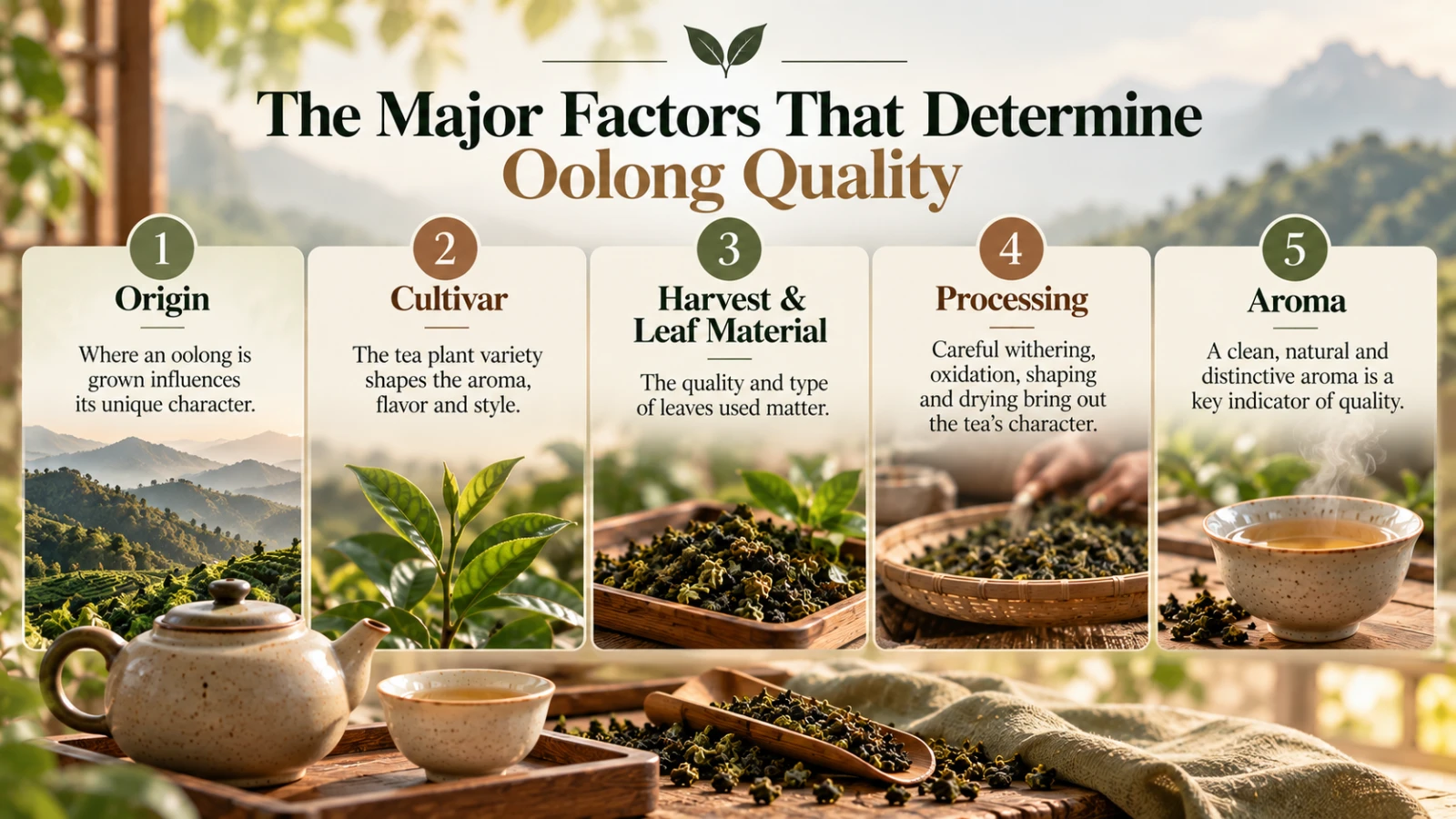
There is no single test that determines whether an oolong is good. Instead, several factors should be considered together.
1. Origin
Where an oolong is grown can have a significant influence on its characteristics.
Important oolong-producing regions include China's Fujian and Guangdong provinces, as well as Taiwan. Within these regions, particular mountains, villages and growing areas may be associated with specific tea traditions.
For example, Wuyi oolongs from northern Fujian are traditionally associated with rocky mountain environments and distinctive processing styles. Phoenix Dancong teas are associated with the Phoenix Mountain area of Guangdong. Tieguanyin originated in Anxi County in Fujian, where it remains an important tea tradition.
Taiwan also produces a wide range of oolongs, including teas from high-elevation growing areas.
Origin does not automatically guarantee quality. A tea from a famous region can still be poorly produced, while a lesser-known tea can be carefully made. However, clear information about origin provides useful context for evaluating authenticity and style.
When purchasing oolong, look for specific information about where the tea was produced rather than a vague description such as "Chinese oolong."
2. Cultivar
The tea plant variety, or cultivar, can also influence the final character of an oolong.
Different cultivars have different chemical compositions and aromatic potential. Some have become strongly associated with particular tea styles.
For example, Tieguanyin is traditionally associated with the Tieguanyin cultivar, while some Wuyi teas are closely connected to specific traditional cultivars. Phoenix Dancong encompasses a collection of distinctive local tea plant types and aroma styles.
Cultivar information is not always necessary for beginners, but it becomes increasingly useful as you develop your palate.
3. Harvest and Leaf Material
The quality of the leaves used to produce the tea matters.
Young leaves and buds are often associated with delicate teas, but "younger" does not automatically mean "better." Different oolong traditions intentionally use different types of leaf material.
Some traditional oolongs are made from relatively mature leaves because these leaves respond well to particular processing methods. What matters is whether the leaf material is appropriate for the tea's intended style.
Look for leaves that appear reasonably consistent with the tea's production style rather than judging quality solely by the presence of buds.
4. Processing
Processing is one of the most important aspects of oolong quality.
After harvesting, leaves may be withered to reduce moisture and prepare them for further processing. They can then be gently bruised or shaken to encourage oxidation. The degree and duration of oxidation are carefully controlled.
Once the desired level of oxidation has been reached, heat is applied to stop or greatly slow enzymatic oxidation. The leaves may then be rolled, shaped and dried.
Some oolongs undergo additional roasting. Roasting can reduce moisture, alter aroma and flavor, and contribute characteristics ranging from gentle toastiness to deeper roasted notes.
The quality of processing depends on precision. Excessive oxidation, insufficient drying, uneven roasting or poor handling can negatively affect the finished tea.
5. Aroma
Aroma is one of the most useful indicators when evaluating oolong.
Before brewing, smell the dry leaves. Depending on the tea, you may notice floral, fruity, creamy, roasted, woody, nutty or mineral-like aromas.
After brewing, smell the wet leaves again. The aroma should generally become more expressive and provide additional information about the tea.
Quality does not necessarily mean an extremely powerful aroma. A tea with a subtle but clean and distinctive fragrance can be more interesting than one with an overwhelming scent.
Be cautious of teas whose fragrance seems unusually artificial or perfume-like. While naturally aromatic oolongs certainly exist, the overall aroma should make sense within the tea's style.
How to Evaluate Oolong Tea by Appearance
Dry leaves can provide useful clues, although appearance alone cannot determine quality.
Look for leaves that are reasonably consistent in size and appearance for the particular style. Excessive dust, broken fragments or large amounts of foreign material may indicate poor handling.
Color should also be considered in context.
A lightly oxidized oolong may have green or green-brown tones, while a darker or roasted oolong may appear brown or dark charcoal. There is no universally correct color for oolong.
One of the most useful observations comes after brewing. High-quality whole-leaf oolong often expands considerably in hot water. Examining the opened leaves can reveal their general integrity and processing.
Again, whole leaves are not automatically superior. Different traditional tea styles use different processing methods, including rolling and shaping. Leaf appearance should therefore be considered alongside origin, processing and taste.
How Should Quality Oolong Taste?
Taste is ultimately one of the most important ways to assess tea.
A quality oolong should generally have a clean and coherent flavor profile appropriate to its style. Depending on the tea, you might encounter:
Floral notes
Stone fruit
Citrus
Honey-like sweetness
Creamy textures
Fresh vegetation
Toasted grain
Roasted nuts
Dried fruit
Cocoa-like notes
Mineral characteristics
Woody or herbal flavors
The tea does not need to contain all of these characteristics.
More important is balance. Bitterness should not dominate unless it results from brewing conditions. Astringency may be present, particularly with certain teas, but it should generally integrate with the tea rather than overwhelm the palate.
Pay attention to the finish after swallowing. Some quality oolongs leave a lingering sweetness or evolving flavor that remains noticeable after the tea has been consumed.
The Importance of Aftertaste and Mouthfeel
Beginners often focus exclusively on the first sip, but experienced tea drinkers pay attention to what happens afterward.
Mouthfeel refers to the physical sensation of the tea in the mouth. An oolong might feel light and delicate, smooth and creamy, or fuller and more structured.
The aftertaste, sometimes called the finish, describes the flavors and sensations that remain after swallowing.
These qualities can be particularly noticeable when brewing oolong several times. A tea that seems relatively simple during the first infusion may become more expressive during later infusions.
This is one reason traditional oolong is often brewed in multiple short infusions rather than prepared as a single large cup.
How to Brew Oolong When Evaluating Quality
Even an excellent tea can taste disappointing if it is brewed poorly.
For an initial evaluation, use good-quality water and begin with a moderate amount of leaf. Water temperature and steeping time can then be adjusted according to the particular oolong.
A practical starting point is:
Use approximately 5 grams of tea for a small brewing vessel.
Use water around 195–205°F (90–96°C), adjusting according to the tea.
Steep for roughly 20–40 seconds for the first infusion.
Taste the tea and adjust subsequent infusions according to strength.
Re-steep the leaves several times.
These are starting points rather than strict rules.
Lighter oolongs may respond well to slightly cooler water, while darker or roasted teas can often tolerate hotter water. Small adjustments can significantly change the balance between aroma, sweetness, bitterness and astringency.
When comparing two teas, brew them using the same conditions. This makes the differences easier to recognize.
Whole Leaf vs. Broken Leaf Oolong
Whole-leaf oolong is often associated with traditional production, particularly teas intended for repeated brewing.
The leaves gradually unfurl during steeping, allowing different infusions to reveal different characteristics.
Broken-leaf teas can also be enjoyable and may produce a quicker, stronger extraction. Therefore, broken leaves should not automatically be classified as low quality.
The more useful question is whether the leaf structure is appropriate for the tea's style and whether the finished tea tastes clean, balanced and distinctive.
Freshness, Age and Roasting
Not every oolong is intended to be consumed immediately after production.
Some lightly oxidized oolongs are valued for fresh floral or creamy characteristics and are typically appreciated for their relatively fresh character.
Other oolongs, particularly certain traditionally roasted teas, may be stored and periodically roasted or aged according to established practices.
This means "fresh" does not always equal "better."
The appropriate age depends on the tea's style, processing and storage history. When purchasing an aged or traditionally stored oolong, information about storage conditions and production history becomes particularly important.
How to Store Oolong Tea
Proper storage helps preserve the characteristics of quality tea.
Oolong should generally be protected from:
Moisture
Strong odors
Excessive heat
Direct sunlight
Air exposure
Contamination
An airtight container in a cool, dry and dark environment is appropriate for many oolongs.
Tea readily absorbs surrounding odors, so avoid storing it next to strongly scented foods, spices or household products.
Different aged and traditionally stored teas can have more specialized storage requirements. If a tea has been intentionally aged, follow storage recommendations appropriate to that specific style rather than treating it like a freshly produced lightly oxidized oolong.
Common Mistakes When Buying Oolong Tea
Choosing Based Only on Price
Expensive tea is not automatically high quality.
Price can reflect factors such as origin, harvest conditions, production costs, rarity, labor and market demand. It does not by itself tell you whether a tea matches your preferences.
Assuming Darker Means Stronger or Better
A dark leaf does not necessarily mean a stronger or higher-quality tea.
Color can result from oxidation, roasting and processing. A lightly oxidized oolong can be just as carefully made as a dark roasted tea.
Judging Tea Only by Dry Appearance
Tea leaves can look impressive while producing an ordinary cup. Conversely, leaves that look less dramatic may produce excellent flavor.
Whenever possible, evaluate aroma and taste as well as appearance.
Ignoring Brewing Variables
Water temperature, steeping time, leaf quantity and water quality all affect the final cup.
If an oolong tastes bitter, overly weak or flat, change the brewing parameters before deciding that the tea itself is poor.
Buying Without Understanding the Tea's Origin
A product described only as "oolong tea" provides limited information.
Look for details about origin, tea style, production method and, when available, harvest information. Greater transparency makes it easier to understand what you are purchasing.
A Practical Checklist for Choosing Quality Oolong Tea
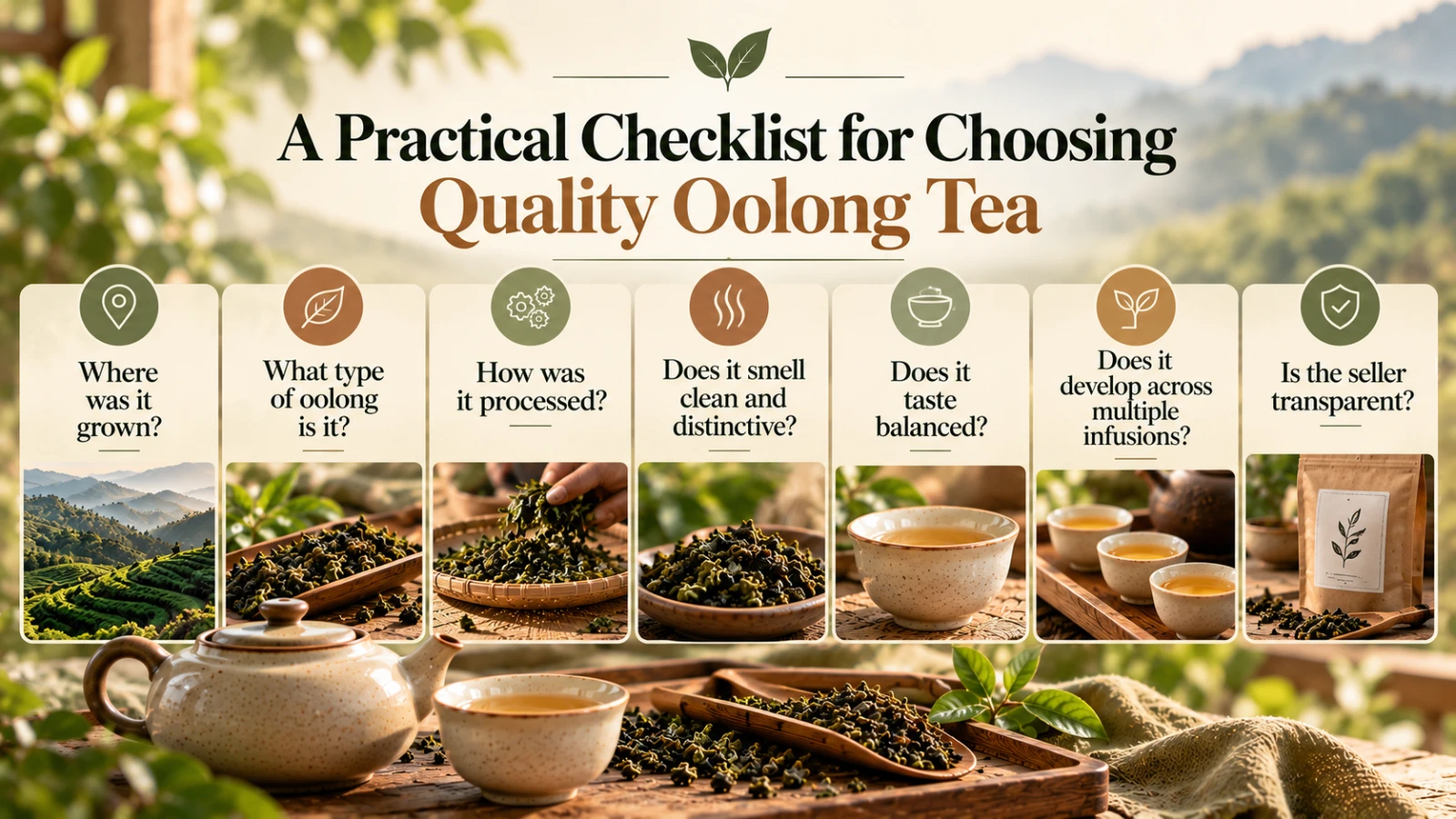
When selecting an oolong, ask these questions:
Where was it grown?
Look for a specific geographic origin.
What type of oolong is it?
Identify whether it is a Tieguanyin, Wuyi tea, Dancong, Taiwanese high-mountain oolong or another recognized style.
How was it processed?
Information about oxidation, shaping and roasting can help explain the tea's character.
Does it smell clean and distinctive?
The aroma should be appropriate to the tea and free from obvious off-odors.
Does it taste balanced?
Look for harmony between aroma, flavor, sweetness, bitterness and astringency.
Does it develop across multiple infusions?
Many traditional oolongs reveal additional characteristics with repeated brewing.
Is the seller transparent?
A reputable tea source should be able to provide meaningful information about the tea rather than relying solely on broad marketing descriptions.
How to Develop Your Oolong Palate
You do not need extensive tea knowledge to learn how to recognize quality.
Start by tasting several different styles side by side. For example, compare a lightly oxidized Tieguanyin with a roasted Wuyi oolong. The differences in aroma, texture, flavor and finish can make the characteristics of each tea easier to understand.
Take simple tasting notes.
Instead of trying to identify highly specific flavors immediately, begin with broad categories:
Aroma: floral, fruity, roasted, vegetal, woody
Body: light, medium, full
Texture: smooth, creamy, dry, brisk
Taste: sweet, savory, bitter, mineral, roasted
Finish: short, clean, lingering, sweet
With repeated tasting, your vocabulary and ability to recognize subtle differences will naturally develop.
Choosing Oolong Based on Personal Preference
There is no single flavor profile that everyone should prefer.
If you enjoy delicate and aromatic teas, a lightly oxidized oolong may be a useful starting point.
If you prefer richer, warmer flavors, explore roasted oolongs.
If you enjoy distinctive fruit and floral aromas, Phoenix Dancong and related styles may be worth exploring.
If you prefer teas with mineral, roasted and structured characteristics, traditional Wuyi oolongs offer another direction.
The purpose of understanding quality is not to eliminate personal preference. It is to help you make more informed choices and recognize what characteristics you enjoy.
Final Thoughts
Choosing quality oolong tea becomes much easier once you understand what you are evaluating.
Start with origin, tea style and processing. Then examine the aroma, leaf appearance, flavor, mouthfeel and aftertaste. Consider how the tea performs across multiple infusions, and remember that brewing technique can significantly influence your perception of quality.
Most importantly, do not assume that the most expensive, darkest or most aromatic tea is necessarily the best. Quality is better understood as a combination of appropriate raw material, careful processing, proper storage and a clean, balanced drinking experience.
Learning to choose oolong is ultimately a process of observation and tasting. The more different traditional styles you experience, the easier it becomes to recognize their individual characteristics and identify the teas that suit your palate.
If you would like to explore authentic Chinese oolong prepared according to traditional tea-making styles, you can browse Stepman's Tea selection of carefully sourced teas and use what you have learned here to choose a style that interests you.
FAQs
1. What makes a good oolong tea?
Quality oolong generally combines appropriate raw materials, careful processing, proper storage and a clean, balanced flavor. Aroma, mouthfeel, aftertaste and performance across multiple infusions can also help indicate quality.
2. How can you tell if oolong tea is high quality?
Look at the tea's origin, processing information, aroma, leaf appearance and flavor. A quality oolong should generally have a clean, distinctive character appropriate to its style.
3. Should quality oolong tea have whole leaves?
Many traditional oolongs use relatively intact leaves, but whole leaves alone do not guarantee quality. Leaf structure should be considered alongside processing, origin, aroma and taste.
4. Is expensive oolong tea better?
Not necessarily. Price can reflect origin, rarity, production methods and market demand, but it does not automatically indicate quality.
5. What does good oolong tea taste like?
Oolong can range from floral, creamy and fresh to fruity, mineral, roasted and woody. The appropriate flavor depends on the specific oolong style.
6. How should quality oolong tea be stored?
Most oolong should be protected from moisture, heat, light, air and strong odors. An airtight container kept in a cool, dry, dark location is suitable for many teas.