How to Choose Quality Sheng Pu-erh?
Sheng Pu-erh, also called raw Pu-erh, is a traditional Chinese tea known for its distinctive character and its ability to change with age. Yet choosing a good Sheng Pu-erh can be difficult, especially for beginners. Tea cakes can look similar while differing significantly in leaf quality, processing, origin, storage, age, and overall character.
The good news is that you do not need to be an expert to make a thoughtful choice. By understanding how Sheng Pu-erh is produced, what influences quality, and what to look for when purchasing, you can approach different teas with greater confidence.
This guide explains what quality Sheng Pu-erh means, why it matters, how the tea develops, and how to evaluate a tea before buying it.
What Is Sheng Pu-erh?
Sheng Pu-erh, commonly translated as raw or unripe Pu-erh, is a style of Pu-erh tea traditionally produced in Yunnan, China. Unlike Shu Pu-erh, which undergoes an accelerated post-fermentation process, Sheng Pu-erh is generally allowed to develop gradually through natural aging.
The basic production process involves harvesting tea leaves, withering them, heating them to reduce enzymatic activity, rolling them, drying them, and often pressing the finished tea into cakes, bricks, or other shapes.
The word "raw" can sometimes be misleading. Sheng Pu-erh is not simply freshly picked tea leaves that have been dried. It undergoes deliberate processing that gives the leaves the structure needed for later transformation.
Over time, properly stored Sheng Pu-erh can develop changes in aroma, flavor, texture, color, and overall balance. Younger teas may be fresh, floral, bitter, astringent, or energetic, while older teas can become smoother and more rounded. However, age alone does not automatically make a tea high quality.
Why Does Sheng Pu-erh Quality Matter?
Quality affects almost every aspect of the drinking experience.
A well-made Sheng Pu-erh can have layers of aroma and flavor that develop across multiple infusions. It may combine bitterness with sweetness, astringency with a pleasant mouthfeel, and freshness with depth. Lower-quality tea may instead taste flat, overly harsh, stale, poorly stored, or lacking in structure.
Quality is also important because Sheng Pu-erh is a tea that can change over time. The condition of the leaves and the quality of their processing provide the foundation for that development.
For this reason, choosing Sheng Pu-erh is not simply a matter of finding the oldest cake or the most expensive tea. A better approach is to consider several factors together:
- Tea origin
- Leaf material
- Harvest and processing
- Storage conditions
- Age
- Aroma and flavor
- Physical appearance
- Producer or source
- Price relative to the tea's characteristics
How Is Sheng Pu-erh Made?
Understanding production makes it easier to evaluate quality.
1. Tea Leaves Are Harvested
Sheng Pu-erh is traditionally made from leaves of the Camellia sinensis var. assamica tea plant, particularly in Yunnan.
The quality and character of the raw material can vary according to cultivar, elevation, soil, climate, season, age of the tea trees, and harvesting practices.
The phrase "ancient tree" or "old tree" is often used in Pu-erh marketing, but buyers should be cautious about treating such descriptions as automatic proof of superior quality. Provenance and trustworthy sourcing matter more than a label alone.
2. The Leaves Are Withered
Freshly harvested leaves are allowed to lose some moisture. This prepares them for subsequent processing.
3. The Leaves Are Heated
The leaves undergo a heating process known as sha qing. This reduces enzymatic activity and helps establish the characteristics of the finished tea.
The degree and manner of heating can influence how Sheng Pu-erh develops over time.
4. The Leaves Are Rolled
Rolling shapes the leaves and helps release some of their internal compounds. It also influences the appearance and later brewing characteristics of the tea.
5. The Tea Is Dried
The processed leaves are traditionally sun-dried for many Sheng Pu-erh teas. The resulting material is often called mao cha before it is pressed.
6. The Tea May Be Pressed
Mao cha can be left loose or compressed into cakes, bricks, tuocha, and other forms.
Compression makes the tea easier to store and transport, but it also influences how air and moisture interact with the leaves during aging.
What Should You Look for in Quality Sheng Pu-erh?
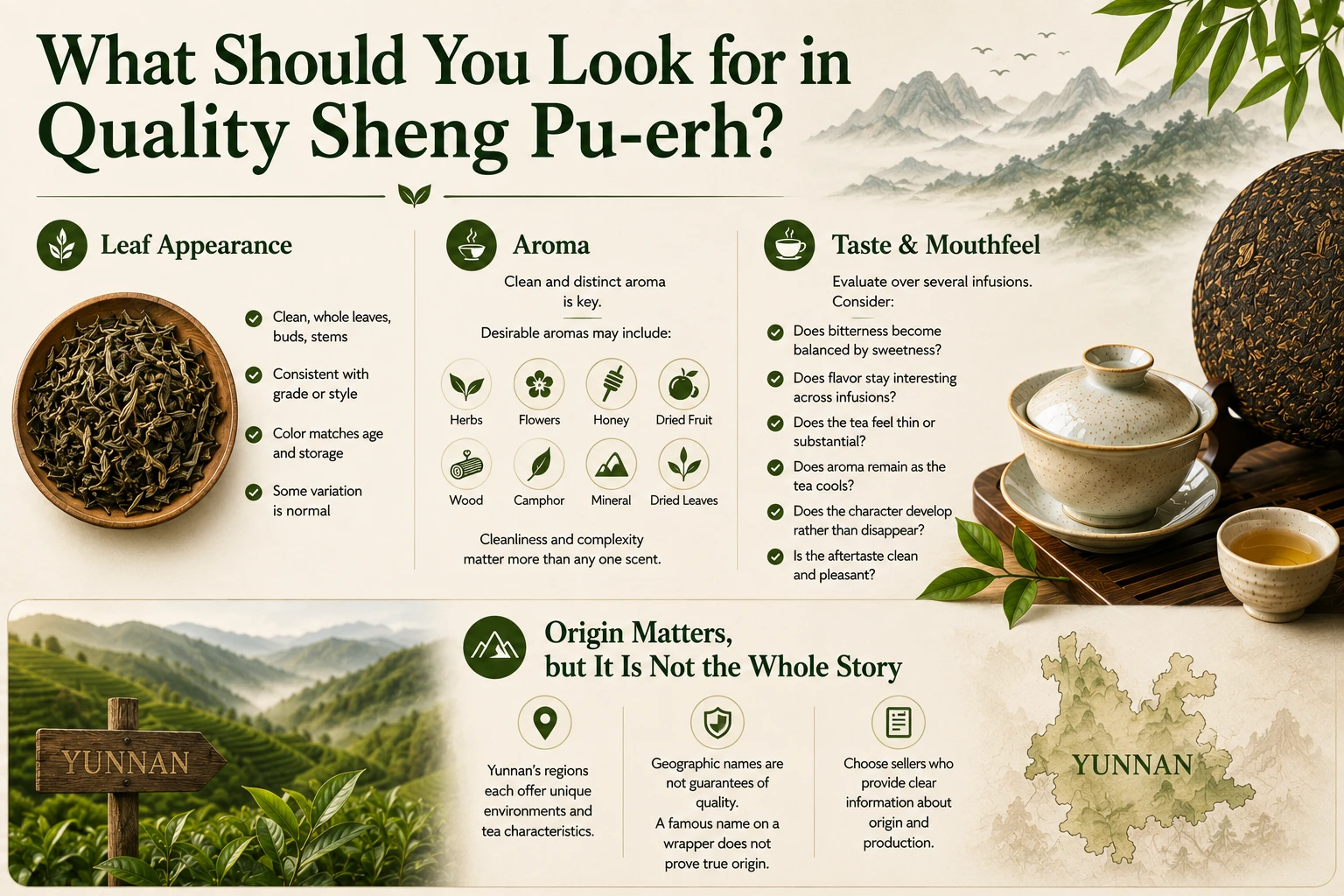
There is no single visual test that can determine whether a Sheng Pu-erh is good. Instead, consider several characteristics together.
Leaf Appearance
Look at the dry leaves when possible.
Quality Sheng Pu-erh can contain whole leaves, buds, stems, or a combination depending on the style. Good tea does not necessarily have perfectly uniform leaves.
Instead, look for material that appears reasonably clean and consistent with the stated grade or production style.
Excessive dust, unexplained debris, or a large amount of broken material may warrant closer examination, although some variation is normal.
The color should also make sense for the tea's age and storage history. A young Sheng Pu-erh may retain shades of green, yellow, or olive, while aged tea generally becomes darker.
Color alone, however, should never be used to determine age or quality.
Aroma
Aroma is one of the most useful ways to assess Sheng Pu-erh.
Before brewing, gently smell the dry tea. After warming the leaves with hot water, smell them again. Notice whether the aroma is clean and distinct or whether it suggests dampness, mold, excessive smoke, or other unwanted odors.
Depending on the tea, desirable aromas may include:
- Fresh herbs
- Flowers
- Honey
- Dried fruit
- Wood
- Camphor-like notes
- Mineral or earthy tones
- Dried leaves
The important point is not whether the tea has one particular aroma. Sheng Pu-erh can have many different aromatic profiles.
Cleanliness and complexity are more useful considerations than chasing a predetermined scent.
Taste and Mouthfeel
Taste the tea over several infusions rather than judging it from the first sip alone.
Young Sheng Pu-erh can be bitter or astringent. These characteristics are not necessarily signs of poor quality. In some teas, bitterness can be followed by sweetness, while astringency may be accompanied by a refreshing or structured mouthfeel.
Pay attention to how the tea changes after swallowing.
Ask yourself:
- Does bitterness become balanced by sweetness?
- Does the flavor remain interesting across several infusions?
- Does the tea feel thin or substantial?
- Does the aroma remain present as the tea cools?
- Does the character develop rather than simply disappear?
- Is the aftertaste clean and pleasant?
A quality tea does not have to be completely free of bitterness or astringency. Balance and structure are often more meaningful than softness alone.
Origin Matters, but It Is Not the Whole Story
Yunnan contains numerous tea-growing areas, each with different environmental conditions and tea traditions.
Tea from different mountains and villages can show differences in aroma, bitterness, sweetness, texture, and aging potential. This is one reason Pu-erh enthusiasts often pay close attention to geographic origin.
However, geographic names should not be treated as guarantees of quality.
A tea's origin is meaningful when supported by reliable sourcing. A famous place name printed on a wrapper does not by itself prove that the leaves came from that location.
When purchasing, consider whether the seller provides clear information about the tea's origin and production rather than relying solely on prestigious-sounding names.
Young Versus Aged Sheng Pu-erh
Age is an important consideration, but it should be understood in context.
Young Sheng Pu-erh
Younger Sheng often has brighter and more pronounced characteristics. Depending on the tea, you may notice floral aromas, fresh vegetation, fruit, bitterness, or astringency.
Some young Sheng is pleasant to drink immediately, while other teas are purchased with long-term aging in mind.
Aged Sheng Pu-erh
With suitable storage over many years, Sheng Pu-erh can gradually develop deeper and more mature characteristics.
Fresh or sharp notes may soften, while woody, dried-fruit, herbal, earthy, or sweet characteristics can become more prominent.
But an old tea that has been poorly stored is not necessarily better than a younger tea that has been well made and properly maintained.
A useful principle is:
Age can contribute to character, but age cannot repair fundamentally poor tea.
Storage Is Part of Quality
Storage deserves particular attention when buying aged Sheng Pu-erh.
Pu-erh continues to interact with its surrounding environment during storage. Temperature, humidity, ventilation, cleanliness, and exposure to odors can all influence how the tea develops.
Poor storage can introduce undesirable smells or flavors. Excessive moisture can create conditions that damage the tea, while extremely dry conditions may slow or alter its development.
When purchasing aged Sheng Pu-erh, ask about its storage history whenever reliable information is available.
A clean storage environment is generally more important than simply knowing the tea's age.
How to Evaluate Sheng Pu-erh Before Buying
If you have an opportunity to examine or taste a tea, use a simple process.
Step 1: Read the Information
Look for basic details such as:
- Origin
- Harvest year
- Producer
- Factory or workshop, where applicable
- Tea cultivar or material
- Production style
- Storage history for aged tea
Not every tea will have complete information, but greater transparency makes evaluation easier.
Step 2: Examine the Dry Leaves
Check the overall appearance, compression, cleanliness, and color.
Do not expect every leaf to look identical.
Step 3: Smell the Tea
Look for a clean and recognizable aroma. Be cautious of strong musty or mold-like odors, particularly in aged tea.
Step 4: Brew Multiple Infusions
A single infusion tells you relatively little about a tea's full character.
Try several short infusions and observe how the flavor, aroma, bitterness, astringency, sweetness, and mouthfeel evolve.
Step 5: Consider Value, Not Just Price
Expensive does not automatically mean high quality, and inexpensive does not automatically mean poor quality.
Consider what you are actually receiving for the price: reliable sourcing, leaf quality, production information, storage, age, and drinking character.
Common Mistakes When Buying Sheng Pu-erh
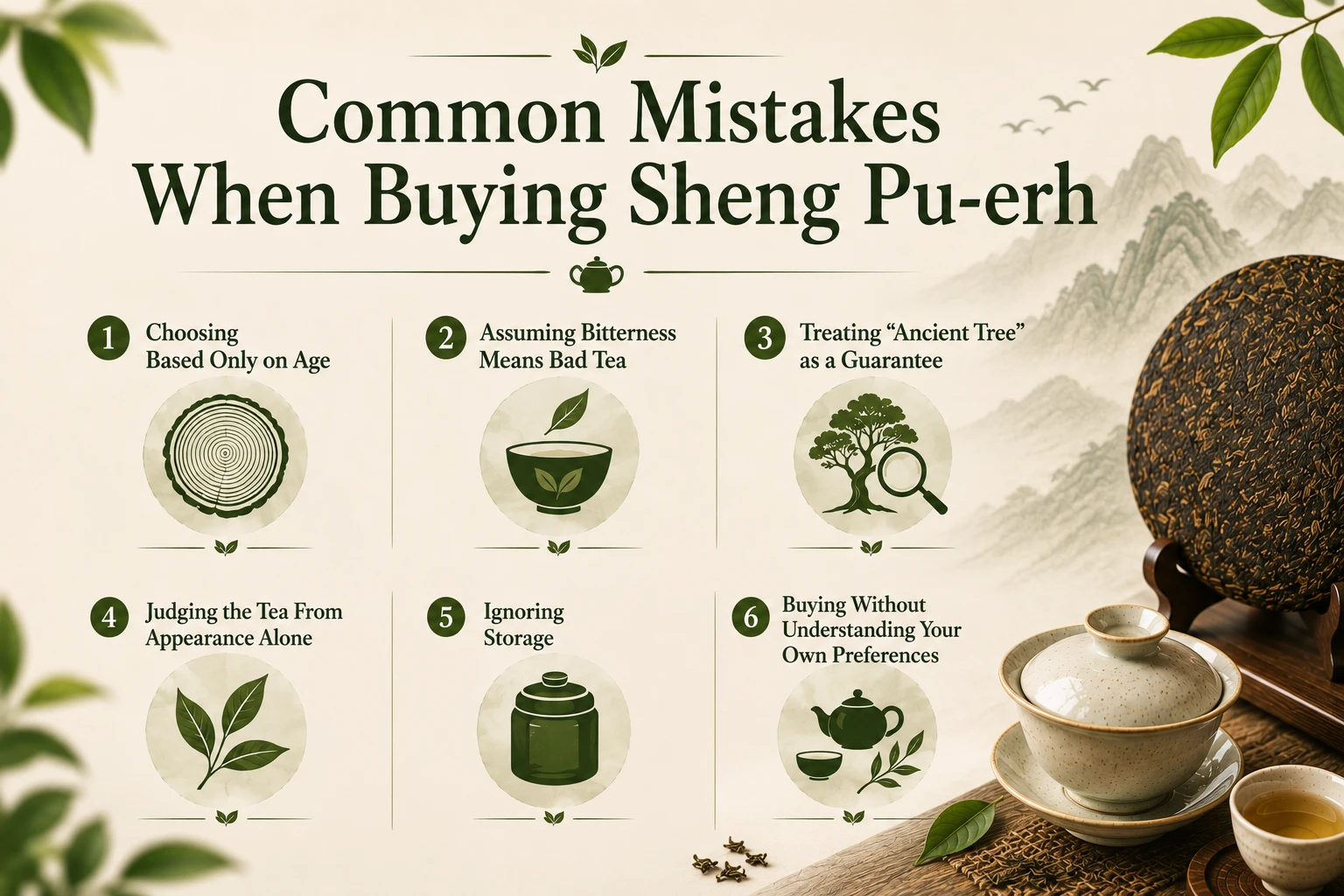
Choosing Based Only on Age
An older tea may be interesting, but age should not be the only criterion.
Assuming Bitterness Means Bad Tea
Some Sheng Pu-erh naturally has noticeable bitterness. The more important question is how that bitterness behaves and whether the tea develops balance.
Treating "Ancient Tree" as a Guarantee
Tree age claims can be difficult to verify. Consider the overall evidence and reputation of the source.
Judging the Tea From Appearance Alone
Beautiful leaves do not necessarily produce an exceptional cup. Brewing and tasting remain essential.
Ignoring Storage
For aged Sheng Pu-erh especially, storage can be as important as the original tea material.
Buying Without Understanding Your Own Preferences
There is no universally perfect Sheng Pu-erh.
If you prefer floral and lively teas, a younger Sheng may appeal to you. If you prefer deeper and softer flavors, an aged tea may be more suitable. Tasting different styles is one of the best ways to discover what you enjoy.
Practical Tips for Beginners
If you are purchasing your first Sheng Pu-erh, keep the process simple.
Start with samples when possible. Small quantities allow you to compare teas without committing to a full cake.
Taste before collecting. A tea that is highly regarded by others may not suit your personal preferences.
Compare different ages. Brewing a young and aged Sheng side by side can make the effects of aging easier to understand.
Pay attention to the aftertaste. The experience after swallowing can reveal qualities that are less obvious during the initial sip.
Keep notes. Record the tea's origin, year, brewing parameters, aroma, flavor, bitterness, astringency, and aftertaste. Your preferences will become clearer with experience.
Choose transparent sources. Sellers who provide meaningful information about origin, production, age, and storage make it easier for buyers to make informed decisions.
How to Brew Sheng Pu-erh for Evaluation
Brewing method can strongly influence your perception of quality.
For a concentrated evaluation, use a small gaiwan or teapot and relatively short infusions. Start with hot water and adjust the temperature and steeping time according to the tea.
A useful starting point is approximately 5–7 grams of tea for 100–120 ml of water, followed by short infusions. These are guidelines rather than strict rules.
If the tea tastes excessively bitter or astringent, shorten the infusion or reduce the amount of leaf. If it tastes thin, try a slightly longer infusion.
The goal is not to force a particular flavor from the tea. It is to find a brewing approach that allows its natural characteristics to become clear.
Quality Sheng Pu-erh Is About the Whole Picture
The most reliable way to choose Sheng Pu-erh is to look beyond a single claim or characteristic.
Origin matters. Leaf material matters. Processing matters. Storage matters. Age matters. But none of these factors should be considered in isolation.
A good Sheng Pu-erh should be approached as the result of a chain of decisions—from the tea plant and growing environment to harvesting, processing, compression, storage, and brewing.
For beginners, the most useful habit is to taste carefully and compare different teas rather than trying to memorize a list of "good" and "bad" characteristics.
Conclusion
Choosing quality Sheng Pu-erh becomes much easier once you understand what you are evaluating.
Look for reliable information about origin and production. Examine the leaves, but do not judge the tea by appearance alone. Smell the dry and warmed leaves for cleanliness. Brew several infusions and pay attention to balance, mouthfeel, aftertaste, and how the tea changes. For aged Sheng, consider storage history as carefully as age.
Most importantly, remember that quality is not defined by price, age, or a prestigious name alone. A well-made tea with transparent sourcing and appropriate storage provides a much stronger foundation for an enjoyable drinking experience.
If you would like to explore authentic Chinese Sheng Pu-erh and compare different styles for yourself, you can browse Stepman's Tea, a carefully selected collection of Chinese teas, and use your tasting experience to determine which characteristics suit your preferences.
FAQs
1. What makes a Sheng Pu-erh high quality?
Quality Sheng Pu-erh generally combines good raw tea material, appropriate processing, clean storage, and desirable drinking characteristics. Aroma, flavor, mouthfeel, aftertaste, and the tea's ability to develop across multiple infusions are more useful indicators than price or age alone.
2. How can you tell if Sheng Pu-erh is authentic?
Authenticity is best assessed through reliable sourcing and detailed information about origin, producer, production, and storage rather than appearance alone. A trustworthy seller should provide as much verifiable information about the tea as reasonably possible.
3. Is older Sheng Pu-erh always better?
No. Age does not automatically indicate quality. Sheng Pu-erh can change considerably during aging, but the quality of the original tea material and its storage conditions remain important. A well-made younger tea may be preferable to an older tea that was poorly stored.
4. Should good Sheng Pu-erh be bitter?
Not necessarily, but bitterness is not automatically a defect. Many young Sheng Pu-erh teas naturally have bitterness or astringency. In a well-balanced tea, these characteristics may be accompanied by sweetness, depth, refreshing mouthfeel, or a lingering aftertaste.
5. What should Sheng Pu-erh smell like?
There is no single correct aroma. Depending on its origin, age, processing, and storage, Sheng Pu-erh may have floral, herbal, fruity, woody, earthy, honeyed, or other aromas. The most important consideration is whether the aroma is clean and appropriate for the tea's age and storage.
6. What is the difference between young and aged Sheng Pu-erh?
Young Sheng Pu-erh often has fresher, brighter, floral, herbal, bitter, or astringent characteristics. With suitable aging, some teas develop deeper, smoother, sweeter, woody, earthy, or dried-fruit notes. The exact changes depend on the tea and its storage conditions.
7. Does the appearance of Sheng Pu-erh determine its quality?
No. Leaf appearance can provide useful information, but it cannot determine quality by itself. Brewing and tasting the tea provide much more meaningful information about its aroma, flavor, texture, balance, and aftertaste.
8. What should I look for when buying a Sheng Pu-erh tea cake?
Look for clear information about origin, production, harvest year, producer, tea material, and storage where applicable. Examine the leaves if possible, and consider purchasing a sample before committing to a full cake.
9. Is Yunnan Sheng Pu-erh better than other Pu-erh tea?
Yunnan is the traditional home of Pu-erh production, and its many tea-growing regions produce a wide range of Sheng Pu-erh styles. However, "better" depends on the individual tea and the drinker's preferences. Origin is important, but it should be considered alongside processing, storage, and taste.
10. Can beginners drink Sheng Pu-erh?
Yes. Beginners can enjoy Sheng Pu-erh, although some young teas can have pronounced bitterness or astringency. Starting with samples and trying teas of different ages and styles can help new drinkers understand their preferences.
11. How should Sheng Pu-erh be stored?
Sheng Pu-erh should generally be kept in a clean environment away from strong odors and excessive moisture. Stable, appropriate conditions with suitable airflow are important for long-term storage. Storage requirements can vary depending on the local environment and intended aging approach.