How to Store Oolong Tea: A Complete Guide to Keeping Oolong Fresh
Oolong tea is valued for its layered aroma, complex flavor, and wide range of styles—from lightly oxidized, floral teas to darker, roasted varieties. Proper storage plays an important role in preserving these qualities after the tea leaves have been produced and packaged.
Unlike some teas that are intentionally aged, most oolong teas are best enjoyed while their original aromatic and flavor characteristics remain intact. Exposure to moisture, oxygen, heat, light, and strong odors can gradually change the tea, sometimes resulting in stale, flat, or unpleasant flavors.
The good news is that storing oolong tea properly does not require complicated equipment. The most important principles are simple: keep oolong tea dry, cool, dark, well sealed, and away from strong odors.
This guide explains why storage matters, how oolong tea responds to its environment, which containers work best, where tea should be kept at home, and what mistakes to avoid.
What Is Oolong Tea?
Oolong tea is a category of tea made from the leaves of the Camellia sinensis plant. It occupies a broad position between green tea and black tea in terms of oxidation, although the traditional classification of tea is more nuanced than a simple spectrum.
During production, fresh tea leaves undergo controlled processes such as withering, bruising or agitation, oxidation, heating, rolling, and drying. The degree and style of oxidation, along with cultivation, processing, roasting, and storage, contribute to the character of the finished tea.
Oolong encompasses remarkably diverse styles.
Some teas are lightly processed and highly aromatic, with floral or fresh fruit-like notes. Others undergo substantial roasting and may develop deeper flavors associated with nuts, caramel, wood, spice, or toasted grain.
This diversity is important when considering storage. Not every oolong tea should necessarily be stored in exactly the same way. A delicate, highly aromatic green-style oolong can be more sensitive to environmental changes than a heavily roasted Wuyi oolong, for example.
Nevertheless, the fundamental storage principles remain consistent.
Why Does Oolong Tea Need Proper Storage?
Tea leaves are a dried agricultural product. Drying makes them relatively stable, but it does not make them immune to their surroundings.
Once tea is exposed to air, humidity, light, heat, and odors, chemical and physical changes can occur.
Moisture Is One of the Biggest Risks
Tea is hygroscopic, meaning it can absorb moisture from the surrounding environment.
This is particularly important because properly dried tea should remain relatively dry until it is brewed. When tea absorbs moisture, its texture, aroma, and flavor can change.
Excessive moisture can also create conditions that encourage undesirable microbial growth.
For this reason, oolong tea should never be stored in an open container or in an area where it is regularly exposed to steam or condensation.
The kitchen may seem convenient, but it is often a poor storage location—particularly near a stove, dishwasher, kettle, or sink.
Oxygen Can Alter Aroma and Flavor
Oxygen gradually contributes to the deterioration of many foods and beverages, and tea is no exception.
A sealed container limits the amount of fresh air continually reaching the leaves. This is particularly useful for aromatic oolong teas, whose volatile compounds contribute substantially to their fragrance.
The goal is not necessarily to create a perfect vacuum. Rather, it is to minimize unnecessary exposure to air.
Light Can Degrade Tea Quality
Light, particularly prolonged exposure to strong light, can contribute to the degradation of compounds in tea.
Transparent containers may look attractive on a countertop, but they provide little protection if the tea is exposed to sunlight or strong artificial lighting.
A better approach is to use an opaque container or keep a suitable airtight container inside a dark cupboard.
Heat Accelerates Deterioration
High temperatures can accelerate chemical changes and cause aromatic compounds to dissipate more quickly.
Tea therefore should not be stored above an oven, next to a stove, on a sunny windowsill, or in another consistently warm location.
A stable, moderate room temperature is generally appropriate for ordinary household storage.
Oolong Tea Can Absorb Odors
Tea leaves readily pick up surrounding aromas.
This characteristic is useful during certain traditional tea-production processes, but it becomes a problem when tea is stored near strongly scented foods.
Spices, coffee, herbs, scented candles, cleaning products, and strongly flavored foods can all introduce unwanted aromas.
Even if the tea remains visually unchanged, its flavor may no longer taste as intended.
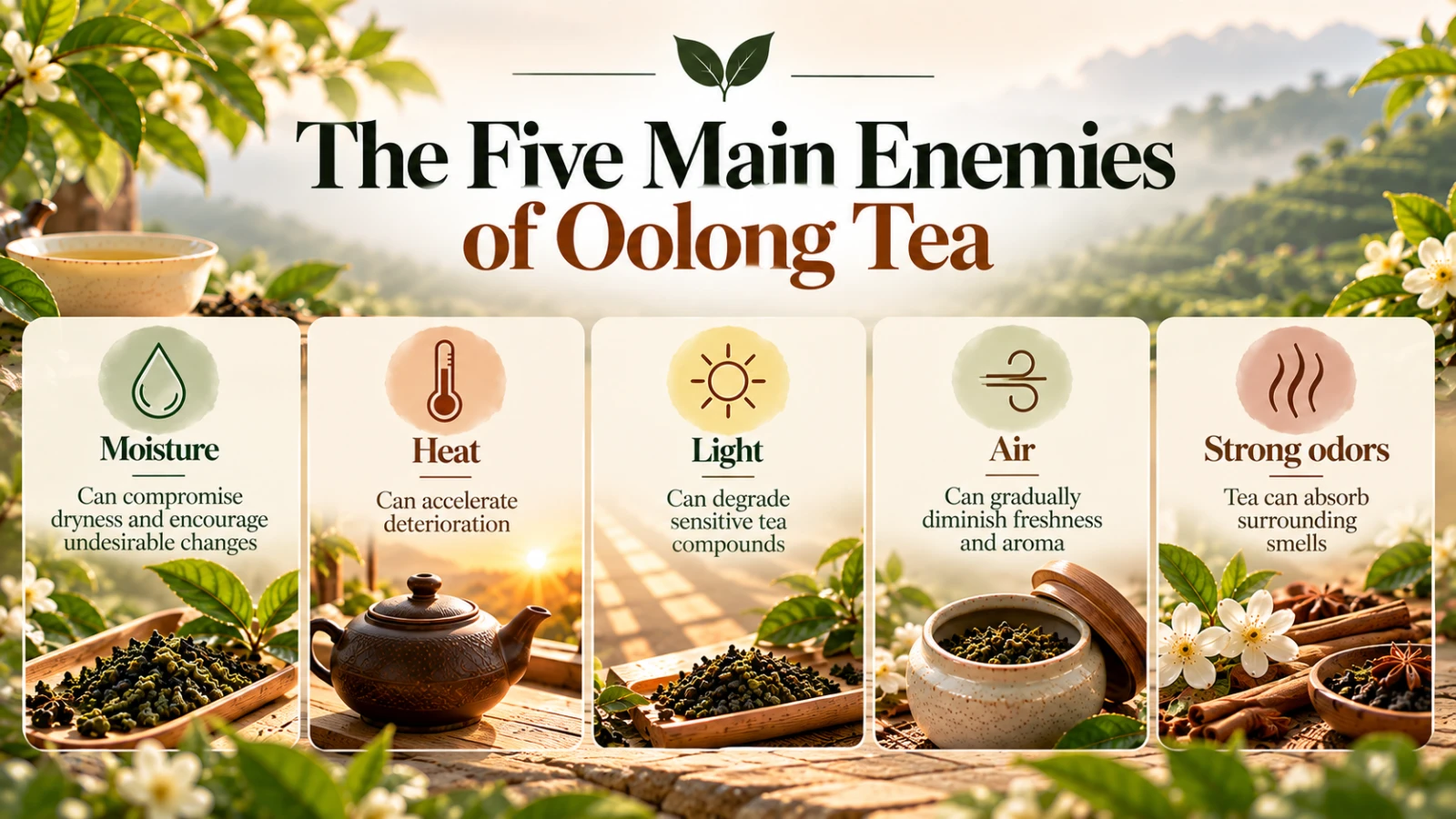
The Five Main Enemies of Oolong Tea
For everyday storage, it helps to remember five major environmental factors:
Moisture + heat + light + air + odors
Strong odors should also be considered a fifth concern.
The objective of good tea storage is therefore to create a relatively stable environment that limits exposure to these factors.
What Is the Best Container for Oolong Tea?
The ideal container should provide a good barrier against moisture, air, light, and odors.
Several options can work well.
Airtight Metal Containers
Opaque metal tins are among the most practical choices for everyday tea storage.
A properly fitted lid can provide good protection from light and air while the opaque material prevents light exposure.
Food-safe containers specifically intended for tea or dry foods are preferable.
Airtight Ceramic Containers
Glazed ceramic containers with secure lids can also work well, particularly when kept in a cool, dark location.
Traditional Chinese tea storage has used a variety of ceramic vessels, although suitability depends on the vessel's material, seal, and intended purpose.
A decorative ceramic container that does not seal properly is less useful for preserving a delicate oolong than a simple airtight container.
Original Packaging
Keeping tea in its original packaging can be perfectly reasonable, particularly when the package has been designed to protect the leaves from environmental exposure.
Many professionally packaged teas use layered or barrier packaging that provides substantial protection from moisture, light, and oxygen.
There is no need to transfer tea simply for the sake of transferring it.
If the original package can be securely resealed, it may be the simplest storage solution.
Should Oolong Tea Be Stored in the Refrigerator?
For most households, refrigeration is not necessary for ordinary oolong tea storage.
A refrigerator introduces several potential problems.
First, refrigerators contain moisture and numerous food aromas. Tea can absorb odors if its packaging is not sufficiently protective.
Second, repeatedly removing cold tea from the refrigerator and exposing it to warmer air can create condensation. Moisture entering the tea is undesirable.
For these reasons, a cool, dry cupboard is generally a better everyday storage environment.
There are circumstances in which specialized cold storage may be used for certain teas, particularly within professional tea storage systems, but this is different from placing an opened package of oolong tea in a household refrigerator.
For most tea drinkers, simplicity is preferable.
Should Oolong Tea Be Stored in the Freezer?
Freezing tea is sometimes used for long-term preservation of particularly delicate, highly aromatic teas. However, it requires more care than ordinary room-temperature storage.
The central concern is condensation.
If a cold package is opened while still cold, humid air can come into contact with the tea and introduce moisture. Repeated temperature changes can therefore undermine the very qualities that cold storage is intended to protect.
For everyday quantities that will be consumed within a reasonable period, freezing is usually unnecessary.
If specialized cold storage is used, the tea should be packaged extremely well and allowed to return to room temperature while still sealed before opening.
For most households, an airtight, opaque container in a cool, dry cupboard remains the easier solution.
Where Should Oolong Tea Be Stored at Home?
The best location is usually a cupboard or cabinet that is:
- Cool and relatively stable in temperature
- Dry
- Dark
- Away from cooking steam
- Away from strong odors
- Protected from direct sunlight
- Convenient enough that the tea can be accessed without repeatedly disturbing other stored tea
A pantry can work well if it does not become excessively warm or humid.
Avoid storing tea:
- Above the stove
- Beside the sink
- Above or beside an oven
- On a sunny countertop
- Near spices
- Beside coffee or strongly scented foods
- In a bathroom or other humid room
A stable environment is generally more important than finding an unusually cold one.
Should Different Oolong Teas Be Stored Separately?
Yes.
Different oolong teas can have very different aromatic profiles, and strong aromas can influence neighboring teas when containers are not sufficiently sealed.
It is particularly useful to keep strongly roasted teas separate from delicate, floral oolongs.
For example, a fragrant, lightly oxidized oolong should ideally not share an inadequately sealed container with a heavily roasted tea.
Individual airtight packaging is therefore preferable.
For larger collections, labeling each container with the tea name and purchase or opening date can also make storage easier to manage.
How Long Does Oolong Tea Last?
There is no single expiration period that applies to every oolong tea.
Shelf life depends on the tea itself, how it was processed, its packaging, storage conditions, and personal expectations regarding freshness.
A properly stored oolong may remain enjoyable for a considerable period, but "safe to drink" and "at its best" are not necessarily the same thing.
Delicate aromatic teas are often best appreciated while their fresh fragrance remains pronounced. More heavily roasted or traditionally handled oolongs may behave differently over time.
Rather than relying exclusively on a calendar, evaluate the tea itself.
Signs that an oolong has lost quality can include:
- Noticeably diminished aroma
- Flat or muted flavor
- Stale or cardboard-like notes
- Unusual mustiness
- Unwanted odors
- Visible moisture or clumping
- Any indication of mold
If tea has developed visible mold or a distinctly abnormal odor associated with moisture contamination, it should not be consumed.
Does Oolong Tea Improve With Age?
This is an important distinction.
Storage and aging are not necessarily the same thing.
Most oolong tea does not need to be aged. Proper storage is generally intended to preserve the tea's existing characteristics rather than deliberately transform them.
However, certain traditionally produced oolongs may be stored and periodically re-roasted over extended periods as part of specific tea traditions. This is a specialized practice requiring appropriate knowledge, conditions, and tea selection.
It should not be assumed that simply keeping any oolong tea in a cupboard for several years will improve it.
For ordinary tea storage, the goal is straightforward:
Preserve the tea you purchased rather than trying to manufacture an aged tea through passive storage.
How to Store Opened Oolong Tea
Once a package has been opened, storage becomes particularly important because the leaves are exposed to fresh air each time the package is opened.
A practical household method is:
- Transfer the tea only if necessary. If the original packaging provides an effective seal, it may be left as is.
- Remove excess air where practical. Do not aggressively compress delicate leaves, but avoid unnecessarily large amounts of empty space.
- Seal the package immediately after use.
- Store it in a dark cupboard.
- Keep it away from heat, moisture, and strong aromas.
- Avoid repeatedly opening the container just to smell or inspect the leaves.
- Use smaller containers for small quantities when appropriate.
If a large quantity of tea is purchased, dividing it into smaller sealed portions can reduce repeated exposure to air.
Common Oolong Storage Mistakes
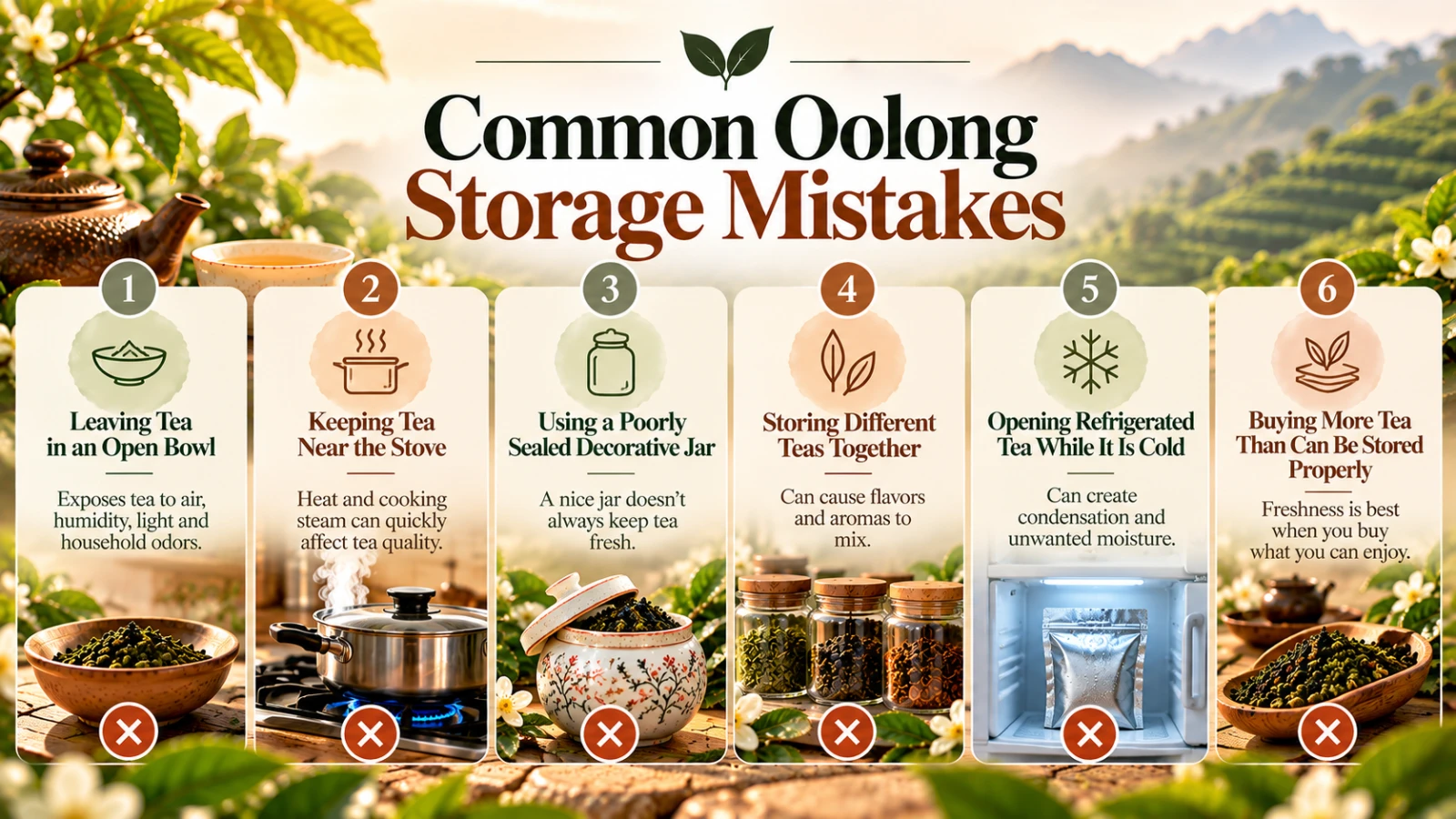
Leaving Tea in an Open Bowl
Tea displayed in an open bowl may look attractive, but prolonged exposure to air, humidity, light, and household aromas is not ideal.
Keeping Tea Near the Stove
Heat and cooking steam create exactly the conditions tea storage should avoid.
Using a Poorly Sealed Decorative Jar
A beautiful container is not necessarily an effective storage container. The quality of the seal matters more than appearance.
Storing Different Teas Together
This can cause aromatic cross-contamination, particularly when one tea has a powerful roasted or smoky character.
Opening Refrigerated Tea While It Is Cold
Condensation can introduce unwanted moisture. If specialized cold storage is used, the sealed package should return to room temperature before opening.
Buying More Tea Than Can Be Stored Properly
Freshness is easier to maintain when tea is purchased in quantities appropriate for its expected rate of consumption.
This is especially relevant for delicate, highly aromatic oolongs.
A Simple Storage Routine for Tea Drinkers
For most people, an effective routine does not need to be complicated.
After opening:
1. Seal — Close the package or container securely.
2. Protect — Keep the tea away from light, heat, moisture, and odors.
3. Separate — Store different teas independently.
4. Label — Record the tea name and, if useful, the date opened.
5. Use — Brew the tea regularly rather than allowing an opened package to sit indefinitely.
This approach preserves most oolong teas effectively without requiring specialized equipment.
Does Storage Affect Brewing?
Yes.
Proper storage preserves the volatile compounds and overall condition of the leaves that contribute to the brewing experience.
When tea has been exposed to moisture, heat, or odors, changes may become noticeable in the cup. Aroma may be weaker, flavors may seem less defined, or unwanted notes may appear.
This is one reason storage should be considered part of tea preparation rather than an entirely separate concern.
Good brewing cannot fully compensate for tea that has been poorly stored.
Practical Storage Guide
For a straightforward approach, use the following checklist:
Best practice
- Keep oolong tea dry.
- Use an airtight or well-sealed container.
- Protect it from light.
- Store it somewhere cool and temperature-stable.
- Keep it away from strong odors.
- Separate different teas.
- Reseal the container immediately after use.
- Purchase quantities that can reasonably be consumed while the tea is in good condition.
Avoid
- Humid environments
- Direct sunlight
- Excessive heat
- Open containers
- Poorly sealed decorative jars
- Storage near spices or strong-smelling foods
- Frequent temperature changes
- Assuming every oolong benefits from long-term aging
Final Thoughts
Properly storing oolong tea is primarily about controlling its environment. The leaves should be protected from moisture, heat, light, air, and strong odors, with particular attention paid to keeping them dry and well sealed.
For most oolong teas, there is no need for complicated storage systems. An appropriate airtight container kept in a cool, dark, dry cupboard is sufficient for everyday use. More specialized approaches, such as cold storage or long-term aging, belong to specific tea traditions and require greater care.
Perhaps most importantly, storage should reflect the character of the tea. Delicate, aromatic oolongs benefit from careful protection of their fragrance, while more robust or traditionally roasted teas may have different storage considerations.
Understanding these differences makes it easier to preserve tea properly and appreciate what the producer intended the leaves to offer.
For those interested in exploring different expressions of Chinese oolong tea, Stepman's Tea offers a selection of traditionally produced teas that can be explored alongside a deeper understanding of their origins, processing, and brewing characteristics.
Frequently Asked Questions (FAQs)
These FAQs address common search queries and can be included near the end of the article. They may also help the content answer specific long-tail searches.
1. What is the best way to store oolong tea?
Store oolong tea in an airtight, opaque container in a cool, dry place away from direct sunlight, heat, moisture, and strong odors. Reseal the container immediately after use to help preserve the tea's aroma and flavor.
2. Should oolong tea be refrigerated?
Most oolong tea does not need refrigeration. A cool, dry cupboard is generally more practical because refrigerators can expose tea to food odors and condensation if packaging is not handled carefully.
3. Can oolong tea be stored in the freezer?
Freezing may help preserve certain delicate teas when they are packaged properly, but it is not necessary for most household tea storage. Keep the tea sealed while it returns to room temperature before opening to reduce condensation.
4. How long does oolong tea stay fresh?
Oolong tea's freshness depends on its processing, packaging, storage conditions, and style. Delicate, aromatic varieties may lose their fragrance sooner than some roasted teas. Proper storage helps preserve quality, but there is no single shelf life for every oolong.
5. Does oolong tea expire?
Oolong tea can gradually lose its aroma and flavor over time. Exposure to moisture can also compromise its condition. Discard tea that shows visible mold or has a distinctly abnormal, musty odor.
6. What container is best for storing oolong tea?
An airtight metal tin, a properly sealed glazed ceramic container, or the tea's original resealable barrier packaging can work well. The most important features are protection from moisture, light, air, and odors.
7. Should different types of oolong tea be stored separately?
Yes. Separate, well-sealed containers help prevent aromatic cross-contamination. This is especially useful when storing delicate floral oolongs alongside strongly roasted teas.
8. Does oolong tea improve with age?
Not necessarily. Most oolong tea is stored to preserve its original qualities rather than to encourage aging. Some traditionally produced oolongs undergo specialized aging and re-roasting practices, but these methods do not apply to every variety.
9. Can oolong tea absorb odors?
Yes. Tea leaves can absorb aromas from their surroundings. Keep oolong tea away from coffee, spices, cleaning products, and other strongly scented materials, and use containers that seal securely.
10. How should opened oolong tea be stored?
Close the original package securely or transfer the leaves to an airtight container if necessary. Keep the tea in a cool, dark cupboard and minimize repeated exposure to air, moisture, and strong odors.