Understanding Oolong Oxidation
Oolong tea occupies a fascinating position within the world of tea. It is neither simply a green tea nor a black tea, and its wide range of aromas, flavors, colors, and textures comes largely from one factor: oxidation.
Yet oxidation is often misunderstood. It is sometimes described as if it were a simple scale from “light” to “dark,” but the reality is more nuanced. Oolong teas can undergo carefully controlled oxidation during processing, and the degree and manner of oxidation influence the tea’s character alongside cultivar, growing environment, processing technique, roasting, and aging.
This guide explains what oxidation means in oolong tea, how it happens, how tea makers control it, and how oxidation affects the finished leaf and liquor. Understanding these fundamentals can make it easier to appreciate the remarkable diversity of authentic Chinese oolong teas and make more informed choices when purchasing and brewing them.
What Is Oxidation in Tea?
Oxidation is a natural chemical process that begins when tea leaves are exposed to oxygen after being picked and their cells are disrupted.
Freshly harvested tea leaves contain enzymes, including polyphenol oxidase, as well as various polyphenols and other compounds. When the leaf remains intact, these components are largely separated within the leaf's cellular structure. Once the leaf is bruised, rolled, shaken, or otherwise damaged, they come into contact with oxygen and enzymatic reactions begin.
This process changes the chemical composition of the leaf.
Oxidation contributes to changes in:
- Leaf color
- Liquor color
- Aroma
- Flavor
- Mouthfeel
- Astringency
- Perceived sweetness
Importantly, oxidation is not the same thing as fermentation in the strict microbiological sense. Traditional tea terminology frequently uses the word “fermentation” to describe oxidation, but most oolong tea oxidation is primarily an enzymatic process rather than microbial fermentation.
This distinction becomes particularly important when comparing oolong with teas such as ripe or shu pu-erh, where microbial activity plays a much more significant role during processing.
Why Is Oxidation Important in Oolong Tea?
Oolong tea is defined in part by its processing, and controlled oxidation is one of its most important characteristics.
Green tea is generally processed to minimize enzymatic oxidation, while black tea is intentionally oxidized extensively. Oolong sits between these broad categories, although the actual range is much more complex than a simple midpoint.
Some oolongs undergo relatively light oxidation and retain fresh, floral, and sometimes vegetal characteristics. Others undergo considerably more oxidation, producing deeper floral, fruity, honeyed, roasted, or woody profiles.
This gives oolong an extraordinary range of styles.
Two oolong teas may come from different cultivars, regions, or processing traditions and taste completely different even when both are technically oolong. Oxidation is one part of the explanation, but it should never be considered in isolation.
Oxidation Is Not the Same as Roast
One of the most common misunderstandings is assuming that a darker oolong must be more highly oxidized.
That is not necessarily true.
Oxidation and roasting are separate processes.
Oxidation occurs while the enzymes in the leaf are active and oxygen is available. Roasting, or baking, involves applying controlled heat to the processed tea. Roasting can deepen color, alter aroma, reduce certain green or grassy notes, and create flavors associated with toast, nuts, caramel, dried fruit, or wood.
A lightly oxidized tea can be heavily roasted, while a more oxidized tea may receive relatively little roasting.
When evaluating an oolong, it is therefore useful to consider at least three separate factors:
- Oxidation
- Roasting
- Aging
These processes can interact, but they are not interchangeable.
How Does Oolong Oxidation Work?
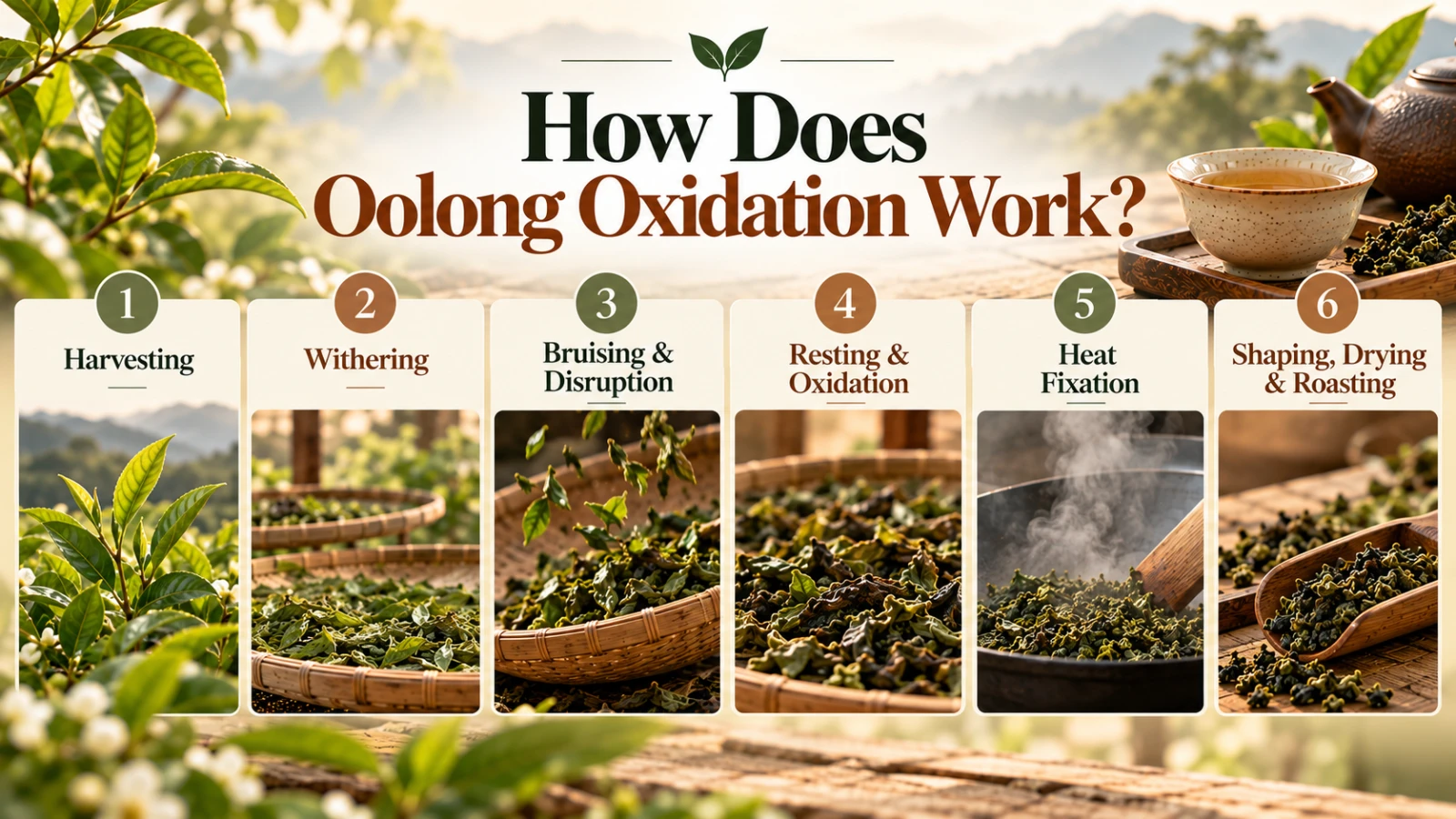
Oolong production varies considerably by region and tea-making tradition, but a simplified sequence helps explain where oxidation occurs.
1. Harvesting
Tea leaves are picked according to the desired style.
The maturity of the leaves and buds can influence the finished tea. Some oolongs use relatively tender shoots, while others are made from more mature leaves.
Harvesting practices are closely connected to regional traditions and cultivar characteristics.
2. Withering
Freshly harvested leaves are spread out and allowed to lose some moisture.
Withering makes the leaves more flexible and begins biochemical changes within them. Depending on the style, withering may take place indoors, outdoors, or through a combination of both.
Environmental conditions such as temperature, humidity, airflow, and duration can influence the process.
Withering itself is not simply “oxidation,” but it prepares the leaves for subsequent processing.
3. Bruising and Disruption
This is one of the defining stages of many oolong production methods.
Tea makers may shake, toss, roll, or otherwise manipulate the leaves. This damages portions of the leaf's cellular structure and allows enzymes and other compounds to interact with oxygen.
At this point, oxidation begins to develop.
The degree and manner of physical disruption can influence how oxidation progresses through the leaf.
4. Resting and Oxidation
After the leaves have been manipulated, they are allowed to rest.
During this period, enzymatic oxidation continues.
Tea makers monitor the leaves carefully rather than simply allowing them to oxidize for an arbitrary amount of time. Temperature, humidity, leaf condition, cultivar, and desired style all affect the process.
The leaves may be manipulated and rested multiple times.
This repeated cycle is one reason traditional oolong production requires considerable experience.
5. Heat Fixation
Once the desired level of oxidation has been reached, heat is applied to slow or stop enzymatic activity.
This stage is sometimes called kill-green or sha qing.
The purpose is not to sterilize the tea. Rather, sufficient heat deactivates the enzymes responsible for continued enzymatic oxidation.
At this point, the tea maker has essentially captured the desired oxidation stage.
6. Shaping, Drying, and Possible Roasting
The leaves may then be rolled, twisted, compressed, or shaped according to the style.
They are dried to reduce moisture and stabilize the tea.
Some oolongs undergo additional roasting. Others may be left with little or no substantial roasting.
The finished character therefore reflects a sequence of decisions rather than oxidation alone.
What Happens to the Tea During Oxidation?
Oxidation causes chemical transformations that influence the compounds responsible for tea's sensory characteristics.
Among the most important changes are those involving tea polyphenols, including catechins.
As oxidation progresses, catechins and related compounds undergo enzymatic reactions that contribute to the formation of compounds such as theaflavins and thearubigins, particularly as oxidation becomes more extensive.
These transformations influence color, flavor, aroma, and mouthfeel.
However, it would be misleading to suggest that every oolong can be accurately described simply by measuring its oxidation percentage. Traditional tea production is much more complicated.
Cultivar, leaf maturity, growing conditions, withering, physical manipulation, temperature, roasting, and storage can all influence the final chemical and sensory profile.
For this reason, oxidation should be understood as one important variable within a larger production system.
How Oxidation Changes Oolong's Flavor
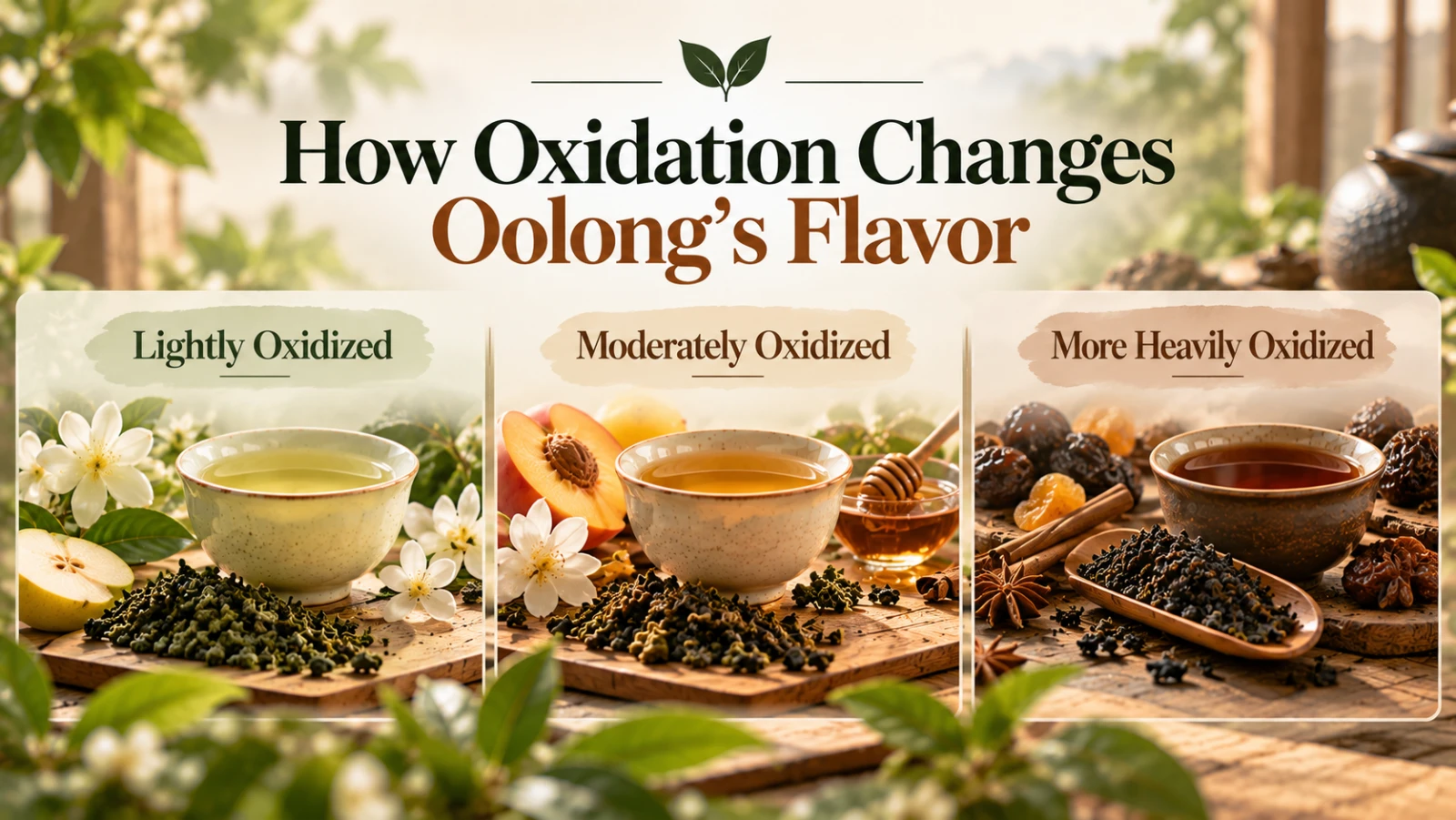
One of the easiest ways to understand oxidation is through sensory characteristics.
Lightly Oxidized Oolongs
Lower-oxidation oolongs may display characteristics such as:
- Fresh flowers
- Gardenia
- Orchid
- Cream
- Fresh fruit
- Vegetal notes
- Light sweetness
- Bright acidity
Some Taiwanese high-mountain oolongs and certain modern interpretations of traditional styles can show this fresher character.
These teas often produce pale yellow or green-gold liquor.
Moderately Oxidized Oolongs
As oxidation increases, the profile can become more rounded.
Depending on the tea, aromas may suggest:
- Ripe fruit
- Honey
- Stone fruit
- Dried flowers
- Sweet spices
- Toast
- Cream
- Orchard fruit
The liquor may become deeper gold or amber.
More Heavily Oxidized Oolongs
Higher oxidation can contribute to deeper and more developed flavors, including:
- Dried fruit
- Honey
- Malt
- Dark floral notes
- Wood
- Spice
- Ripe fruit
Some traditional oolongs from Fujian and Guangdong are known for more substantial oxidation and processing.
Again, these descriptions are tendencies rather than strict rules. A tea's final flavor cannot be predicted from oxidation level alone.
Famous Chinese Oolong Traditions and Oxidation
China's oolong-producing regions demonstrate why oxidation should be viewed within its cultural and processing context.
Wuyi Oolong
Wuyi oolongs from northern Fujian are often associated with substantial processing and roasting.
Teas such as Da Hong Pao and other Wuyi yancha can display mineral, roasted, fruity, floral, and woody characteristics.
Their complexity does not come from oxidation alone. Cultivar, rocky growing environment, leaf processing, roasting, and production tradition all contribute.
Anxi Oolong
Anxi, in southern Fujian, is particularly famous for Tieguanyin.
Modern Tieguanyin styles can be relatively light, fresh, and floral, while traditional styles may involve more substantial oxidation and roasting.
This provides a useful illustration of why the name of a tea does not necessarily tell the entire story of its processing.
Guangdong Oolong
Phoenix oolongs, including Dancong teas from the Chaozhou region, are another important category.
These teas are often known for distinctive aromatic profiles, which can include floral, fruity, honeyed, and spice-like characteristics.
Traditional brewing methods can emphasize these aromas dramatically.
Is More Oxidation Better?
No.
There is no universal “ideal” oxidation level.
The appropriate degree of oxidation depends on the tea's intended style, cultivar, terroir, production method, and the tea maker's objectives.
A lightly oxidized oolong is not inherently superior to a heavily oxidized one, just as a heavily roasted tea is not automatically more traditional or higher quality.
Quality is better evaluated through the tea as a whole:
- Raw material quality
- Cultivar
- Growing environment
- Harvesting
- Processing skill
- Aroma
- Flavor
- Texture
- Balance
- Clean finish
- Storage condition
A well-made tea should express its intended style clearly and remain balanced in the cup.
How Can Consumers Recognize Oxidation?
Visual appearance can provide clues, but it should not be treated as definitive evidence.
A greener-looking dry leaf may suggest lighter oxidation, while darker leaves may indicate greater oxidation or roasting. However, roasting can substantially change the appearance of the finished tea.
The liquor provides another clue. Pale yellow-green liquor is common among some lightly oxidized oolongs, while amber or deeper golden liquor can occur with more oxidation or roasting.
A better approach is to evaluate several characteristics together.
Look at the Dry Leaf
Notice:
- Color
- Shape
- Uniformity
- Degree of twisting or rolling
- Presence of stems
- Aroma
Examine the Wet Leaves
After brewing, look at:
- Leaf color
- Leaf integrity
- Uniformity
- Degree of expansion
- Aroma
Taste the Tea
Pay attention to:
- Initial aroma
- Flavor development
- Sweetness
- Astringency
- Bitterness
- Body
- Aftertaste
- Persistence
Most importantly, observe how the tea changes across several infusions.
Quality oolong is often not fully revealed by the first cup.
Brewing Oolong According to Its Oxidation Level
Understanding oxidation can also help with brewing.
There is no single brewing method suitable for every oolong.
Lighter Oolongs
Lighter, greener oolongs often respond well to moderately hot water rather than extremely aggressive brewing.
A starting point might be:
- Water: approximately 85–95°C (185–203°F)
- Moderate leaf quantity
- Short initial infusion
- Several subsequent infusions
The goal is to preserve delicate floral and fresh fruit characteristics without overwhelming them.
More Oxidized or Roasted Oolongs
More substantially processed oolongs can often tolerate hotter water.
A starting point might be:
- Water: approximately 90–100°C (194–212°F)
- Generous leaf quantity
- Short to moderate infusion times
- Multiple infusions
These parameters are starting points rather than rigid rules.
The most useful principle is to adjust one variable at a time.
If the tea tastes harsh, shorten the infusion or lower the temperature. If it tastes thin, increase the leaf quantity or steep slightly longer.
Common Misunderstandings About Oolong Oxidation
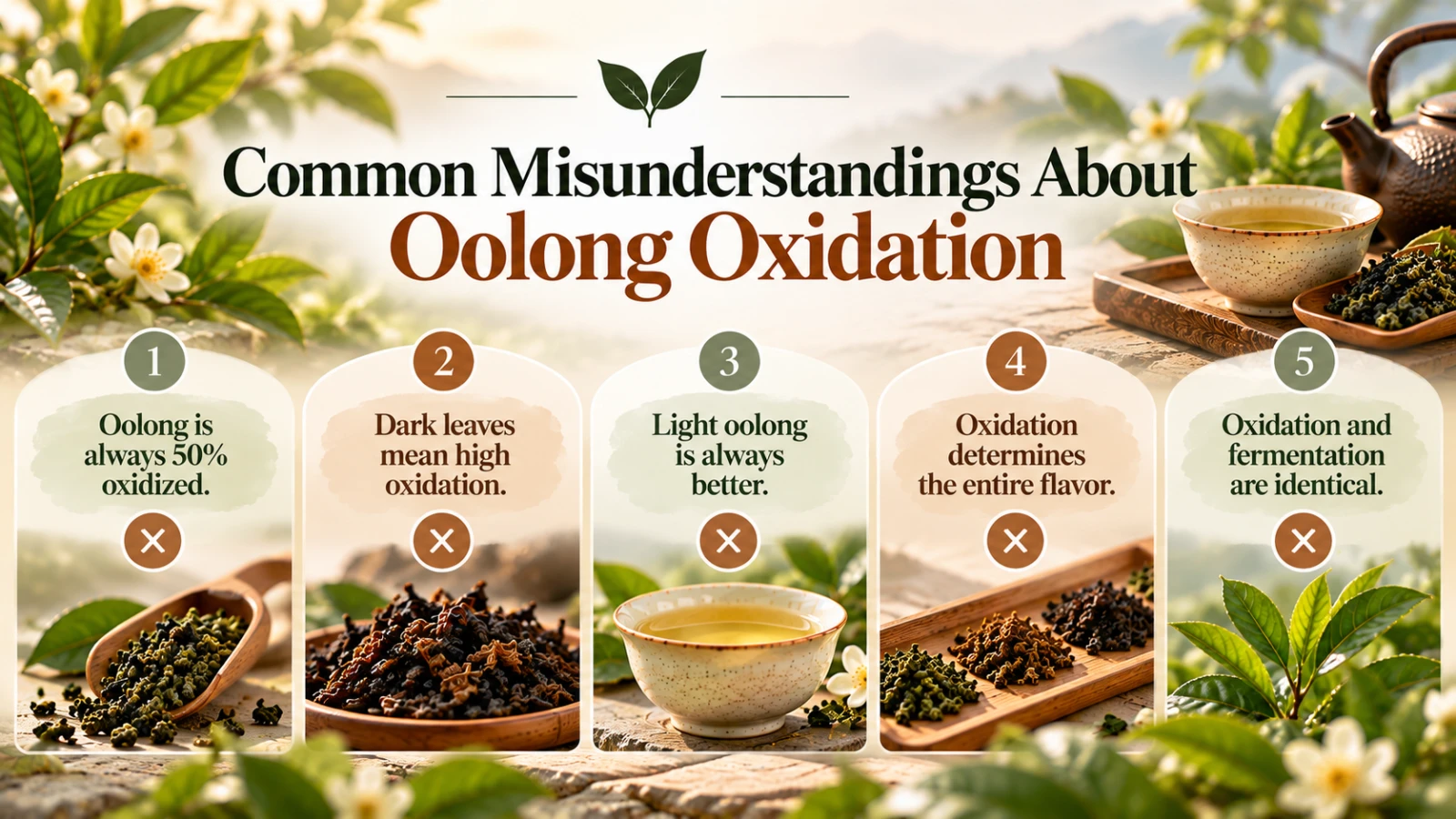
“Oolong is always 50% oxidized.”
This is an oversimplification.
Oolong encompasses a broad range of oxidation levels and production methods. There is no single oxidation percentage that defines all oolong tea.
“Dark leaves mean high oxidation.”
Not necessarily.
Roasting can darken tea substantially.
“Light oolong is always better.”
Not necessarily.
Light and traditional styles appeal to different palates and express different production philosophies.
“Oxidation determines the entire flavor.”
It does not.
Oxidation is important, but cultivar, terroir, harvesting, withering, shaping, roasting, and storage also contribute substantially.
“Oxidation and fermentation are identical.”
They are not.
Traditional oolong production primarily involves enzymatic oxidation. Fermentation in the microbiological sense refers to microbial activity and is a different biological process.
Practical Tips for Buying Oolong Tea
For anyone beginning to explore Chinese oolong, focusing exclusively on oxidation level can make the selection process unnecessarily complicated.
Instead, consider the tea's style and intended character.
Ask:
- Is the tea lightly or substantially oxidized?
- Is it roasted?
- What cultivar is used?
- Where was it produced?
- What processing tradition does it represent?
- Does the aroma seem clean and distinctive?
- Does the tea remain balanced through multiple infusions?
- Is sufficient information provided about its origin and production?
A reputable tea source should be able to explain what the tea is and where it comes from rather than relying solely on vague descriptions such as “premium,” “detoxifying,” or “extra healthy.”
For authentic Chinese tea, provenance matters. Region, cultivar, processing tradition, and preparation all provide useful context for understanding what is in the cup. Learn more about How to Choose Quality Oolong Tea in our blog post.
Storing Oolong Tea Properly
Oxidation does not end entirely once the tea has been produced. Exposure to oxygen, moisture, heat, light, and strong odors can continue to alter the tea over time.
For most oolong teas, practical storage means:
- Keep tea dry.
- Protect it from excessive heat.
- Limit unnecessary exposure to air.
- Keep it away from strong odors.
- Store it away from direct sunlight.
- Use a suitable airtight container when appropriate.
Storage requirements can vary depending on the style.
Fresh, lightly processed oolongs are often best protected from environmental exposure, while traditionally roasted or aged oolongs may be handled differently.
The key is to understand the tea's intended storage tradition rather than applying one rule to every oolong.
Understanding Oolong as a Spectrum
Perhaps the most useful way to think about oolong oxidation is not as a rigid scale but as part of a spectrum of processing possibilities.
At one end are teas with relatively fresh, floral, and green characteristics. Further along the spectrum are teas with increasingly developed fruit, honey, spice, roasted, woody, and deeper aromatic qualities.
But even this spectrum is only a starting point.
Two teas with similar oxidation levels can taste dramatically different because they were made from different cultivars, grown in different environments, manipulated differently, roasted differently, or stored differently.
This is precisely what makes oolong so rewarding to study.
Understanding oxidation does not reduce tea to chemistry. Instead, it provides a framework for understanding why different teas taste different.
Conclusion
Oolong oxidation is a controlled stage of tea processing in which natural enzymatic reactions transform compounds within the leaf. Tea makers influence this process through withering, physical manipulation, resting, and heat fixation, creating a remarkably broad range of finished teas.
The degree of oxidation can influence color, aroma, flavor, texture, and aftertaste, but it does not determine quality by itself. Roasting, cultivar, terroir, harvesting, craftsmanship, and storage are equally important parts of the final character.
For tea drinkers, the practical lesson is simple: do not judge an oolong solely by how light or dark it looks. Learn about its origin, processing style, oxidation, roasting, and brewing requirements, then evaluate what happens in the cup.
The more familiar these distinctions become, the easier it is to recognize the diversity within Chinese oolong and choose teas according to individual taste and curiosity.
If you would like to experience the differences that processing and oxidation can create firsthand, explore Stepman's Tea collection of carefully selected authentic Chinese teas and compare oolong styles across regions and traditions.
FAQs
These FAQs can appear near the end of the article. The answers are written to address common reader questions directly and support long-tail search visibility.
1. What is oxidation in oolong tea?
Oxidation is a chemical process in which enzymes and oxygen transform compounds within tea leaves after their cellular structure is disrupted. Oolong tea makers control this process to develop particular aromas, flavors, colors, and textures.
2. Is oolong tea fully oxidized?
No. Oolong tea encompasses a broad range of oxidation levels. Some styles are lightly oxidized and retain fresh, floral characteristics, while others undergo more extensive oxidation and develop deeper fruity, honeyed, or woody notes.
3. What is the difference between oolong oxidation and roasting?
Oxidation is primarily an enzymatic process that occurs during tea production before heat fixation. Roasting uses heat to change the tea's aroma, flavor, and appearance. Both influence the finished tea, but they are distinct processes.
4. Does higher oxidation make oolong tea stronger?
Not necessarily. Oxidation influences flavor and aroma, but perceived strength also depends on the tea cultivar, leaf quantity, water temperature, infusion time, roasting, and brewing method.
5. How does oxidation affect oolong tea flavor?
Oxidation can contribute to changes in floral, fruity, honeyed, and deeper aromatic characteristics. The exact result depends on the cultivar and the entire processing method, not oxidation alone.
6. Is lightly oxidized oolong better than heavily oxidized oolong?
Neither style is inherently better. Lightly oxidized oolongs often emphasize fresh and floral notes, while more oxidized styles may offer deeper fruit, honey, or spice characteristics. Quality depends on the tea's intended style, craftsmanship, and balance.
7. How can oxidation levels be identified in oolong tea?
Leaf color, liquor color, and flavor can provide clues, but none reliably determines oxidation level on its own. Roasting and other processing decisions also affect appearance and taste. Information about the tea's origin and production is more informative.
8. What temperature should be used to brew oolong tea?
Many lightly oxidized oolongs can be brewed at approximately 85–95°C (185–203°F), while more oxidized or roasted styles may respond well to 90–100°C (194–212°F). These are starting ranges; leaf quantity and infusion time should also be adjusted to taste.
9. Does oolong oxidation continue after processing?
Enzymatic oxidation is largely stopped through heat fixation, but the finished tea can continue to change chemically during storage. Exposure to oxygen, heat, light, moisture, and odors can affect its quality over time.
10. Which Chinese oolong teas are good for comparing oxidation styles?
Tieguanyin from Anxi, Wuyi yancha from northern Fujian, and Phoenix Dancong from Guangdong offer useful points of comparison. However, individual styles vary, so the specific tea's processing and roasting should be considered rather than assuming every tea from a region has the same oxidation level.