How to Store Sheng Pu-erh Tea: A Practical Guide
Sheng Pu-erh is unlike most teas because storage is not simply about keeping the leaves fresh. Over time, the tea can continue to change, gradually developing new aromas, flavors, texture, and color. For this reason, how Sheng Pu-erh is stored can have a meaningful effect on how it ages.
The basic principle is straightforward: protect Sheng Pu-erh from excessive moisture, heat, light, odors, and unstable conditions while allowing it to remain in an environment where gradual transformation can occur.
Recent research confirms that temperature, humidity, water activity, oxygen availability, and the surrounding microenvironment all influence the chemical and sensory development of raw Pu-erh. Long-term studies also show that different storage environments can produce noticeably different flavor profiles.
This guide explains what proper Sheng Pu-erh storage involves, why the storage environment matters, which containers work best, common mistakes to avoid, and how to create a practical storage setup at home.
What Is Sheng Pu-erh?
Sheng Pu-erh, also called raw Pu-erh or sheng cha, is a traditional Chinese tea produced primarily in Yunnan Province.
The basic tea begins with fresh leaves from tea trees, which are withered, heated to reduce enzymatic activity, rolled, and sun-dried to produce what is commonly called mao cha. The tea may then be left loose or compressed into cakes, bricks, tuocha, or other forms.
Unlike Shu Pu-erh, or ripe Pu-erh, Sheng Pu-erh does not undergo the accelerated wet-piling fermentation process used to produce Shu. Instead, Sheng gradually changes during storage.
This distinction is important when thinking about storage.
Sheng Pu-erh is generally stored with the intention of allowing slow, long-term transformation. Shu Pu-erh, having already undergone accelerated fermentation, is generally approached differently.
As Sheng ages, its original character can gradually become less sharp and more integrated. Depending on the tea and storage conditions, bitterness and astringency may soften, the liquor may become deeper in color, and aromas may shift toward dried fruit, wood, herbs, earth, honey, or other aged characteristics.
However, aging does not automatically make every Sheng Pu-erh better. The quality of the original tea and the conditions under which it is stored both matter.
Why Does Sheng Pu-erh Need Special Storage?
Most teas are stored primarily to prevent deterioration. Green tea, for example, is generally protected from heat, moisture, oxygen, and light because these factors can accelerate unwanted changes.
Sheng Pu-erh is different.
Its continued transformation is part of the appeal.
During storage, compounds in the tea gradually change through processes involving oxidation, chemical reactions, moisture, and microbial activity. Research has found that storage conditions can influence both the chemical composition and sensory qualities of raw Pu-erh.
This means storage is effectively part of the tea's development.
The goal, however, is not to create the warmest or wettest environment possible. Excessive humidity can encourage undesirable microbial growth and off-flavors, while very dry conditions can slow the transformations associated with aging.
The objective is a stable, clean, moderate environment.
The Five Main Factors in Sheng Pu-erh Storage
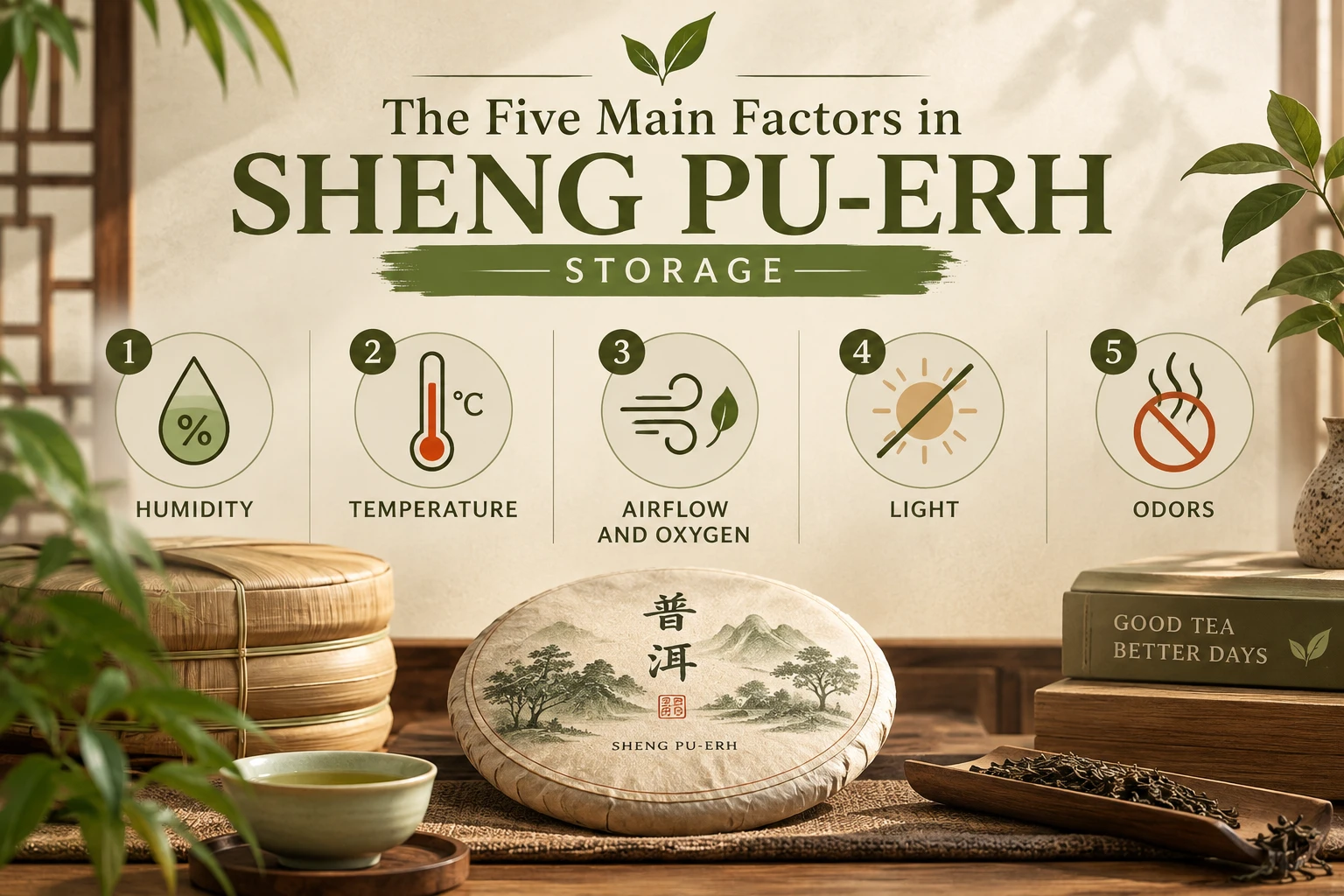
Five environmental factors deserve particular attention:
- Humidity
- Temperature
- Airflow and oxygen
- Light
- Odors
The interaction among these factors matters more than any single number.
1. Humidity
Humidity is perhaps the most discussed aspect of Pu-erh storage.
Sheng Pu-erh contains hygroscopic plant material, meaning the leaves can absorb moisture from the surrounding environment. Moisture affects chemical reactions and microbial activity during storage.
Recent research examining raw Pu-erh under controlled conditions found that water activity—the amount of water available for chemical and microbial processes—is particularly important for understanding storage behavior. The researchers found that excessively high water availability can alter microbial communities and increase the risk of undesirable changes.
For home storage, this does not mean that you need to measure water activity.
A practical approach is to maintain a moderate, relatively stable household environment, avoiding both extremely dry and persistently damp conditions.
Many experienced Pu-erh collectors use approximately 60–70% relative humidity as a practical target for natural home storage, although there is no single universally correct humidity level for every tea, location, or aging objective.
More importantly, avoid sustained conditions that are very damp.
Humidity above roughly 80% can become increasingly difficult to manage safely, particularly when combined with warmth and poor ventilation. Recent research has found that very high relative humidity can shift microbial communities toward spoilage-associated organisms.
Practical rule: moderate humidity is preferable to either extreme.
2. Temperature
Temperature influences the speed of chemical and microbial processes.
Warmer environments generally accelerate transformation, while cooler environments slow it down. But faster does not necessarily mean better.
Research comparing raw Pu-erh stored in different environments found that warmer, more humid conditions accelerated chemical changes, while drier and cooler conditions preserved more of the tea's original floral and fruity characteristics.
For home storage, a stable room temperature is generally preferable.
A range around 18–25°C (64–77°F) is a reasonable practical guideline for ordinary home storage. Avoid placing tea next to radiators, heating vents, ovens, hot appliances, or windows exposed to strong afternoon sunlight.
The key word is stable.
Large repeated temperature swings can cause corresponding changes in the tea's microenvironment and may encourage condensation under certain circumstances.
3. Airflow and Oxygen
Sheng Pu-erh needs access to its surrounding environment, but that does not mean it should sit in a constantly moving stream of air.
Oxygen participates in the gradual transformations that occur during aging. At the same time, excessive airflow can contribute to unnecessarily rapid drying.
The ideal home environment is therefore quiet and reasonably stable rather than sealed airtight or constantly ventilated.
This is one reason traditional Pu-erh storage often relies on paper wrappers, cardboard boxes, bamboo packaging, or other materials that provide some protection without creating an entirely airtight environment.
Avoid placing cakes in vacuum-sealed bags if your intention is long-term natural aging.
4. Light
Light is undesirable for long-term tea storage.
Direct sunlight can raise the temperature of the tea and expose its compounds to prolonged light exposure. It can also create significant temperature fluctuations inside packaging.
Store Sheng Pu-erh in a dark or dimly lit location.
A cupboard, cabinet, or dedicated tea-storage area is generally preferable to an open shelf beside a sunny window.
5. Odors
Tea leaves readily absorb surrounding aromas.
This makes odor control one of the simplest—and most frequently overlooked—parts of storage.
Do not store Sheng Pu-erh beside:
- Coffee
- Spices
- Incense
- Perfume
- Cleaning products
- Strongly scented foods
- Essential oils
- Tobacco
- Strongly aromatic herbs
A tea can be perfectly healthy and still be disappointing if it has absorbed an unwanted smell.
For this reason, clean, neutral-smelling storage is more important than an elaborate storage container.
Where Should You Store Sheng Pu-erh at Home?
For most people, the best solution is surprisingly simple.
Choose a location that is:
- Dark
- Clean
- Dry but not excessively dry
- Moderately humid
- Away from strong odors
- Away from heat sources
- Relatively stable in temperature
- Protected from sudden environmental changes
An interior cupboard or dedicated cabinet can work very well.
Avoid garages, attics, bathrooms, kitchens, basements prone to dampness, and locations directly beside heating or cooling equipment.
Your tea does not need to be stored in a special "Pu-erh room."
In fact, a stable indoor environment is often more practical than attempting to recreate a particular climate.
Should Sheng Pu-erh Be Stored in Paper, Plastic, or a Container?
The container matters because it creates a microenvironment around the tea.
Recent research comparing different storage containers—including original packaging, pottery, metal, cardboard, and wooden boxes—found that the container can influence the resulting flavor profile because different materials create different microclimates around the tea.
For home collectors, the safest starting point is usually to keep Sheng Pu-erh in its original paper packaging and place it in a clean cardboard box or suitable cabinet.
Paper Wrappers
Traditional paper wrapping is useful because it protects the tea from light, dust, and physical damage while allowing some interaction with the surrounding environment.
If a cake arrives traditionally wrapped, there is generally no reason to remove that wrapper simply for storage.
Cardboard Boxes
Clean, odor-free cardboard boxes are practical for storing multiple cakes.
They provide protection while avoiding the completely sealed environment created by airtight plastic containers.
Ceramic or Clay Containers
Ceramic and clay vessels can be useful, but they require more attention to the surrounding environment and the condition of the vessel.
The container should be clean, completely dry, and free of odors.
Plastic Bags and Airtight Containers
Plastic is not automatically unsuitable, but airtight storage is generally not the first choice when the goal is natural long-term aging.
If plastic is used, it should be clean, food-safe, odor-free, and selected with a specific purpose in mind rather than simply because it is convenient.
Should You Separate Sheng Pu-erh Cakes?
Usually, yes—at least when the teas have substantially different aromas or storage histories.
For example, strongly aged tea should not necessarily be stored directly alongside young tea if its aroma could transfer.
Similarly, tea with a distinctive smoky, earthy, or heavily aromatic character may influence nearby cakes.
Keeping teas organized by type, age, aroma, and storage history makes it easier to monitor their development.
You can also keep individual cakes in their original wrappers and group them inside larger clean boxes.
Should You Break Up a Sheng Pu-erh Cake?
Generally, no.
If you purchased a compressed cake for long-term aging, there is usually no need to break it apart.
Keeping the cake intact protects the tea from unnecessary handling and reduces its exposed surface area.
Breaking up a cake can make sense if you intend to drink it regularly, but if your primary goal is long-term storage, maintaining the original form is the simpler approach.
What About Humidity-Control Packs?
Humidity-control products can be useful in certain situations, particularly in very dry climates or when storing small quantities of tea.
However, they should be used cautiously.
The objective is not to make the container as humid as possible. Excess moisture can create conditions that encourage unwanted microbial activity.
For most beginners, it is better to first establish a stable room environment and monitor the tea rather than immediately attempting to engineer a tightly controlled humidity chamber.
How Long Does Sheng Pu-erh Take to Age?
There is no universal aging schedule.
A Sheng Pu-erh can begin changing relatively soon after production, but meaningful differences become more apparent over longer periods.
The pace depends on:
- Leaf material
- Processing
- Compression
- Original tea quality
- Temperature
- Humidity
- Oxygen availability
- Storage history
- Regional climate
Two identical cakes stored in different environments for ten years can taste remarkably different.
Research has demonstrated that temperature and humidity can significantly alter the rate and direction of chemical changes in raw Pu-erh. One study comparing storage regions found faster chemical changes under warmer, more humid conditions, but faster change did not necessarily correspond to better overall quality.
This is an important point:
Aging is not a race.
The goal is not simply to make the tea change as quickly as possible.
Natural Storage vs. "Wet" Storage
Pu-erh discussions sometimes distinguish between dry storage and wet storage.
These terms can be confusing because they do not always have standardized definitions.
Generally, dry or natural storage refers to relatively moderate conditions where the tea changes gradually. Wet storage involves substantially higher humidity and historically has been used to accelerate transformation.
While wet environments can produce faster changes, excessive moisture introduces greater risks of undesirable microbial activity, off-aromas, and deterioration.
For home storage, deliberately creating a very humid environment is therefore not recommended for beginners.
A clean, moderate, stable environment offers much greater control.
Common Sheng Pu-erh Storage Mistakes
1. Storing Tea in Direct Sunlight
Sunlight can heat the tea and accelerate unwanted degradation.
Better: use a dark cabinet or storage area.
2. Keeping Tea Beside the Kitchen
Cooking creates heat, steam, moisture, and strong aromas.
Better: choose a room away from cooking activity.
3. Using an Airtight Container Without Understanding the Environment
Sealing tea away does not automatically create better aging conditions.
Better: understand the humidity and temperature of the surrounding environment before choosing a sealed container.
4. Adding Too Much Moisture
More humidity does not necessarily mean better aging.
Better: aim for moderate, stable conditions.
5. Storing Tea Near Strong Odors
Tea can absorb surrounding aromas.
Better: give tea a clean, neutral environment.
6. Constantly Moving the Tea
Repeatedly moving tea between rooms, containers, climates, and humidity levels can create unnecessary environmental changes.
Better: choose a suitable location and allow the tea to remain there.
7. Assuming Older Always Means Better
Age is only one variable.
A well-made young Sheng stored carefully may be more enjoyable than an older tea that has been poorly stored.
A Simple Sheng Pu-erh Storage Setup
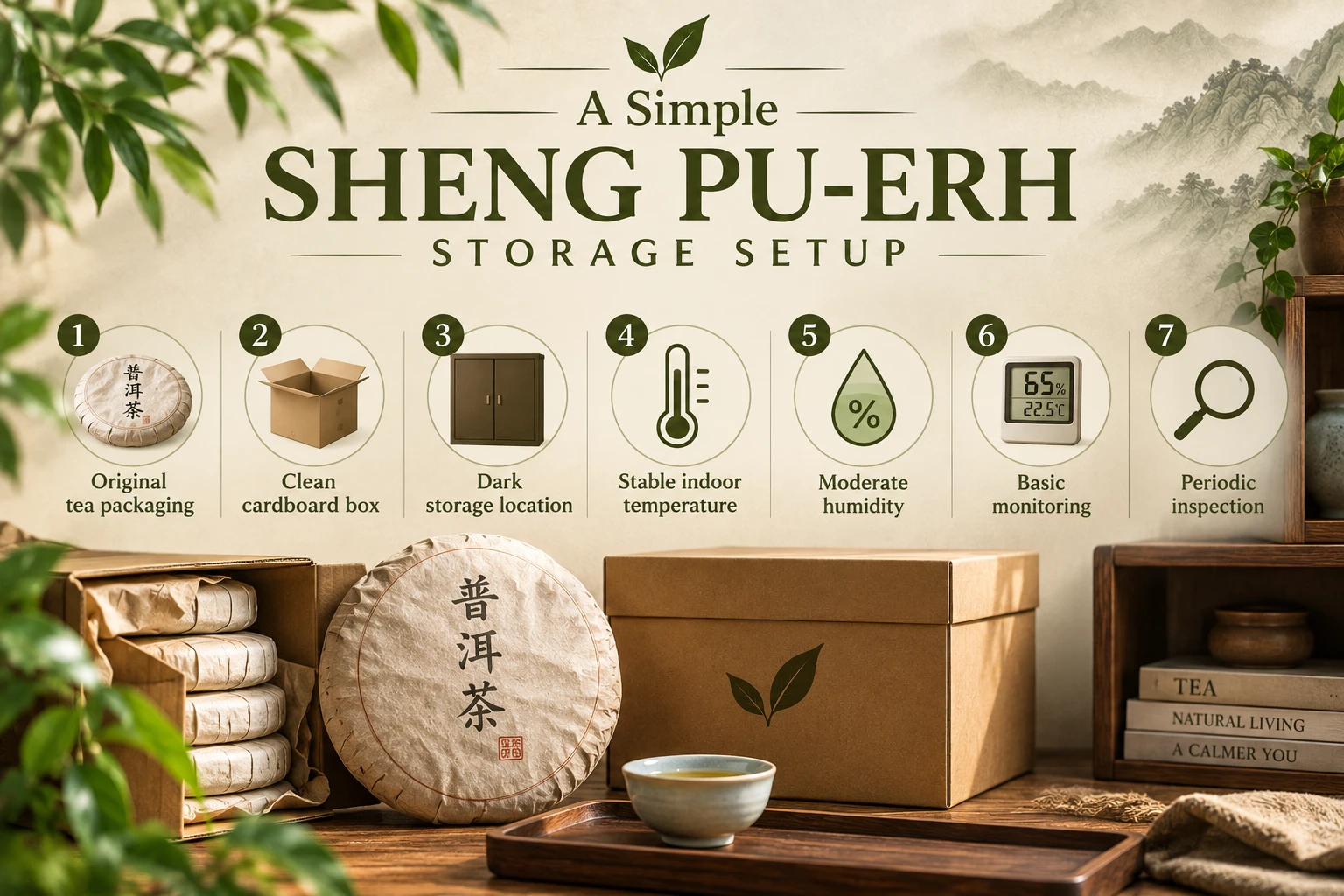
For someone beginning a home collection, there is no need for complicated equipment.
A practical setup might include:
1. Original tea packaging
Keep each cake in its original wrapper whenever possible.
2. Clean cardboard box
Use an odor-free box for additional protection.
3. Dark storage location
Keep the box away from direct sunlight.
4. Stable indoor temperature
Avoid extreme heat and repeated temperature fluctuations.
5. Moderate humidity
Aim for a comfortable, relatively stable environment rather than excessive moisture.
6. Basic monitoring
A small hygrometer can help you understand the humidity in your storage area.
7. Periodic inspection
Check the tea occasionally for unusual odors, visible mold, dampness, or other changes.
You do not need to open the cakes constantly. The purpose of monitoring is to make sure the storage environment remains appropriate.
How Do You Know If Sheng Pu-erh Is Storing Well?
Healthy aging does not have one universal appearance or aroma.
Over time, you may notice:
- A deeper liquor color
- Softer bitterness or astringency
- More integrated flavors
- Changes in aroma
- Greater sweetness or roundness
- Development of woody, fruity, herbal, floral, or aged notes
These changes vary substantially between teas.
What should concern you is not simply a darkening tea or an unfamiliar aroma, but clear signs of excessive moisture or contamination.
If you see fuzzy growth or obvious mold, smell strong mustiness, or discover that the tea has become unusually damp, do not assume that this is simply evidence of successful aging.
An Important Distinction: Aging vs. Storing
It helps to think of these as two related but different objectives.
Storing tea means preserving it under conditions that minimize unwanted deterioration.
Aging tea means allowing the tea to undergo gradual transformation over time.
Good storage supports aging.
Poor storage can damage it.
The best approach is therefore not to manipulate the tea aggressively, but to create an environment in which gradual change can happen without exposing the tea to unnecessary risks.
Practical Checklist for Storing Sheng Pu-erh
Before putting your tea away, ask:
- Is the tea protected from direct sunlight?
- Is the location free from strong odors?
- Is the environment reasonably stable?
- Is there excessive humidity?
- Is the tea exposed to a heat source?
- Is the original wrapper intact?
- Is the storage container clean and odor-free?
- Are different teas separated when their aromas differ significantly?
- Can you periodically check the storage environment?
- Are you avoiding unnecessary handling?
If the answer to these questions is yes, you already have the foundation for effective home storage.
Conclusion
Storing Sheng Pu-erh is ultimately about balance.
The tea needs protection from excessive moisture, heat, light, odors, and environmental instability, while still being allowed to undergo the gradual changes that make long-term Sheng Pu-erh interesting.
There is no single storage formula that produces the same result for every tea. Climate, tea material, processing, compression, storage history, and personal preference all influence the outcome. Modern research increasingly confirms what experienced tea drinkers have observed for years: temperature, humidity, water activity, microbial activity, and the surrounding storage environment can significantly influence how raw Pu-erh develops over time.
For most home collectors, the best place to begin is simple: keep Sheng Pu-erh wrapped, clean, dark, moderately humid, reasonably stable, and away from strong odors and heat.
Good storage does not require complicated equipment. It requires consistency, patience, and an understanding that aging is a gradual process rather than something that should be forced.
If you'd like to explore authentic Chinese tea and experience how different Sheng Pu-erh teas develop across regions, styles, and ages, you can explore carefully selected collection at Stepman's Tea, and choose teas that suit your own approach to drinking and aging Pu-erh.
FAQs
1. How should Sheng Pu-erh be stored?
Sheng Pu-erh should be kept in a clean, dark, odor-free environment with moderate humidity and relatively stable temperature. Keep the tea in its original paper wrapper when possible and protect it from direct sunlight, excessive moisture, heat, and strong odors.
2. What humidity is best for Sheng Pu-erh?
A moderate relative humidity of approximately 60–70% is commonly used as a practical guideline for home storage. The exact ideal level depends on the tea, climate, and desired aging conditions. Consistency is generally more important than maintaining one precise number.
3. Should Sheng Pu-erh be stored in an airtight container?
For traditional long-term aging, completely airtight storage is generally not necessary and may not be desirable. Sheng Pu-erh benefits from a stable storage environment rather than being aggressively sealed. Original paper wrappers and clean cardboard boxes are practical choices for many home collectors.
4. Should Sheng Pu-erh be refrigerated?
No. Refrigerators are generally unsuitable for long-term Sheng Pu-erh storage because they introduce low temperatures, humidity fluctuations, condensation risks, and exposure to food odors. Store Sheng Pu-erh at a stable indoor temperature instead.
5. Can Sheng Pu-erh be stored in a plastic bag?
Plastic can be used for specific storage purposes, but it is not automatically the best option for long-term natural aging. If plastic is used, it should be clean, food-safe, and odor-free. Avoid trapping excessive moisture around the tea.
6. How long does Sheng Pu-erh take to age?
There is no fixed aging timeline. Sheng Pu-erh begins changing after production, but noticeable differences develop over years and can continue for decades. The rate and character of aging depend on the tea's raw material, processing, compression, temperature, humidity, and storage history.
7. Does Sheng Pu-erh need airflow?
Sheng Pu-erh does not need strong or continuous airflow. A stable environment with some natural interaction with the surrounding atmosphere is generally preferable to either constant ventilation or completely uncontrolled exposure.
8. Can Sheng Pu-erh absorb odors?
Yes. Tea can absorb surrounding aromas, so Sheng Pu-erh should be kept away from coffee, spices, incense, perfume, cleaning products, tobacco, and strongly scented foods.
9. What is the difference between dry storage and wet storage?
Dry storage generally refers to relatively moderate conditions that allow gradual aging, while wet storage uses substantially higher humidity to accelerate transformation. Excessive moisture can increase the risk of undesirable microbial activity, off-aromas, and deterioration, making very humid storage unsuitable for beginners.
10. How can I tell if my Sheng Pu-erh has been stored properly?
Look for gradual changes in aroma, flavor, liquor color, bitterness, and texture rather than one specific appearance. Strong musty odors, unusual dampness, or visible fuzzy growth can indicate storage problems and should not automatically be interpreted as normal aging.